
Europol Sting, Qivalis Stablecoin, Onshore Perps
Europe takes center stage as Europol breaks a sprawling fraud ring, Italy probes retail risk, and ten banks build a euro-backed stablecoin—while Cboe brings perp-style futures onshore and Beldex advances privacy tech. Clear, fast insights on the rails crypto will ride into 2026.
Episode Infographic
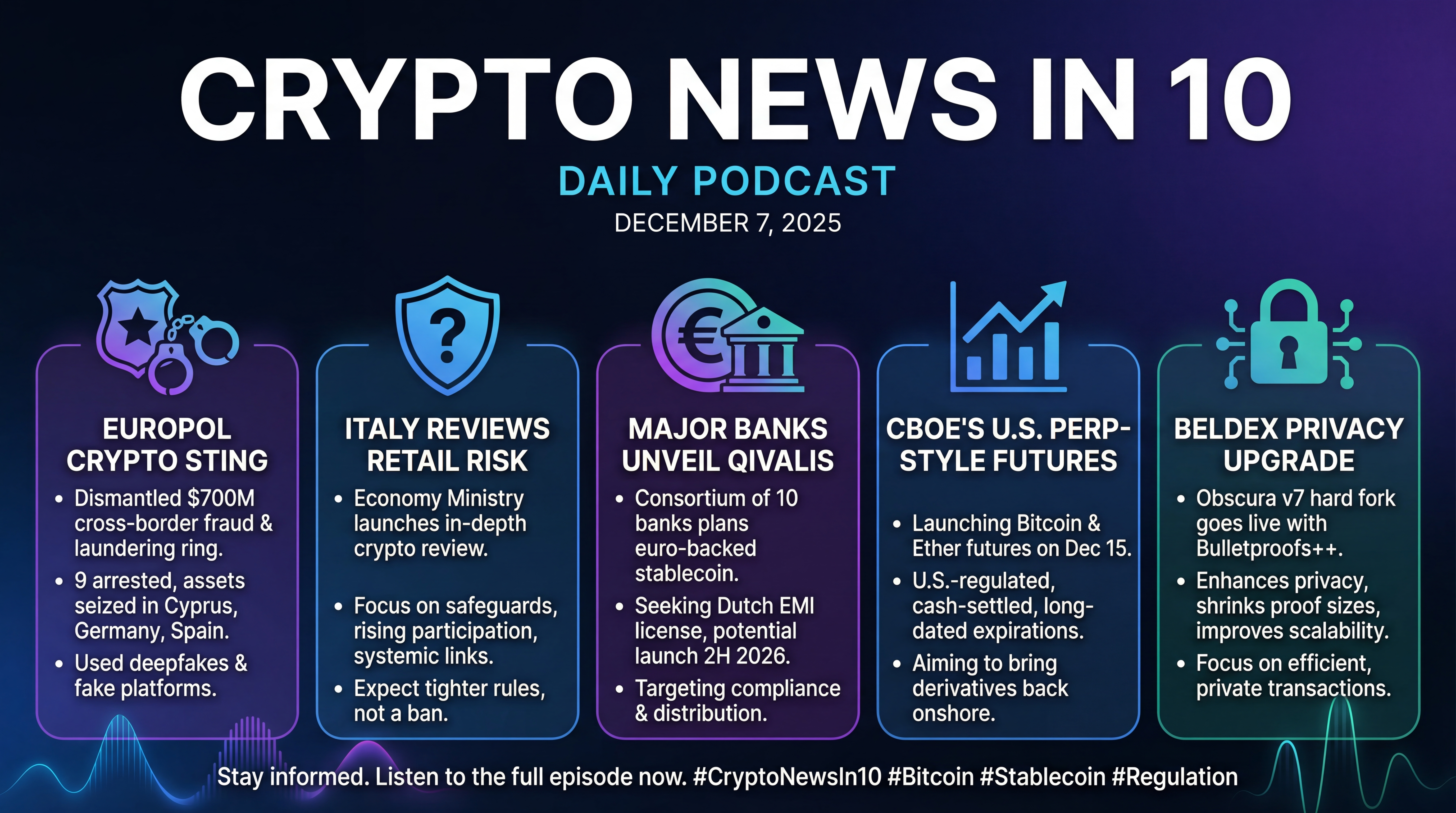
Show Notes
Welcome to our Crypto news in 10, a daily podcast bringing you the latest news about crypto in under 10 minutes.
It's Sunday, December 7, 2025. We've got a Europe-heavy lineup, real policy movement, and one very large law enforcement takedown. Here's what's on deck... Europol says it has dismantled a cross-border crypto scam and laundering ring worth hundreds of millions, Italy opens an in-depth review of retail crypto risks, a consortium of major banks unveils plans for a euro-backed stablecoin called Qivalis, stateside, Cboe is about to launch U.S.-regulated, perp-style crypto futures, and we'll finish with a privacy-focused network upgrade going live today. Let's get into it.
[BEGINNING_SPONSORS]
Story one... a big win for law enforcement.
Europol coordinated raids across Cyprus, Germany, and Spain to break up what it describes as a sprawling crypto fraud and money-laundering network. TechRadar reports authorities arrested nine suspects and seized cash, crypto, bank funds, devices, and luxury watches.
According to investigators, the scheme used fake investment platforms, boiler-room-style call centers, and even deepfake videos of high-profile figures to lure victims — then laundered the proceeds through a web of accounts. It's another reminder that when scams scale, they start to look like full-fledged businesses — complete with marketing funnels and customer support. Europol says the operation's value topped seven hundred million dollars.
Two quick takeaways... First, this is part of a broader European push to blunt cross-border crypto fraud. Second, the deepfake angle is clearly rising — expect more joint cyber and financial crime operations in 2026 as agencies get comfortable chasing scams that blend AI media and crypto rails.
Story two... Italy is turning the policy microscope on retail crypto risk.
Rome's Economy Ministry has kicked off an in-depth review via the Committee for Macroprudential Policies, pulling in the Bank of Italy, Consob, insurance and pension watchdogs, and the Treasury. Reuters reports the brief is to assess whether existing safeguards are enough — given rising retail participation and growing links between digital assets and the broader financial system. It's not a ban, it's not MiCA 2... but it is a signal that even inside the EU's relatively clear framework, national authorities want extra comfort around consumer protection and systemic risk.
Watch for three things — tighter marketing rules, stricter exchange due diligence on listings, and whether stablecoin portfolio disclosures get a fresh, country-level template on top of MiCA. Any one of those would ripple out to EU peers.
Story three... Europe's banks throw their hat into the stablecoin ring.
Ten major lenders — including ING, UniCredit, and BNP Paribas — announced a new Amsterdam-based company, Qivalis, to develop a euro-backed stablecoin. Reuters reports the leadership includes Jan Oliver Sell, formerly of Coinbase Germany, with Floris Lugt of ING as CFO and former NatWest chair Howard Davies as chair. The plan is to seek an Electronic Money Institution license from the Dutch central bank. If approved, launch could come in the second half of 2026. The message is unmistakable — banks don't want to leave stablecoins to U.S. issuers.
Context matters here... Europe now has MiCA live, stablecoins are explicitly in scope, and big banks see an opening to marry compliance with bank-grade distribution. If Qivalis clears licensing, expect pilots around merchant settlement and wholesale cash management — before it trickles down to retail wallets.
[MIDPOINT_SPONSORS]
Story four... coming attractions in derivatives. Cboe is set to list continuous Bitcoin and Ether futures on December 15.
CoinDesk reports these are U.S.-regulated, cash-settled contracts designed to behave like the offshore perpetuals most crypto traders know, but with long-dated expirations — up to ten years — and daily cash adjustments to keep them tracking spot. If you're an institution that can't touch overseas perps, this is meant to scratch that risk-management itch inside a CFTC-regulated wrapper.
Why this could matter: the product design reduces the operational overhead of rolling expiring futures and could bring basis trading and hedging flows back onshore. Put differently... more of the crypto derivatives center of gravity could migrate into U.S. hours and U.S. compliance. That can tighten spreads, improve liquidity, and — over time — reduce the reflex to run to offshore venues when volatility spikes.
Story five... a privacy coin quietly ships a meaningful upgrade today.
BeInCrypto reports Beldex's Obscura v7 hard fork goes live on mainnet, bringing improvements like Bulletproofs plus plus to shrink proof sizes and lay groundwork for more scalable private transactions. While Beldex is a smaller network, the upgrade is noteworthy in the broader privacy-tech arms race — projects are aiming to cut fees, speed up verification, and keep zero-knowledge math efficient enough for regular users, not just zealots with beefy hardware.
If privacy coins can keep compressing proofs and optimizing verification, we'll likely see renewed interest from payments apps and cross-chain privacy layers in 2026 — especially as regulators and exchanges get clearer about what counts as acceptable privacy tooling versus illicit obfuscation. Today's fork is one brick in that wall.
Quick recap... Europol's multinational sting hit a seven hundred million dollar fraud and laundering ring, Italy opened an in-depth review of retail crypto risks, ten European banks are building Qivalis — a euro stablecoin effort — Cboe's continuous futures arrive December 15 to give U.S. traders a perp-style option in regulated markets, and Beldex shipped Obscura v7 to make private transactions leaner and faster. We'll keep tracking how Europe's policy and banking moves intersect with U.S. market structure — because together, they're drawing the rails that crypto will run on in 2026.
Thanks for listening and see you tommorow!