
Wall Street Tokenizes — Solana Lands J.P. Morgan Debt
DTCC gets an SEC nod to tokenize real assets, J.P. Morgan settles commercial paper on Solana with USDC, and XRP goes multi-chain via a regulated wrapper. Plus, Pakistan opens a licensing path as India pushes back on stablecoins, with Ethereum's latest upgrade lowering costs just as institutions lean in.
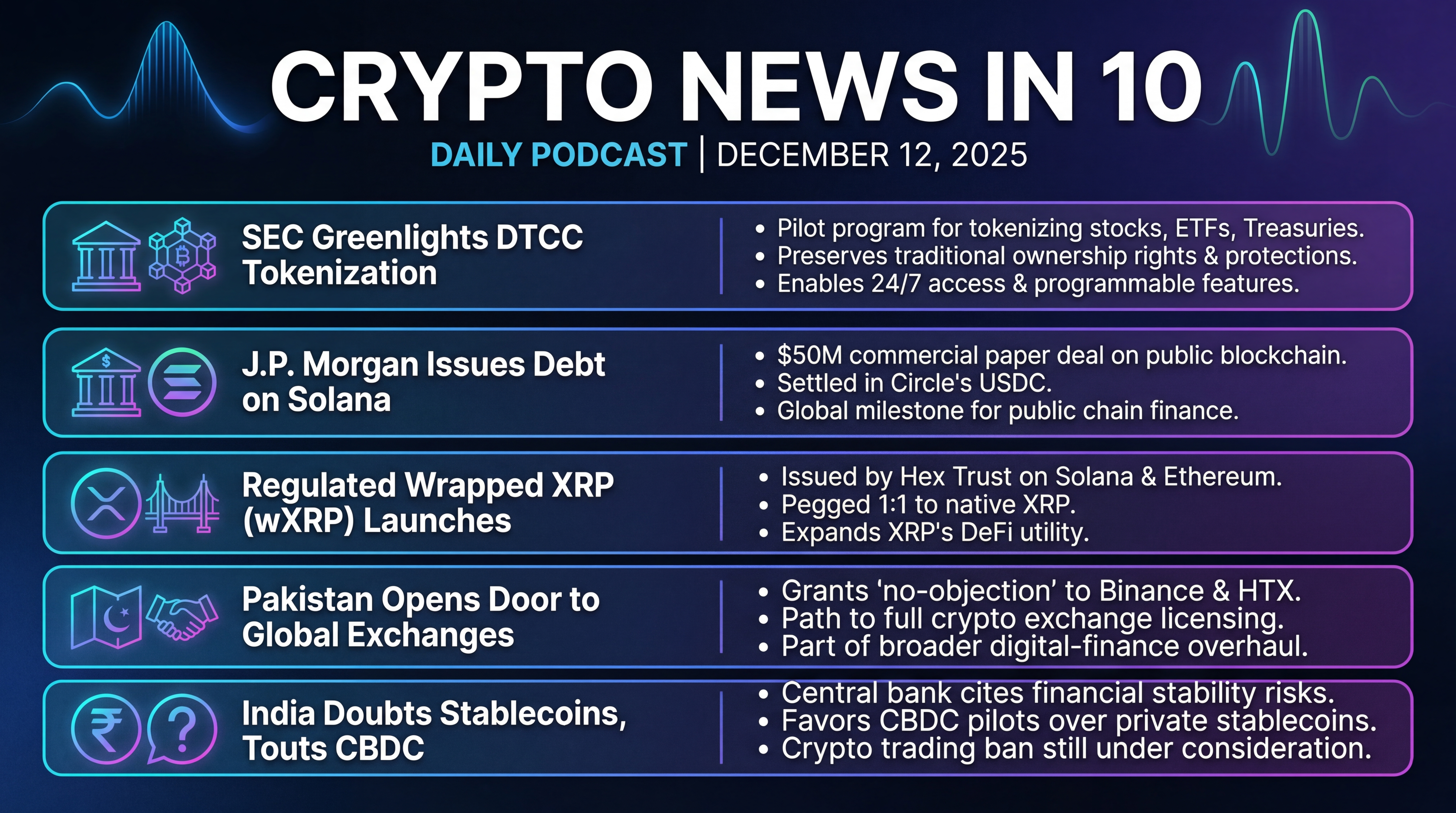
Episode Infographic
Show Notes
Welcome to our Crypto news in 10, a daily podcast bringing you the latest news about crypto in under 10 minutes.
Here's what's moving crypto today, Friday, December 12, 2025... We've got Wall Street getting explicit permission to tokenize traditional assets, a blue-chip bank pushing real debt onto a public chain, XRP stretching into multi-chain DeFi with a regulated wrapper, and two big regulatory signals out of Asia — Pakistan opening its doors to major exchanges while India's central bank doubles down on skepticism toward stablecoins. Let's unpack the five stories that matter.
[BEGINNING_SPONSORS]
Story one: a landmark green light for tokenization.
The U.S. Securities and Exchange Commission issued a no-action letter to DTCC's Depository Trust Company, allowing the market utility that safeguards U.S. securities to offer a tokenization service for stocks, ETFs, bonds — and even Treasuries — on pre-approved blockchains for three years.
In plain English: the gatekeeper of Wall Street's plumbing just got permission to put real assets on-chain while preserving the same ownership rights and investor protections as their traditional forms. DTCC executives say the service rolls out next year — potentially enabling 24/7 access, programmable entitlements, and faster collateral movement. It's not a full rule change... but no-action letters are how the SEC clears early steps without formal rulemaking — and this one is a big step. According to Reuters and DTCC statements, the pilot has guardrails, yet it formalizes a path for participants to custody and recognize tokenized versions inside existing market infrastructure.
Why it matters: tokenization has been hyped for years — today's action plants it in the core of U.S. market plumbing. If DTCC's pilot scales, features like instant settlement and programmable corporate actions stop being demos... and start becoming defaults for parts of traditional finance.
Story two: J.P. Morgan just executed one of the earliest U.S. debt deals on a public blockchain — Solana. The bank arranged 50 million dollars in U.S. commercial paper for Galaxy Digital, purchased by Coinbase and Franklin Templeton, with settlement handled entirely in Circle's USDC. J.P. Morgan created an on-chain "USCP" token and settled delivery-versus-payment on Solana, calling it a "global milestone."
Translation: this wasn't a closed-garden, private-chain experiment — this was real money-market paper issued and serviced on public infrastructure, with major institutions on both sides of the trade.
A quick take: DTCC's pilot plus J.P. Morgan's issuance point in the same direction — production-grade finance migrating to public or permissioned chains where programmability and always-on rails offer advantages. For stablecoins, this is validation too... USDC wasn't just a conduit for crypto trading — it was the settlement asset for a blue-chip debt deal.
Story three: XRP is going multi-chain in a regulated wrapper. Hex Trust — a licensed institutional custodian — launched wrapped XRP, ticker wXRP, issued one-to-one against native XRP held in segregated custody. Day-one access includes Solana and Ethereum, with Optimism and HyperEVM in the queue, and the rollout begins with over 100 million dollars in initial liquidity committed. The wrapper uses authorized merchants for minting and redemption, and Hex Trust says wXRP will trade alongside Ripple's RLUSD on supported chains — expanding XRP's DeFi utility while anchoring redemption to regulated custody. Ripple's CTO, David Schwartz, cheered the move, noting that more environments mean more utility — while XRPL remains the anchor.
Why this matters now: cross-chain bridges have been a magnet for hacks. Institutional-grade wrapped assets with clear redemption, auditable backing, and regulated issuers are one route to safer interoperability. For Solana DeFi in particular — fast, cheap, liquid — wXRP could open collateral and liquidity strategies that weren't practical on XRPL.
[MIDPOINT_SPONSORS]
Story four: Pakistan is opening the door to major global exchanges. The country's new Virtual Assets Regulatory Authority granted "no-objection" certificates to Binance and HTX to begin the process of applying for full crypto exchange licenses. These NOCs aren't operational licenses — they allow AML registration, local subsidiary setup, and prep for full applications under forthcoming rules. It's part of a broader digital-finance overhaul that includes a Virtual Assets Act, a central bank digital currency roadmap, and exploration of mining and AI data-center proposals to use surplus electricity. Officials framed this as responsible innovation with financial discipline. For a nation that ranks high in retail crypto usage, laying a formal licensing path could channel informal activity into regulated venues.
What to watch: the transition from NOC to license, how on-ramps are supervised, and whether Pakistan coordinates with FATF-style standards for the travel rule and market integrity. Also, the competitive dynamics — if Binance and HTX get to the starting line, do others follow?
Story five: India's central bank remains unconvinced about stablecoins. Reserve Bank of India Deputy Governor T. Rabi Sankar warned that stablecoins pose macro and financial-stability risks without adding benefits beyond fiat — arguing they can undermine monetary policy, banking, and fiscal stability. He positioned CBDC pilots — now counting millions of users — as the superior digital alternative, and said a decision on an outright crypto trading ban remains under consideration, pending stakeholder input. It's a stark contrast to jurisdictions leaning into stablecoin rules, and a reminder that regulatory fragmentation across Asia is widening — Pakistan is moving toward licensing exchanges, while India is, at least rhetorically, standing firm against stablecoins' core value proposition.
A quick macro lens: if tokenized assets and on-chain settlement rails accelerate in the U.S. and Europe while India holds the line, adoption will be uneven. That matters for cross-border payments, capital-markets access, and developer ecosystems that tend to congregate where policy is predictable.
Before we wrap, one honorable mention that ties the week together: Ethereum's December 3 "Fusaka" upgrade — PeerDAS, blob scaling, all of it — has pushed network costs to multi-year lows in recent days, reinforcing the on-chain cost story just as institutions lean in. That context sits behind both J.P. Morgan's choice of a high-throughput public chain and DTCC's tokenization pilot ambitions — cheaper, faster, programmable rails are here... and the pipes are finally getting used by the largest players.
That's the rundown: the SEC gives DTCC a formal runway to tokenize securities, J.P. Morgan brings real commercial paper onto Solana with USDC settlement, XRP jumps into regulated multi-chain DeFi via Hex Trust, Pakistan opens a licensing path for major exchanges, and India's central bank throws fresh shade at stablecoins while touting CBDC progress. The through-line... mainstream finance is moving on-chain, and the policy map is still being drawn in real time.
Thanks for listening and see you tommorow!