
Bank Charters, Index Drama, Quantum Risks, Texas Solar
Federal regulators open the door to national trust banks while Strategy keeps its Nasdaq-100 seat. We also unpack the CFTC’s tokenized-collateral pilot, the real quantum threat timeline, and a Texas solar-powered bitcoin mine coming online.
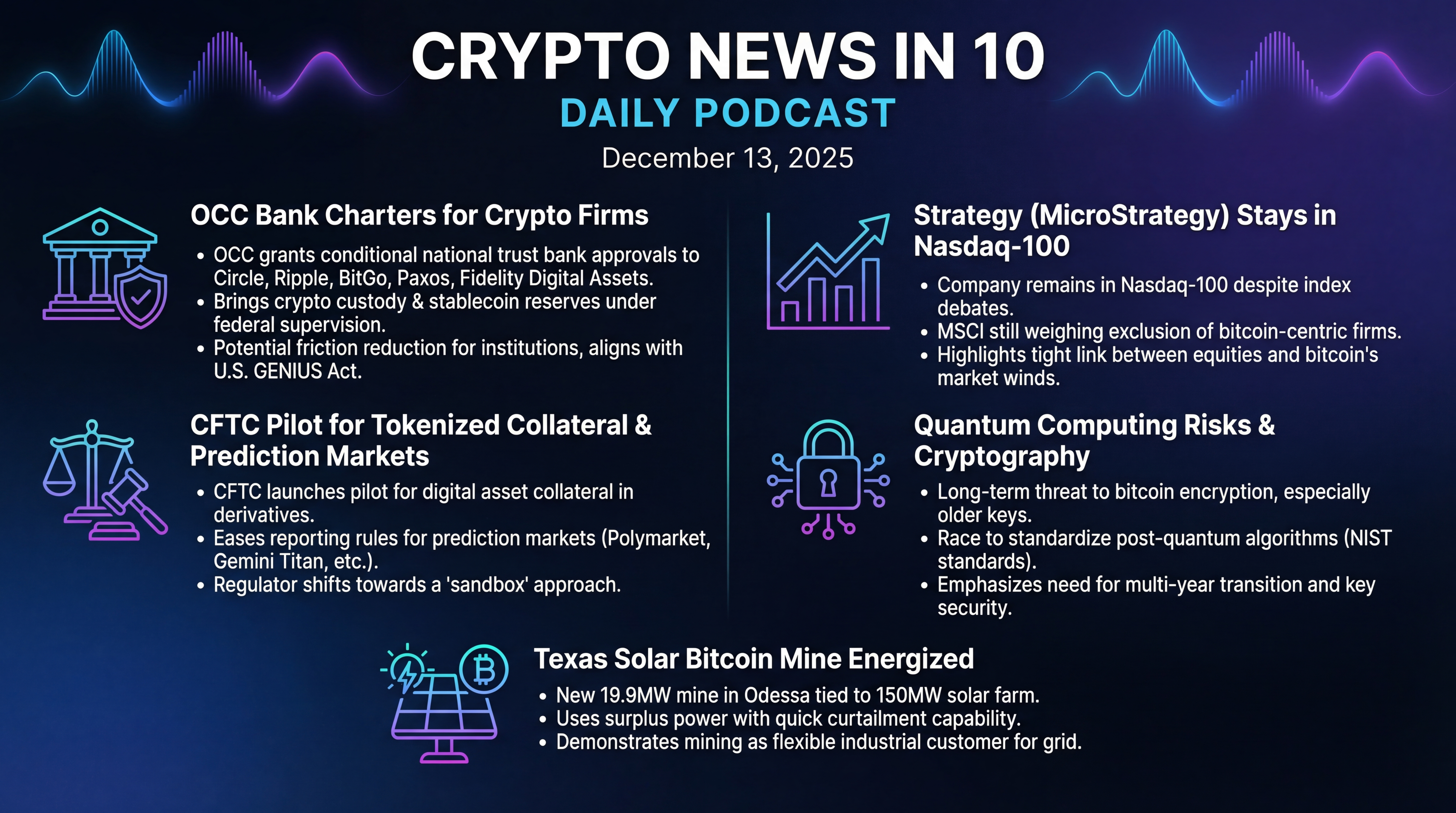
Episode Infographic
Show Notes
Welcome to our Crypto news in 10, a daily podcast bringing you the latest news about crypto in under 10 minutes.
Here’s what’s moving the crypto world this Saturday, December 13, 2025...
Momentum is building for federal charters in the U.S. as the banking watchdog clears major crypto firms to form national trust banks. Strategy — the company formerly known as MicroStrategy — keeps its seat in the Nasdaq-100, even as index providers debate what to do with bitcoin-heavy companies. The U.S. derivatives regulator is rolling out a pilot that lets tokenized collateral flow into clearing, dialing back some legacy rules and giving prediction markets some temporary breathing room. We’ll also zoom out to the long-term threat from quantum computing — what’s real, what’s hype — and finish in Texas, where a new behind-the-meter solar bitcoin mine just flipped the switch.
[BEGINNING_SPONSORS]
Story one: the Office of the Comptroller of the Currency — the OCC — took a big step toward bringing crypto inside the banking system.
On Friday, the OCC issued preliminary or conditional approvals for several crypto companies — including Circle and Ripple — to establish national trust banks. It also cleared BitGo, Paxos, and Fidelity Digital Assets to convert their state trust charters into national ones.
These national trust banks can custody assets and manage stablecoin reserves, but they still can’t take deposits or make loans. Anchorage remains the only crypto firm with a full national trust bank charter today, and all of these newcomers still have to clear capital, governance, and risk management hurdles before going live.
Banking trade groups are already signaling concerns about standards and systemic risk. But the approvals dovetail with the U.S. GENIUS Act’s push to put stablecoins under explicit federal guardrails. According to Reuters and The Wall Street Journal, final sign-offs could take many months — but the direction of travel is clear.
Why it matters... A Circle trust bank, for example, is expected to oversee the USDC reserve under federal supervision. If these charters are consummated, crypto custody and payments functions move from a patchwork of state regimes into a single national framework — potentially lowering friction for institutions that have been waiting on clearer rules. Axios has been tracking that angle closely.
Story two: Strategy — yes, this is MicroStrategy’s new name — will remain in the Nasdaq-100 after this year’s reconstitution, effective Monday, December 22.
The decision lands as index giant MSCI weighs whether to exclude companies whose core business is acquiring crypto — a move Strategy has warned could force billions in passive outflows from funds that track those benchmarks.
For now, Strategy stays put in the Nasdaq-100 as six companies rotate out and six rotate in. But the MSCI debate underscores how tightly some public equities are tethered to bitcoin’s price and policy winds. Reuters says that MSCI call is expected in January.
Context... Back in 2020, Strategy pivoted from software into a bitcoin-first treasury and financing model, which amplified its market sensitivity. Staying in broad tech indices matters, because index membership influences who can own the stock — and, by extension, how bitcoin‑levered equities feed back into crypto markets during drawdowns or rallies.
Story three: the CFTC is quietly redrawing the playbook for regulated crypto markets.
On December 8, Acting Chair Caroline Pham launched a digital-assets pilot for tokenized collateral — think Bitcoin, Ether, and USDC — as margin in derivatives markets, with tight guardrails and weekly reporting in the initial phase.
The agency also withdrew older restrictions that had limited futures commission merchants from accepting digital assets as collateral. And on December 11, it scrapped its years-old “actual delivery” guidance for virtual currencies — calling it outdated.
Meanwhile, prediction markets caught a break. The CFTC issued targeted no-action relief to platforms including Polymarket U.S., PredictIt, Gemini Titan, and LedgerX and MIAX — easing specific data-reporting and record-keeping burdens as the market evolves. Add in Gemini Titan’s fresh CFTC license for event contracts, and you’ve got a picture of a regulator shifting from whack-a-mole to sandbox — at least on the margins. The agency said as much in its own statement.
[MIDPOINT_SPONSORS]
Story four: the quantum clock is ticking louder.
A new analysis warns that advances in quantum computing could eventually threaten the cryptography underpinning bitcoin and other chains — especially older addresses whose public keys are exposed on-chain.
Researchers and policymakers are racing to standardize and deploy post-quantum algorithms. NIST has already published a first suite of standards, but migrating global systems — let alone decentralized networks — takes years.
The takeaway for crypto is practical, not apocalyptic. Inventory your key exposure, watch for protocol-level proposals that rotate to quantum-resistant signatures, and expect a multi-year transition plan rather than a panic button. Investor’s Business Daily notes that some experts think a sizable share of dormant coins could be vulnerable if timelines accelerate — hence the urgency around quantum-safe roadmaps.
Story five: back to the here and now of energy and infrastructure.
Texas just energized a 19.9 megawatt bitcoin mine in Odessa, tied directly to a 150 megawatt solar farm.
The site buys up to 20 megawatts behind the meter, soaking up surplus generation that might otherwise hit negative prices. It’s designed to curtail quickly during grid stress — unlike traditional data centers that need constant uptime.
This comes the same day fresh reporting highlighted how large the state’s crypto load has become — and how lawmakers have armed grid operators with emergency tools to manage it. Net net... mining continues to entrench as a flexible industrial customer, but scrutiny on grid impacts, incentives, and shutdown protocols is only going to rise. Local reporting from the Midland Reporter-Telegram has details.
Quick recap... The OCC’s trust-bank greenlights pull crypto custody and stablecoin reserves deeper into U.S. bank supervision. Strategy keeps its Nasdaq-100 seat while index gatekeepers debate bitcoin-centric business models. The CFTC’s pilot and no-action letters nudge tokenized collateral and prediction markets into clearer air. Quantum computing risk is real — but addressable with time and planning. And Texas adds a solar-powered mine while regulators sharpen their levers.
We’ll keep tracking the policy shifts — and the tech that could reshape security itself — as the week unfolds.
Thanks for listening and see you tommorow!