
Tokenized Yield, Regulated Perps, and a Juventus Twist
JPMorgan takes money market yields on-chain as Cboe debuts U.S.-regulated perp-style futures, while the U.K. locks a 2027 crypto regime and the SEC confronts the privacy debate. Plus, Tether’s billion-euro bid for Juventus gets rebuffed — and what it means for partnerships ahead.
Episode Infographic
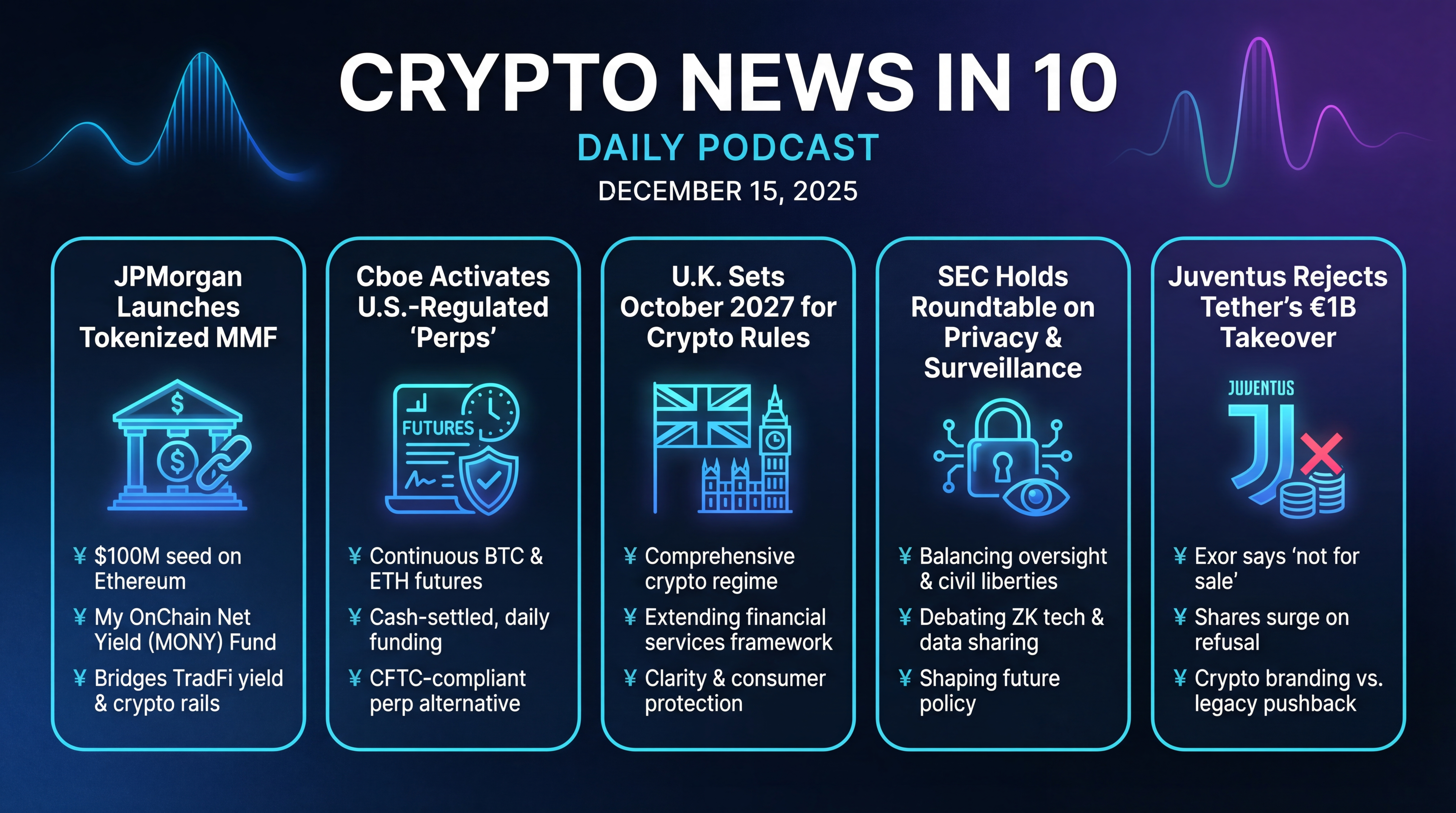
Show Notes
Welcome to our Crypto news in 10, a daily podcast bringing you the latest news about crypto in under 10 minutes.
Here’s what’s moving in crypto on Monday, December 15, 2025... JPMorgan is taking tokenized, cash-like yields on-chain. Cboe is turning on U.S.-regulated, perpetual-style futures for bitcoin and ether. The U.K. finally has a start date for its broad crypto regime. The SEC is hosting a closely watched roundtable on privacy and financial surveillance this afternoon. And a plot twist in Europe — Juventus’ owners just rebuffed Tether’s billion-euro takeover bid as the club’s shares surge. Let’s dive in.
[BEGINNING_SPONSORS]
Story one.
Wall Street’s biggest bank just put real money into a tokenized money market fund on Ethereum. JPMorgan Asset Management is launching the My OnChain Net Yield fund — ticker MONY — seeding it with one hundred million dollars of its own capital and opening it to qualified investors. Minimum check is one million dollars. You can subscribe with cash or USDC, and you’ll receive digital tokens on-chain that represent your shares... the idea is to bring the familiar money market experience directly onto crypto rails.
That’s notable for stablecoin users hunting yield, and for treasurers who want faster settlement without leaving a regulated framework. According to the Wall Street Journal, access is limited to individuals with at least five million dollars in investments, or institutions with twenty-five million — classic private-fund guardrails, just with blockchain plumbing. Under the hood, JPMorgan’s Kinexys Digital Assets platform handles the tokenization and the fund flows. Think of it as the bank’s production-grade tokenization stack, tested on tokenized Treasuries and private funds — now extending into money market funds on a public chain.
Why this matters... Tokenized money funds are quickly becoming the bridge between crypto liquidity and traditional finance yield, especially after stablecoin legislation in the U.S. If big banks bring billions of client cash on-chain — with same-day subscriptions, redemptions, and collateral use — the knock-on effects for DeFi collateral, on-chain repo, and stablecoin competitors could be huge. Today’s launch is a concrete step in that direction.
Story two.
U.S.-regulated perps, at last — well, perpetual-style. Cboe Futures Exchange is switching on new continuous futures for bitcoin and ether today. The contracts — PBT for bitcoin and PET for ether — are designed to mimic the economics of perpetual futures while fitting neatly inside U.S. derivatives rules.
They list with ten-year expirations to avoid monthly roll headaches. They settle in cash. And they apply a daily funding adjustment, tied to Cboe and Kaiko real-time reference rates, to keep prices anchored to spot. Trading runs twenty-three hours a day, five days a week, with clearing at Cboe Clear U.S. and potential cross-margining alongside existing Cboe crypto futures. If you’re a U.S. fund that couldn’t — or wouldn’t — touch offshore perps, this is the compliant alternative.
The big picture... Perpetuals dominate global crypto derivatives volume, but most of that has lived offshore. If Cboe’s structure gains traction, it could reduce basis gaps between U.S. and non-U.S. venues and give risk managers a standardized, CFTC-regulated instrument for long-term hedging — without the monthly roll tax. That’s good for pensions, RIA platforms, and traditional desks that need clean counterparty, clearing, and surveillance.
Story three.
The U.K. just put a firm date on comprehensive crypto rules — October 2027. HM Treasury says Britain will extend its existing financial services framework to cover cryptoassets rather than adopting the European Union’s MiCA-style regime. The point is clarity for firms, protections for consumers, and a route to scale in London. Supporting rules for trading, custody, and stablecoins are slated to be wrapped up by the end of 2026 by the Financial Conduct Authority and the Bank of England. Officials are calling this proportionate, innovation-friendly regulation — City minister Lucy Rigby even said the U.K. can lead the world as the regime comes into force in the second half of 2027. Industry reaction so far: relief at certainty, along with calls to tweak a few legal edges.
Why it’s interesting now... Firms choosing global hubs weigh rule clarity, market access, and speed to product. With dates on the calendar, London is making an explicit bid for crypto market structure — from stablecoin payments to prime brokerage — just as U.S. and Asian venues accelerate tokenization and derivatives. Expect licensing roadmaps and hiring to follow into 2026.
[MIDPOINT_SPONSORS]
Story four.
Privacy is in the spotlight in Washington, D.C. The SEC’s Crypto Task Force is hosting a roundtable today — Monday — from 1 p.m. to 5 p.m. Eastern on financial surveillance and privacy. Commissioner Hester Peirce, who leads the task force, set the tone: regulators want to learn more about privacy-preserving tools and how to balance oversight with civil liberties. The session is open to the public via webcast and follows a year of intense debate over mixers, wallet analytics, and what proportionate monitoring should look like in an on-chain world. No rules are being voted on today, but when the SEC gathers researchers, builders, and enforcers in the same room... it tends to shape future policy drafts.
Listen for three fault lines as the panel unfolds... First, what level of data collection is necessary and proper for compliance — and what counts as overreach. Second, whether zero-knowledge techniques can give regulators assurance without exposing everyone’s financial life. And third, how exchanges and custodians should scope retention and sharing of user data when wallets are increasingly self-hosted. Answers here could ripple into 2026 proposals.
Story five.
Football meets stablecoins — again. Juventus shares jumped nearly fourteen percent in Milan after the Agnelli family’s holding company, Exor, rejected an all-cash takeover bid from Tether that valued the club at just over one billion euros — about two euros and sixty-six cents per share. Tether, which already owns more than ten percent of the team, had also dangled up to one billion euros of future investment. Exor’s message was blunt — Juventus is not for sale. The move underscores how crypto issuers are trying to turn financial might into mainstream brand assets... but also how legacy owners can slam the door, fast.
A quick takeaway... If a leading stablecoin issuer can’t buy its way into a storied European club — even with a premium — expect more calibrated partnerships over outright acquisitions. Sponsorships, venue tech, and fan token integrations are far less politically charged than ownership bids, and European football has long memories on governance and finance.
That’s a wrap. JPMorgan’s tokenized money market fund brings on-chain yield closer to the mainstream. Cboe’s continuous futures give U.S. traders a compliant, perp-like tool. The U.K. sets a 2027 go-live for its comprehensive crypto regime. The SEC’s privacy roundtable could steer 2026 policy. And Tether’s Juventus play gets red-carded by the Agnellis as shares spike. We’ll keep tracking what gets built, listed, regulated — and rejected — so you don’t have to.
Thanks for listening and see you tommorow!