
Stablecoin Settlement, Binance Bounty, Bitcoin Seller Fatigue
Visa expands USDC settlement to U.S. banks, Binance offers a five million dollar bounty to expose fake listing agents, and a bipartisan bill proposes a federal crypto-fraud task force. Plus, K33 suggests long-term selling may be easing as funds and miners recalibrate after the autumn drawdown.
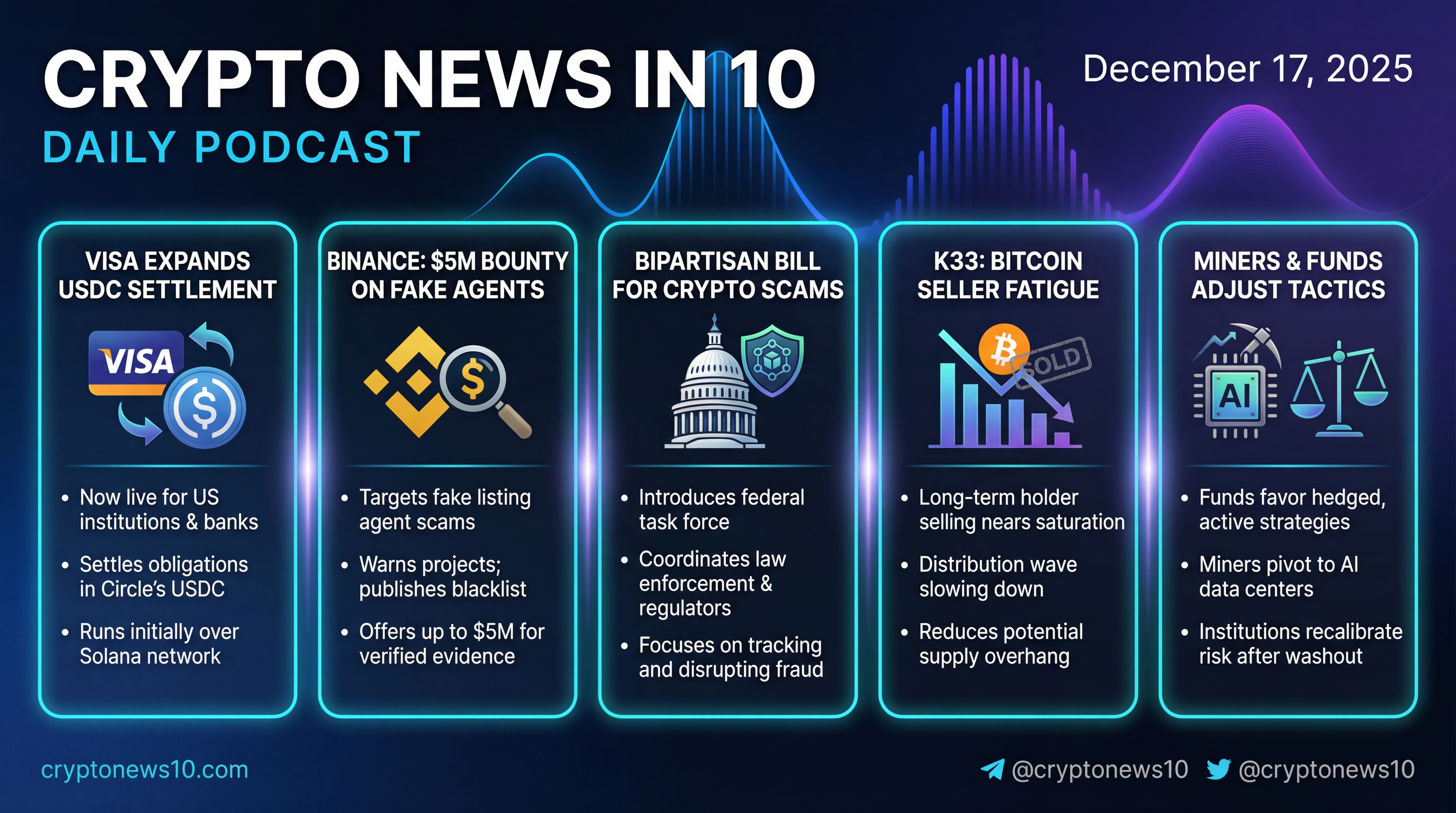
Episode Infographic
Show Notes
Welcome to our Crypto news in 10, a daily podcast bringing you the latest news about crypto in under 10 minutes.
Here’s what’s new in crypto for Wednesday, December 17, 2025.
A major payments giant just expanded stablecoin settlement to U.S. banks. Binance is dangling up to five million dollars to root out fake token listing agents. And on Capitol Hill, a bipartisan bill would stand up a federal task force to tackle crypto scams.
We’ll also dig into fresh on-chain data from K33 that suggests long-term bitcoin selling may be close to running its course... and the bigger picture from Reuters on how funds and miners are changing their playbooks after the autumn washout.
[BEGINNING_SPONSORS]
Story one. Visa has switched on USDC settlement for U.S. institutions.
Selected issuer and acquirer partners can now settle obligations to Visa in Circle’s dollar-pegged stablecoin — initially over Solana — with Cross River Bank and Lead Bank already live.
Visa frames this as seven-day, API-driven settlement with clearer liquidity timing. It’s also a continuation of pilots the company began years ago.
And there’s a builder angle: Visa is a design partner for Circle’s Arc blockchain, and it plans to run a validator once Arc goes live.
Markets noticed — coverage today highlighted a bounce in Circle’s stock on the news, even as Visa’s shares barely moved. The U.S. rollout broadens through 2026.
Source: Visa press announcement and market coverage.
Why it matters. Moving stablecoins from pilots into core settlement is a big deal — especially when Visa is telling U.S. banks they can settle in USDC without changing the consumer card experience.
If you’re an issuer, that means faster funds movement on weekends and holidays... If you’re a builder, it’s a signal that stablecoin rails are becoming boring, reliable plumbing.
Story two. Binance is going after fake listing agents.
The exchange warned projects to avoid anyone claiming to broker Binance listings and published an internal blacklist — while offering up to five million dollars for verifiable evidence of these scams.
Binance reiterated that it doesn’t authorize third-party intermediaries for listings and urged teams to report attempts through official channels. The move follows recent scrutiny of listing conduct, and a separate earlier incident involving alleged employee misconduct.
Source: The Block.
Why it matters. Listing-agent grifts are as old as altcoin season. A public whistleblower bounty at this scale — and naming names — raises the cost for would-be intermediaries and pushes projects to tighten their vendor hygiene.
If imitation is the scammer’s playbook, transparency is the antidote.
Story three. On the Hill, a bipartisan push to coordinate crypto-fraud enforcement.
Senators Elissa Slotkin and Jerry Moran introduced the SAFE Crypto Act, which would create a federal task force bringing together Treasury, law enforcement, regulators, and private-sector experts to identify, track, and disrupt scams.
The bill emphasizes tools for local law enforcement, public education, and regular threat updates to Congress. The Block flagged the effort today, and Slotkin’s office posted details earlier this week.
Source: The Block and congressional materials.
What to watch. Even in a friendlier policy climate, fraud remains the industry’s reputational Achilles’ heel. A centralized federal forum — if it gets traction — could standardize playbooks across agencies and shorten response times when new scam patterns emerge.
[MIDPOINT_SPONSORS]
Story four. K33’s latest on-chain read says long-term bitcoin holder sell-side pressure may be near saturation.
Roughly one-fifth of bitcoin’s total supply has reactivated over the past two years — one of the largest distribution phases on record. K33 argues the wave looks closer to its end than its beginning.
For context, bitcoin is still down about 30 percent from the October highs, and long-dormant coins waking up have been a reliable headwind. If the distribution slows, that supply overhang eases.
Source: K33 via The Block.
How to use it. If you model flows, a tapering long-term-holder distribution can reduce the sell pressure you assume at key levels. It’s not a green light by itself — but paired with futures positioning and ETF flow data, it can refine risk windows.
Story five. Zooming out, investors are changing tactics after the drawdown.
Reuters reports that with bitcoin off roughly 30 percent from its October peak, funds are favoring actively managed, risk-hedged strategies. VanEck’s Onchain Economy ETF, for example, is up double digits since May by steering clear of over-levered firms.
On the corporate side, miners are leaning harder into AI data centers — think IREN, CleanSpark, Riot, and Marathon — leveraging cheap power while public markets scrutinize debt and profitability. And treasuries heavy in bitcoin — like Strategy Inc. and Japan’s Metaplanet — have learned how quickly the so-called bitcoin premium can evaporate on the way down.
The through-line: crypto and AI continue to converge around energy and infrastructure, while institutions recalibrate risk after a crowded year.
Source: Reuters.
Two quick honorable mentions before we wrap.
Hong Kong’s HashKey listed today after pricing its IPO earlier this week — an important regional milestone, but we covered the pricing and setup in yesterday’s episode, so we won’t rehash it here.
And on the markets desk, several outlets note bitcoin’s grind around the mid-80,000s today as gold outperforms into year-end — a reminder that correlations and narratives shift.
Recap. Today’s signals point in two directions — maturing rails and maturing behavior.
Visa expanding USDC settlement to U.S. banks, Binance paying big to police listing fraud, and a Senate bill to coordinate scam enforcement all push the market toward better plumbing and better guardrails.
Meanwhile, K33’s data hints the worst of long-term selling may be fading, even as investors reset with hedged, active strategies and miners chase AI adjacency. We’ll keep watching how those trends collide as we head into the holidays.
Thanks for listening and see you tommorow!