
Coinbase Diversifies, Aave Cleared, Stablecoins Surge Past Visa
Coinbase moves into stocks and prediction markets and taps former UK chancellor George Osborne. The Senate punts crypto legislation to 2026 as Bitcoin cools, Aave closes its SEC chapter, and stablecoins eclipse Visa and PayPal on monthly volume.
Episode Infographic
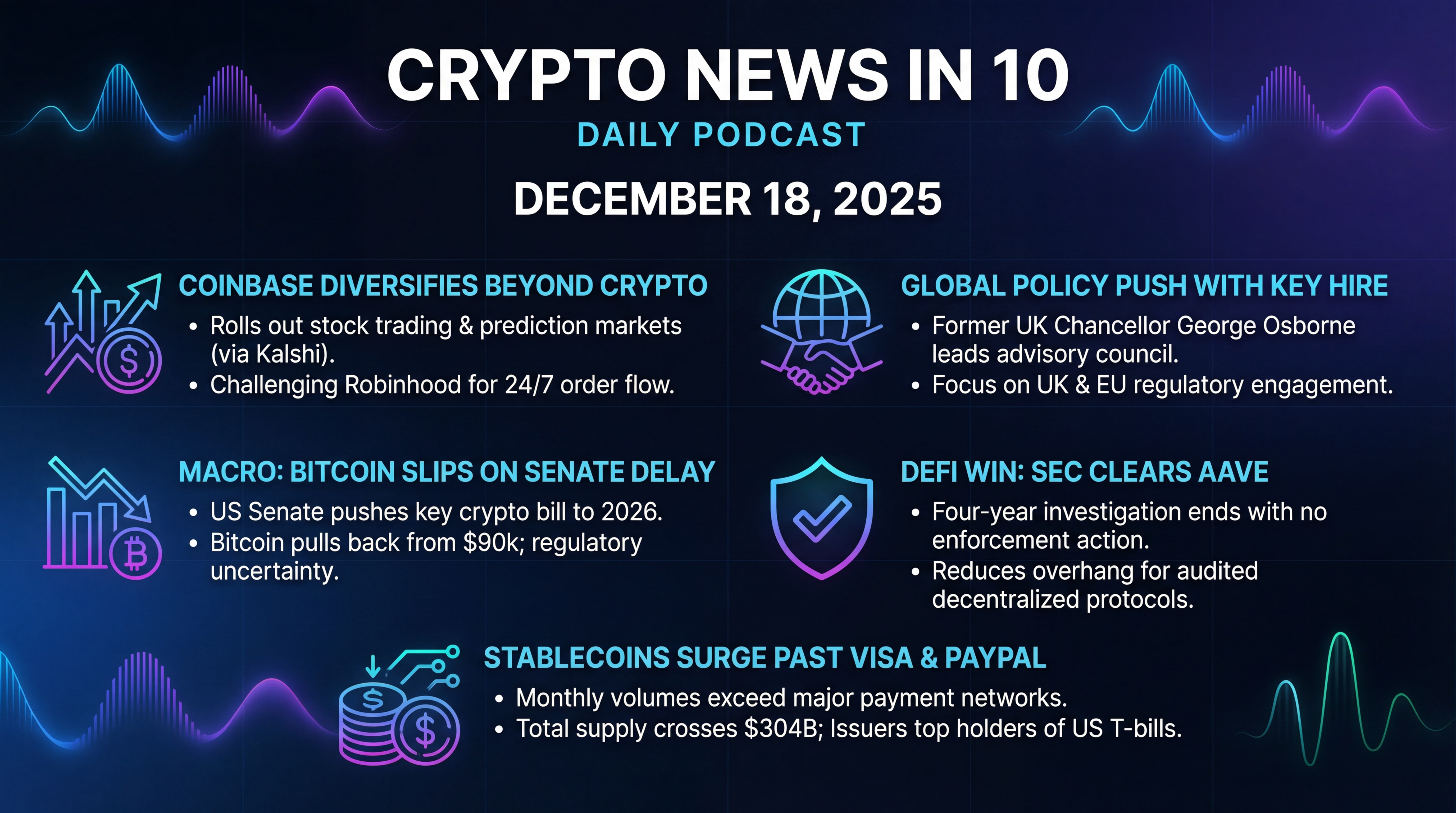
Show Notes
Welcome to our Crypto news in 10, a daily podcast bringing you the latest news about crypto in under 10 minutes.
Here's what's moving crypto on Thursday, December 18, 2025... Coinbase is stepping beyond crypto into stocks and prediction markets — and it's beefing up its geopolitical muscle with a high-profile hire in London.
On the macro front, the US Senate just pushed a key crypto bill into 2026, and markets reacted — Bitcoin slipped back after flirting with ninety thousand.
DeFi gets a win: the SEC has closed its four-year investigation into Aave with no enforcement action.
And one big-picture data point to end the year... new research says stablecoins' monthly volumes now top Visa and PayPal, with total supply crossing the three hundred billion dollar mark.
We'll unpack what each move means, and where the signals are pointing next.
[BEGINNING_SPONSORS]
Let's start with Coinbase's product pivot.
Late Wednesday, Coinbase said it's rolling out stock trading and event-based contracts — prediction markets — inside its app, positioning itself as an everything exchange.
Stocks would be tradable with USDC rails. The event contracts come via a tie-up with Kalshi, whose federally regulated markets let users take yes-or-no positions on real-world outcomes.
Analysts framed it as a direct challenge to Robinhood — and a way to capture twenty-four seven order flow as tokenized and traditional assets converge. Coinbase shares initially popped on the news.
The expansion underscores how exchanges are racing to diversify revenue beyond pure crypto spot trading.
Staying with Coinbase... the company also named former UK finance minister George Osborne to lead its internal advisory council.
Osborne, who served as chancellor from 2010 to 2016 and has advised Coinbase since early 2024, will focus on shaping policy engagement in the UK and EU.
This is part of Coinbase's push to export its influence overseas after pouring money and energy into US policy this year.
The appointment signals a sustained focus on tax clarity, stablecoin rules, and tokenization frameworks across Europe — areas that will shape how fast traditional finance plugs into on-chain markets.
Macro watch: Bitcoin's bid faded after the US Senate pushed broader crypto legislation off until 2026.
Traders pulled risk — Bitcoin briefly traded above ninety thousand before slipping back toward the mid eighty-six thousand range today.
The delay keeps regulatory uncertainty alive for another year, and you could see that hesitation bleed across majors as the session wore on.
Bottom line... policy is still the biggest swing factor in crypto pricing — even with stronger institutional plumbing in place.
[MIDPOINT_SPONSORS]
A clear win for DeFi: Aave says the SEC has closed its four-year investigation without recommending enforcement.
Founder Stani Kulechov shared the agency's letter confirming no action, bringing an end to a probe that began around 2021.
Why it matters... a major protocol just shed a cloud that often scares off developers and larger capital.
It doesn't mean regulators are blessing DeFi — only that this specific inquiry is done — but it reduces overhang and may widen the lane for audited, progressively decentralized protocols that separate governance from any single corporate issuer.
Keep an eye on how this affects Aave's roadmap into 2026, including its next-gen upgrade plans.
And the structural stat of the day: stablecoins are quietly becoming the backbone of on-chain money.
Delphi Digital's new outlook report says monthly adjusted stablecoin volumes now exceed Visa and PayPal, with supply growing 33 percent this year to over 304 billion dollars.
The same analysis estimates stablecoin treasuries hold about 133 billion in US government debt — putting issuers among the top holders of T-bills.
That tracks with what we've seen all year — real-time, near-free settlement pulling business-to-business flows on-chain, while consumer rails follow behind.
The implication... stablecoins aren't just a crypto trading tool anymore — they're an international dollar network operating at payment-network scale.
Quick context before we wrap: while the Senate punt adds near-term uncertainty, this year was still a breakout for US crypto policy — stablecoin law enacted, lawsuits dropped, and bank charters opening up — with industry voices already lobbying for an SEC innovation exemption as 2026 approaches.
If that narrative holds, next year's driver may be how fast US rules converge with what's forming in the UK and EU — and whether that unlocks the next leg of institutional adoption.
That's the rundown... Coinbase pushes into stocks and prediction markets, and taps a former UK chancellor to steer global policy.
The Senate delays a major crypto bill, and Bitcoin pulls back.
Aave gets regulatory relief as the SEC closes its probe.
And stablecoins quietly pass Visa and PayPal on monthly volume — cementing themselves as the on-chain dollar.
Thanks for listening and see you tommorow!