
Wall Street, Stablecoins, and a Fed Reset
From SoFi’s bank issued stablecoin to the Fed’s policy shift, this week accelerated the build out of crypto’s core plumbing. We unpack ICE’s MoonPay talks, Coinbase’s prediction market lawsuits, and a new FDIC insured bank aiming to serve the on chain economy.
Episode Infographic
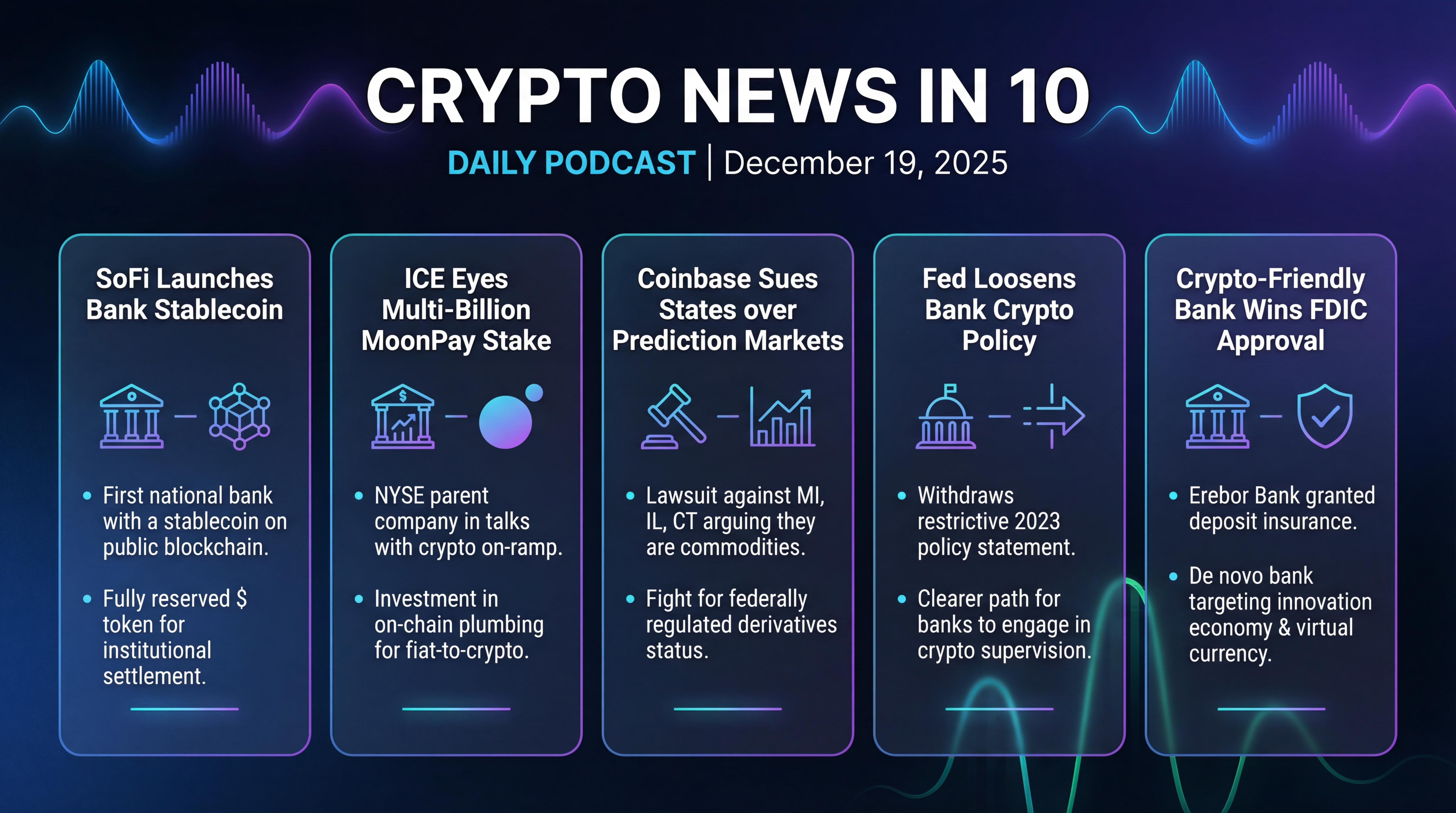
Show Notes
Welcome to our Crypto news in 10, a daily podcast bringing you the latest news about crypto in under 10 minutes.
It’s Friday, December nineteenth. Here’s what’s new in crypto today... a nationally chartered bank launches its own stablecoin, Wall Street’s top exchange operator circles a crypto payments unicorn, Coinbase goes to court over prediction markets, the Federal Reserve loosens a key policy roadblock for bank crypto activity, and a new, crypto friendly bank wins FDIC approval. Let’s break it down.
[BEGINNING_SPONSORS]
Story one. SoFi just entered the stablecoin arena with SoFiUSD — a fully reserved dollar token issued by SoFi Bank, N.A. That makes SoFi the first national bank to put a stablecoin on a public, permissionless blockchain.
SoFi says SoFiUSD is backed one to one in cash, with immediate redemption. The initial rollout focuses on institutional settlement rails... faster money movement for banks, fintechs, and enterprise partners... before opening to SoFi members.
They’re framing this as infrastructure, not just a consumer coin. Partners can white label issuance or use SoFiUSD directly for twenty four seven settlement at fractional cent costs. The debut coin was initially minted at ten thousand dollars, with a broader release coming soon. Markets liked it — SoFi shares popped on the announcement. Sources: SoFi’s press release, The Block, and Barron’s.
Why this matters: stablecoin rails are quickly becoming the connective tissue between traditional finance and crypto. With the U.S. GENIUS Act now in place, bank grade issuers — alongside payments giants — are racing to power instant settlement in and out of crypto markets. Source: Barron’s.
Story two. The parent company of the New York Stock Exchange — Intercontinental Exchange — is in talks to invest in MoonPay at roughly a five billion dollar valuation, according to multiple reports citing Bloomberg. MoonPay runs one of the largest fiat to crypto on ramps and has been expanding into stablecoin infrastructure and cards.
For ICE, which already made a splash with a multibillion commitment to Polymarket’s event data business this fall, a MoonPay stake would lock down more of the plumbing that moves dollars onto blockchains. Another sign that market infrastructure heavyweights want to own the rails, not just trade the assets. Sources: Investing.com and the Associated Press.
Quick angle check: if that deal closes, expect closer integrations between brokerage, data, tokenization, and payments — exactly the stack that enables twenty four seven asset flows and on chain settlement. ICE’s foray into prediction market data suggests they see event markets and crypto payments as complementary streams.
Story three. Coinbase filed lawsuits against Michigan, Illinois, and Connecticut, arguing that prediction markets are federally regulated commodities venues — squarely under the CFTC — not state gambling. This comes days after multiple states sent cease and desist letters to companies offering event contracts.
Coinbase, which recently added prediction markets to its “everything exchange” strategy, says the state actions overreach. The legal fight matters because it could determine whether event contracts — on sports, macro prints, even election odds — are treated like derivatives instead of wagers, and whether on chain markets can interoperate with U.S. brokerages at scale. Sources: Barron’s and Investopedia.
Practical takeaway: if courts or the CFTC bless broader event contract trading, flows between on chain prediction markets and crypto brokerages could accelerate — potentially creating a new demand sink for dollar token rails and exchange liquidity.
[MIDPOINT_SPONSORS]
Story four. A significant policy reset from the Federal Reserve. On Wednesday, December seventeenth, the Fed withdrew a 2023 policy statement that had boxed in state chartered banks — especially uninsured ones — on novel activities like crypto custody and dollar token issuance.
The new statement acknowledges that different bank types can be permitted different activities if done safely and soundly, and it routes oversight back through the standard supervisory process — rather than special hurdles. Translation: the presumption of “no” is gone... there’s now a clearer, neutral pathway to engage in crypto under normal bank supervision. Observers say this could reopen competition between state and national charters and lower friction for services like custody, tokenization, and stablecoin programs. Sources: Federal Reserve releases.
Why you should care: banks already power a lot of crypto’s behind the scenes cash movement. With the Fed’s shift, expect more banks to pilot custody, payments, and tokenized deposit experiments — particularly those aligned with the new federal stablecoin framework. That’s fuel for real world integrations... payroll, business to business settlement, and cross border flows.
Story five. New crypto friendly bank incoming. The FDIC just approved deposit insurance for Erebor Bank, a de novo national bank headquartered in Columbus, Ohio, targeting the innovation economy — including virtual currency market participants.
It’s not a free pass. The approval imposes stout conditions, like maintaining a minimum twelve percent Tier one leverage ratio during the first three years, and honoring a capital call agreement if it ever dips below “well capitalized.” The OCC had already granted preliminary conditional charter approval in October. With FDIC insurance now in hand, Erebor is a step closer to launch in 2026, pending remaining milestones. For crypto companies seeking stable U.S. banking partners — and for dollar token programs that need insured, supervised banking touchpoints — this is a notable win. Source: FDIC.
Zooming out, these threads connect. A bank issued stablecoin joins the field the same week the Fed removes a key policy roadblock; the top U.S. exchange operator explores a stake in the on ramp that moves fiat into crypto; a crypto focused bank secures insurance with strict guardrails; and a courtroom fight over prediction markets could define a new class of on chain financial products. The through line... more institutional plumbing, clearer rules of the road, and more ways for dollars to move on chain, around the clock.
That’s today’s wrap: SoFi’s stablecoin launch, ICE’s potential MoonPay bet, Coinbase’s state versus federal showdown on prediction markets, a friendlier Fed framework for bank crypto activity, and FDIC approval for Erebor Bank. Watch stablecoin and banking headlines into year end — those rails are quickly becoming the backbone of on chain finance.
Thanks for listening and see you tommorow!