
Bailouts, On-Chain UBI, and Tokenized Markets
From potential U.S. crypto bailouts to the Marshall Islands’ on-chain UBI, we break down the policy and plumbing shifts reshaping digital assets. Plus, DTCC’s tokenization green light, the UK’s new property law, Bakkt’s token cuts, and a quick market check.
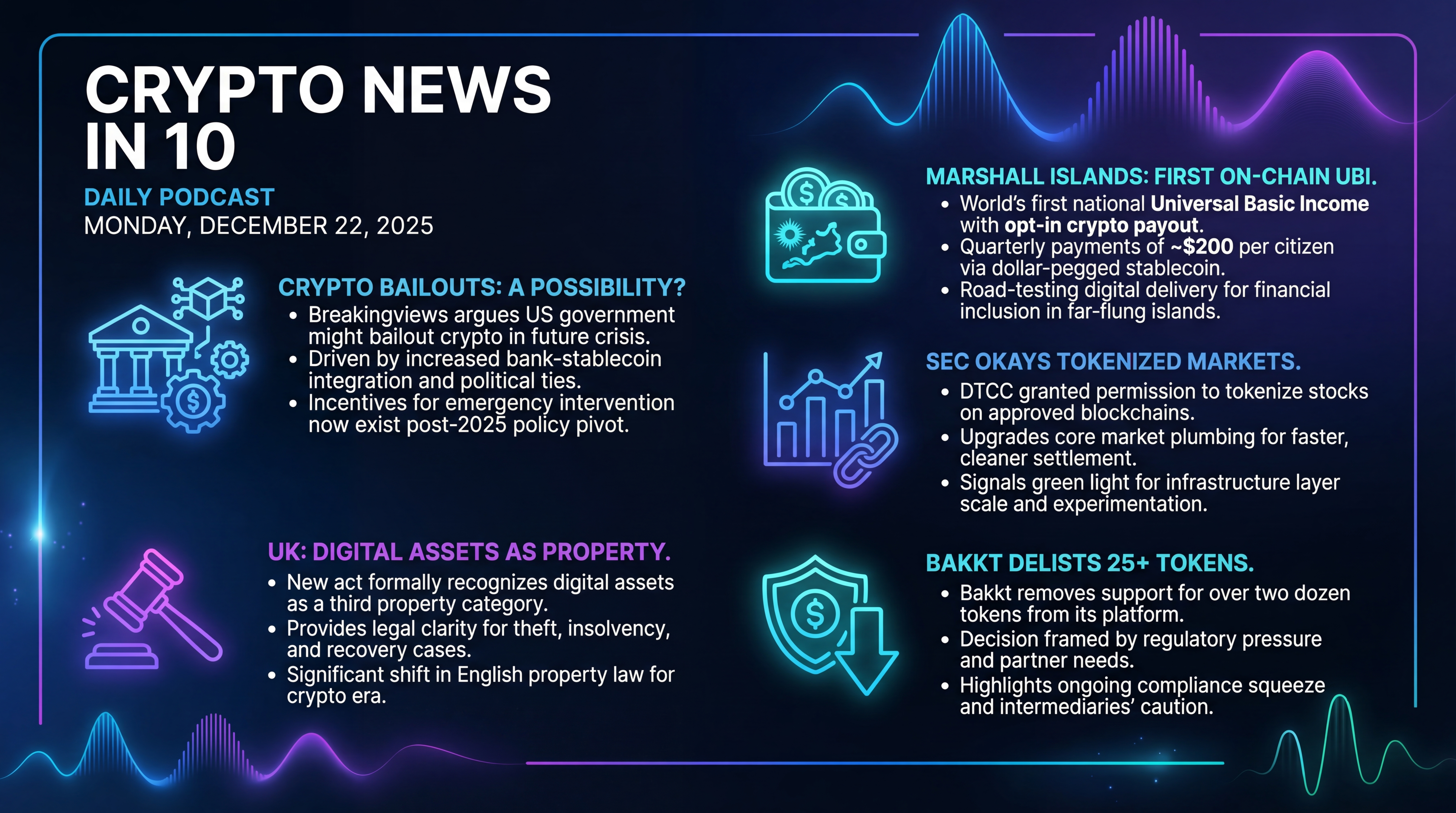
Episode Infographic
Show Notes
Welcome to our Crypto news in 10, a daily podcast bringing you the latest news about crypto in under 10 minutes.
Here’s what’s moving in crypto on Monday, December 22, 2025... Reuters Breakingviews poses a provocative question: would the White House ever bail out crypto in a future crisis? The Marshall Islands quietly launched the world’s first national universal basic income with an opt-in crypto payout. The SEC gave DTCC a key nod to tokenize stocks on approved blockchains. The UK now recognizes digital assets as property in their own right. And Bakkt is trimming its token roster by more than two dozen coins as regulatory heat persists. Let’s dive in.
[BEGINNING_SPONSORS]
First up — would Washington ever bail out crypto?
Breakingviews argues that 2025’s policy pivot — friendlier legislation, banks integrating stablecoins, and a new Strategic Bitcoin Reserve — means the next major shock could tempt the administration to reach for emergency tools like the Exchange Stabilization Fund.
They frame the risk around today’s market plumbing: stablecoins hold large piles of Treasuries, banks are touching more on-chain rails, and political ties that didn’t exist a few years ago are now in play.
Since the 2024 election, crypto’s total market value is up roughly 1.2 trillion dollars, and the sector is more intertwined with traditional finance than ever. The takeaway isn’t that a bailout is promised — it’s that the incentives and mechanisms now exist in a way they didn’t in 2022. According to Breakingviews, that makes a future rescue at least plausible if a systemic failure hit a big stablecoin or a major venue.
Next — a world first on social policy.
The Marshall Islands has begun a nationwide universal basic income that residents can receive by bank transfer, check... or through a government-backed digital wallet using a dollar-pegged stablecoin.
The quarterly payment is about 200 dollars per citizen, funded by a U.S.-backed trust tied to nuclear-testing compensation — roughly 1.3 billion dollars today, with another 500 million pledged by 2027.
Only a small early cohort opted to receive crypto — dozens at launch — but policymakers see the wallet as crucial for far-flung islands where banking access is limited. The IMF has warned about governance and financial-integrity risks, but officials say the program is already helping with everyday costs while road-testing digital delivery at national scale. If it works here, it’s a template other small nations could study in 2026.
Third — the pipes of Wall Street inch on-chain.
Bloomberg reports the SEC has granted DTCC a no-action letter to custody and recognize tokenized versions of equities, bonds, and Treasuries on pre-approved blockchains for three years.
DTCC is the back office for U.S. securities — giving it tokenization authority is a big step because it doesn’t just enable a pilot fund here or a single issuer there... it upgrades the market’s core plumbing.
Expect early use cases to look boring — and important: faster corporate actions, cleaner settlement, and synchronized records between traditional ledgers and blockchains. Combined with the burst of tokenized funds we’ve seen this quarter, today’s move signals that the infrastructure layer — custody, clearing, and record-keeping — is getting the green light to experiment at scale.
[MIDPOINT_SPONSORS]
Now to the UK — property law for the crypto era.
A new statute, the Property (Digital Assets etc.) Act 2025, has received Royal Assent, formally recognizing digital assets as a third category of property — distinct from physical things or purely contractual rights.
Industry group CryptoUK says this gives courts a clearer footing for theft, insolvency, and recovery cases. Some even call it the biggest shift in English property law in centuries.
For crypto businesses, that clarity matters when pursuing hacked funds, handling collateral, or litigating disputes around custody and staking. It also lines the UK up with its broader 2027 timeline to regulate crypto like other financial products — but this piece is purely about property rights: what you own, how you transfer it, and how courts protect it.
Finally — another sign of the compliance squeeze.
Bakkt, the crypto custody and clearing firm whose Apex Crypto unit powers trading for fintech apps like Public and Webull, is removing support for 25 of its 36 tokens. Among those cut: Uniswap, Avalanche, Maker, and Chainlink, while mainstays like Bitcoin, Ether, Solana, and USDC remain.
Bakkt framed the decision around regulatory pressure and partner needs. The practical effect for users inside those fintech apps is reduced long-tail exposure and a tilt toward larger, more clearly categorized assets. It’s a reminder that even with friendlier headlines in Washington this year, many intermediaries are still reshaping product lineups to minimize legal ambiguity — especially around assets that might be deemed securities.
Quick market check before we wrap.
Trading is subdued heading into the holidays... Bitcoin is hovering around the high eighty-eight thousand range, and Ether holds above three thousand dollars on thin liquidity — typical for late December. Macro data later this week is the next near-term catalyst. Keep an eye on options expiries and funding as positioning gets reset into year-end.
That’s it for today — big ideas about potential bailouts, a pioneering UBI delivered — optionally — on-chain, the SEC opening doors for tokenized stocks through DTCC, a UK property-law leap that gives crypto clearer legal footing, and Bakkt’s conservative pivot on token listings. We’ll keep tracking how these policy and plumbing shifts translate into real-world adoption as we head into the last days of 2025.
Thanks for listening and see you tommorow!