Pipes Not Hype: Wall Street Goes On-Chain
Institutions double down on crypto market infrastructure as JPMorgan eyes client trading, the FDIC sketches a bank stablecoin path, and Cboe debuts perp-style futures. Plus, UniCredit’s tokenized note and J.P. Morgan’s on-chain commercial paper bring tokenization from pilot to production.
Episode Infographic
Show Notes
Welcome to our Crypto news in 10, a daily podcast bringing you the latest news about crypto in under 10 minutes.
Here’s your quick rundown for Wednesday, December 24, 2025.
Wall Street keeps inching into digital assets. JPMorgan is weighing crypto trading for big clients, U.S. bank regulators are sketching the playbook for issuing stablecoins, and Cboe just rolled out the closest U.S. equivalent yet to perpetual futures on bitcoin and ether.
Over in Europe, UniCredit completed its first tokenized structured note — a real proof point for on-chain securities — while J.P. Morgan and Galaxy Digital moved short-term debt issuance onto Solana.
It’s a lot of institutional plumbing... and that’s exactly what makes the space sturdier heading into 2026. Reuters, the FDIC, and CoinDesk have more.
[BEGINNING_SPONSORS]
Story one...
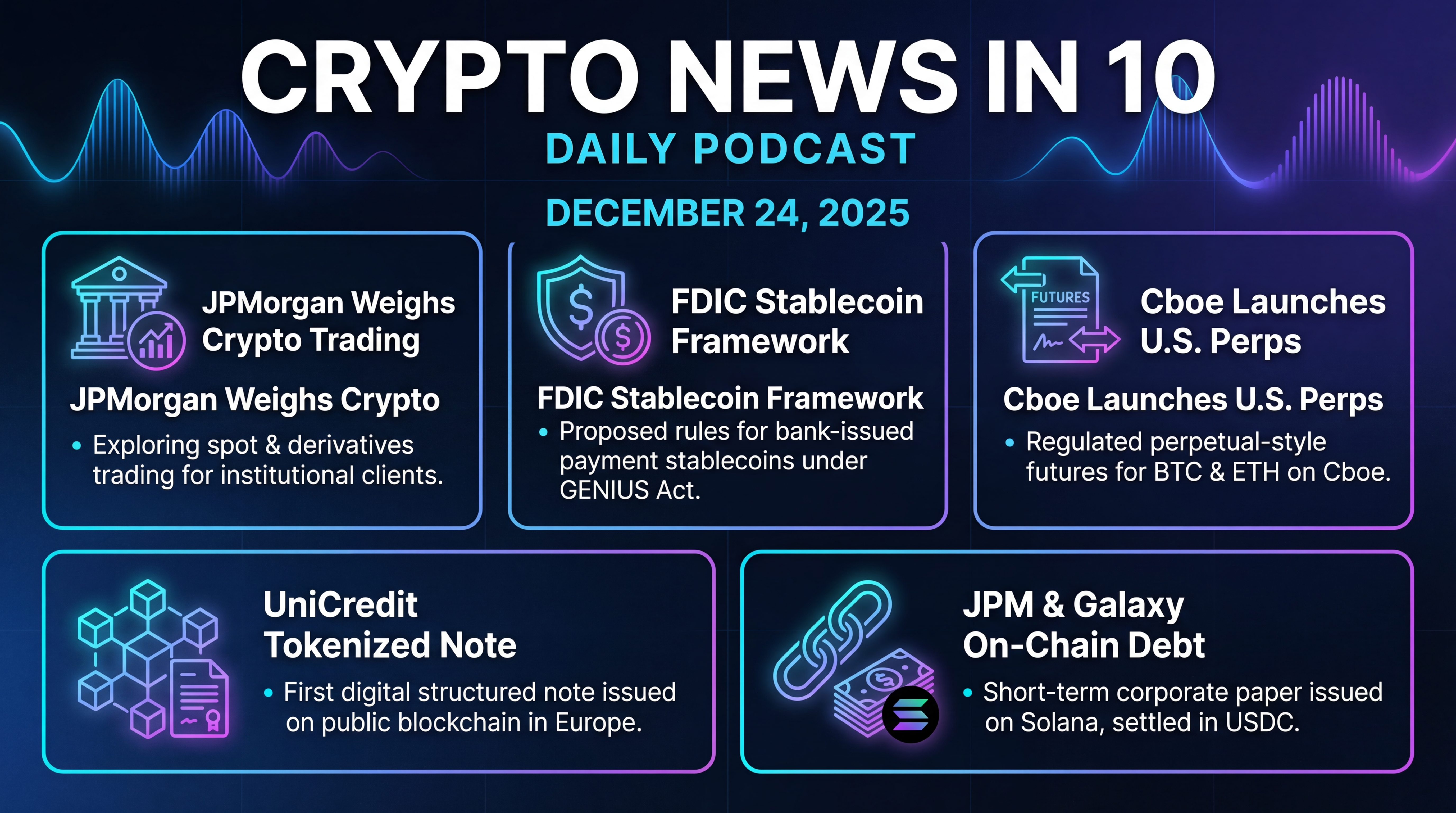
JPMorgan is exploring whether to let institutional clients trade crypto — potentially both spot and derivatives. No timelines yet, no specific products — and it all depends on client demand — but the signal matters.
The bank already runs a major blockchain program through Onyx and has piloted tokenized payments and collateral. Moving from building rails to offering trading services would be a meaningful step toward regulated, mainstream access for big money managers.
Reuters, citing Bloomberg, framed it as part of a broader 2025 theme: the biggest incumbents want to intermediate crypto under U.S. rules rather than leave that flow offshore. If even cautious banks are testing the waters, liquidity depth and compliance tooling should keep improving... bullish for market structure, even if prices chop into year-end.
Source: Reuters, December 22.
Story two...
U.S. banking regulators are laying out the process for bank-issued stablecoins. On December 16, the FDIC proposed an application framework under the new GENIUS Act for FDIC-supervised institutions that want a subsidiary to issue a payment stablecoin.
In plain English: if a state-chartered, FDIC-supervised bank wants to issue a dollar-backed token, here’s how you apply, what gets evaluated — think capital, liquidity, redemption mechanics, and risk management — and how appeals work. Comments stay open for 60 days after the rule hits the Federal Register.
It’s the first formal FDIC rulemaking to implement the law — and it’s notable because bank-issued tokens could coexist with today’s non-bank issuers, enabling instant settlement rails inside the insured banking system. If finalized, expect more pilots and clearer supervision lanes in 2026.
Sources: FDIC notice, press release, and board materials dated December 16.
Story three...
Cboe launched U.S. perpetual-style crypto futures for bitcoin and ether on December 15 — cash-settled, with ultra-long expiries and daily funding designed to mimic perps — but on a CFTC-regulated exchange.
If you’ve traded perpetuals offshore, you know the appeal: continuous exposure, no monthly roll headaches. Cboe’s structure uses long-dated contracts with mechanism tweaks to track spot — giving institutions and sophisticated traders a familiar product inside U.S. market rails.
Between CME’s growing suite and Cboe’s new design, U.S. venues are steadily chipping away at the regulatory gap that pushed volume offshore. Watch for follow-on listings across major altcoins as compliance models mature.
Source: CoinDesk, November 17, with the December 15 go-live.
[MIDPOINT_SPONSORS]
Story four...
In Europe, Italy’s UniCredit issued its first tokenized structured note — a fully digital issuance recorded on a public blockchain, using infrastructure from BlockInvest, with recording by Weltix. Target buyers are professional wealth clients, and the bank says the digital process cut manual steps and removed the need for traditional custodial mechanics — lowering issuance friction.
The move follows UniCredit’s tokenized minibond earlier this year and adds momentum to Europe’s tokenized-securities push under MiCA and related frameworks. These aren’t experiments for press releases — structured notes are real revenue products. Expect more banks to follow as legal plumbing, auditors, and regulators get comfortable with on-chain registries.
Source: Reuters, December 19.
Story five...
J.P. Morgan brought a short-term corporate debt deal on-chain for Galaxy Digital — issuing U.S. commercial paper recorded on Solana and settling the cash leg in USDC. Investors included Coinbase and Franklin Templeton.
Why care? Because commercial paper is the circulatory system for corporate cash management. Moving issuance and settlement on-chain can compress timelines, reduce reconciliation errors, and unlock programmable features like instant coupons or atomic delivery-versus-payment. It’s another concrete example of tokenization moving from pilots to production-grade deals — a top-tier bank stitching public-chain speed into capital-markets workflows.
Source: Reuters, December 11.
A quick market note before we wrap...
Trading is thin into the holidays, and bitcoin has been pinned below ninety thousand as desks wind down — ETF flow softness and year-end positioning are keeping a lid on rallies. If you’re managing risk, remember: late-December liquidity holes can magnify small orders both ways.
Sources: The Block’s price wrap today and broader December coverage.
That’s the set — JPMorgan’s institutional trading exploration, the FDIC’s roadmap for bank-issued stablecoins, Cboe’s U.S. perp-style futures, UniCredit’s tokenized note, and J.P. Morgan’s on-chain commercial paper.
The through-line is pretty clear... 2025’s endgame isn’t hype — it’s pipes. Institutions are standardizing custody, issuance, and derivatives under regulated umbrellas. If that continues into 2026, the next cycle’s foundation should be stronger, faster, and a lot more interoperable across banks and blockchains.
Stay warm out there — we’ll be back tomorrow with more.
Thanks for listening and see you tommorow!
