Hong Kong's Seatbelt, dYdX Buybacks, Record Hacks
Hong Kong drafts capital rules for insurers entering crypto as Belarus clamps down and 2025 sets a new high for thefts. Plus dYdX launches buybacks and Hilbert buys a high-frequency platform—why it all matters for markets, builders, and policy.
Episode Infographic
Show Notes
Welcome to our Crypto news in 10, a daily podcast bringing you the latest news about crypto in under 10 minutes.
Here's a quick tour of today's crypto landscape.
Hong Kong just took a notable step toward letting insurance companies invest in digital assets — yes, with heavy capital buffers. In Eastern Europe, Belarus quietly blocked access to Bybit, Bitget, and OKX, underscoring a patchwork of regional rules. Security data is landing, and 2025 is closing with record-setting crypto thefts — plus one gargantuan exchange hack that defined the year. On the builder side, dYdX unveiled a token buyback program funded by protocol fees. And institutional crypto trading got another nudge as Sweden's Hilbert Group snapped up a high-frequency platform to beef up its systematic strategies. We'll connect the dots on why each matters for markets, builders, and policy... right now.
[BEGINNING_SPONSORS]
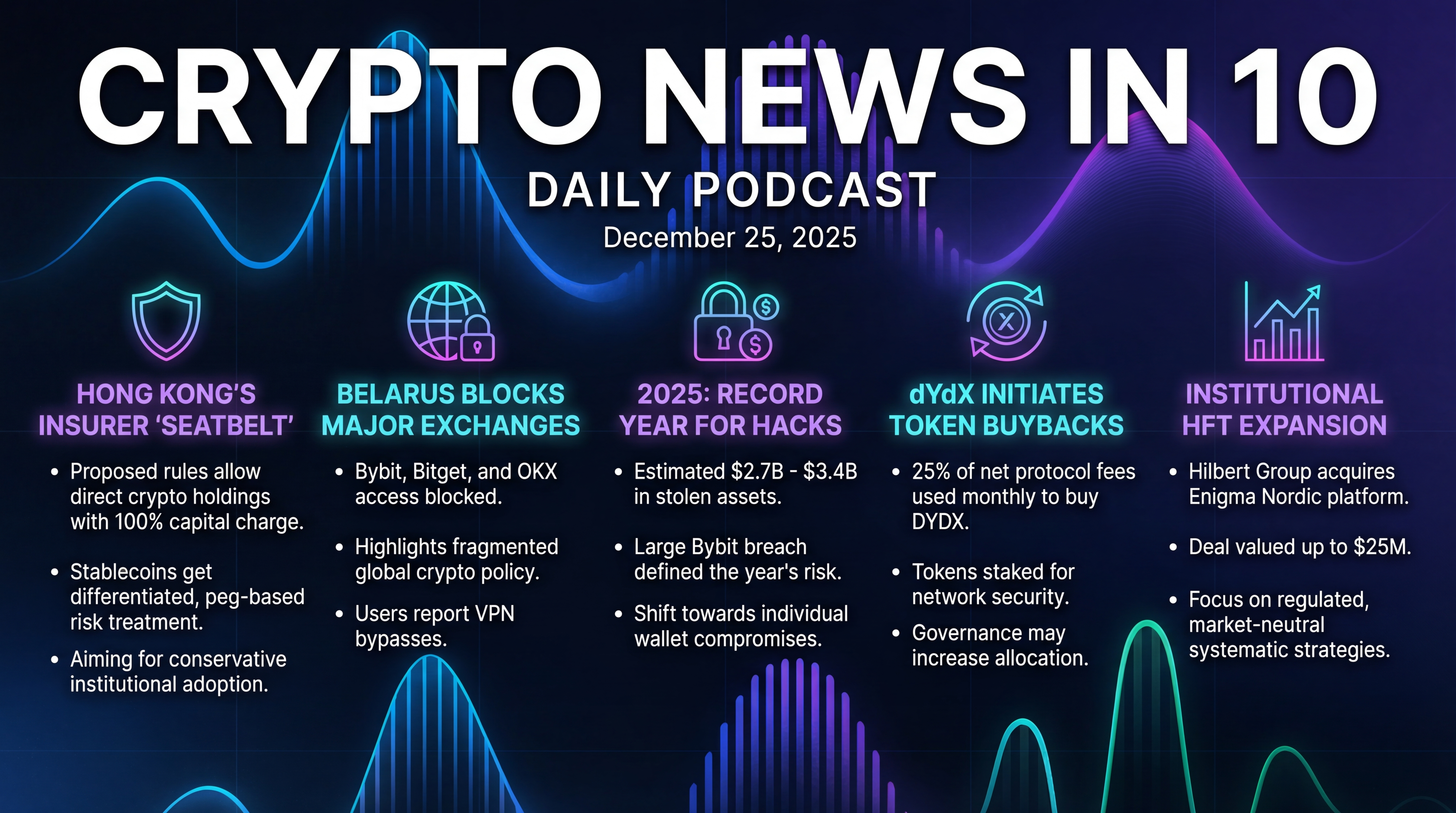
First up... Hong Kong — and this is big for institutional allocation. The Hong Kong Insurance Authority has floated rules that would, for the first time, plug crypto directly into insurers' risk-based capital framework. The headline is simple — a 100 percent risk charge on direct crypto holdings, meaning an insurer must hold a dollar of capital for every dollar of crypto. Stablecoins would get differentiated treatment, with risk charges tied to the fiat currency they're pegged to. The proposal heads to public consultation from February through April, followed by legislative submissions. Hong Kong's central bank also expects the first batch of stablecoin approvals early next year, which could give insurers a more capital-efficient way to dip a toe.
Net-net — it's permission with prudence, a green light with a seatbelt. The aim is to channel some of the sector's sizable balance sheets into tokenized finance without loosening solvency safeguards. According to reporting in The Star, the framework is designed to be conservative while still opening a door.
Why it matters — insurance capital is sticky, long-dated money. Even limited allocations can professionalize flows into tokenization, on-chain cash, and infrastructure credit. But that 100 percent charge says, go slow — and it will likely favor Hong Kong-regulated stablecoins and high-grade tokenized instruments over volatile coins in the near term.
Second... a notable regional clampdown. Belarus has blocked access to three major exchanges — Bybit, Bitget, and OKX. The government's Ministry of Information hasn't published a detailed rationale, and local users say blocks can be bypassed with VPNs. It's a snapshot of 2025's fractured policy map: even as some hubs open channels for institutional crypto, others tighten retail access — sometimes abruptly. If you're a user or builder in the region, expect customer-support spikes, liquidity fragmentation, and renewed emphasis on compliant on-ramps. DL News first highlighted the move.
Third... security. Multiple datasets now frame 2025 as the costliest year yet for crypto thefts. Chainalysis estimates roughly 3.4 billion dollars in stolen assets through early December, while other tallies put the full-year figure closer to 2.7 billion — still a record, depending on methodology. The single biggest swing factor: the Bybit exchange breach, estimated around 1.4 to 1.5 billion dollars, which alone defined the year's risk profile. Analysts also highlight North Korea-linked actors as disproportionately successful, and they warn of a pivot toward compromising individual wallets — even as DeFi exploit counts fell versus 2024. The takeaway is twofold: centralized venues remain high-value targets, and personal-security hygiene — hardware wallets, phishing resistance, strong device operational security — matters more than ever.
[MIDPOINT_SPONSORS]
On to DeFi... dYdX rolled out its first-ever token buyback program. Starting now, 25 percent of net protocol fees will be used monthly to buy back DYDX on the open market, with purchased tokens staked to bolster network security. Governance is already debating whether to scale that allocation as high as 100 percent of fees over time. Markets liked the signal — DYDX popped about 8 percent on the announcement. More broadly, it's another milestone in maturing token economics — shifting from issuance-heavy incentives toward cash-flow-backed programs where protocol revenue explicitly supports the asset and the validator set. The Block covered the launch in detail.
And institutions keep building tools for disciplined exposure. Sweden's Hilbert Group agreed to acquire high-frequency crypto trading platform Enigma Nordic in a deal valued up to 25 million dollars. The structure includes 7.5 million in Hilbert shares at closing, and up to 17.5 million in earn-outs tied to performance. Enigma says its systems have executed more than 50 billion Swedish kronor — about 5.4 billion U.S. dollars — in trading volume this year, with market-neutral strategies claiming a Sharpe ratio above three. For allocators, this is another proof point that quant managers are scaling regulated, market-neutral crypto strategies — less directional beta, more systematic alpha — inside an institutional wrapper.
Quick connective tissue across today's stories... Hong Kong's insurer blueprint shows how cautious capital can meet crypto — likely favoring regulated stablecoins and tokenized cash equivalents before higher-volatility assets. Belarus reminds us that venue risk and jurisdictional arbitrage never sleep — builders have to design for policy whiplash. The security numbers highlight where the real risk vectors moved in 2025: fewer flashy DeFi exploits, more concentrated service breaches, and a troubling rise in attacks on individuals. Meanwhile, dYdX's buyback signals a serious turn toward sustainable token economics, and Hilbert's deal shows quant infrastructure becoming part of mainstream asset-management toolkits.
That's the wrap. Today we covered Hong Kong's cautious green light for insurers, Belarus's exchange blocks, a record year in crypto thefts, a new DeFi buyback era at dYdX, and institutional build-out via Hilbert's acquisition. Keep an eye on Hong Kong's consultation window, the enforcement tone in Eastern Europe, and how protocols choose to share — or burn — fee revenues. Those levers could shape flows well into 2026.
Thanks for listening and see you tommorow!
