
Quiet Markets, Loud Moves: Deals, Rules, Bitcoin Treasuries
Coinbase doubles down on prediction markets as crypto M&A hits records, the UK sets an October 2027 start for comprehensive rules, and Binance faces fresh scrutiny. Plus, Semler Scientific makes Bitcoin its primary treasury asset amid a quiet-but-twitchy holiday market.
Episode Infographic
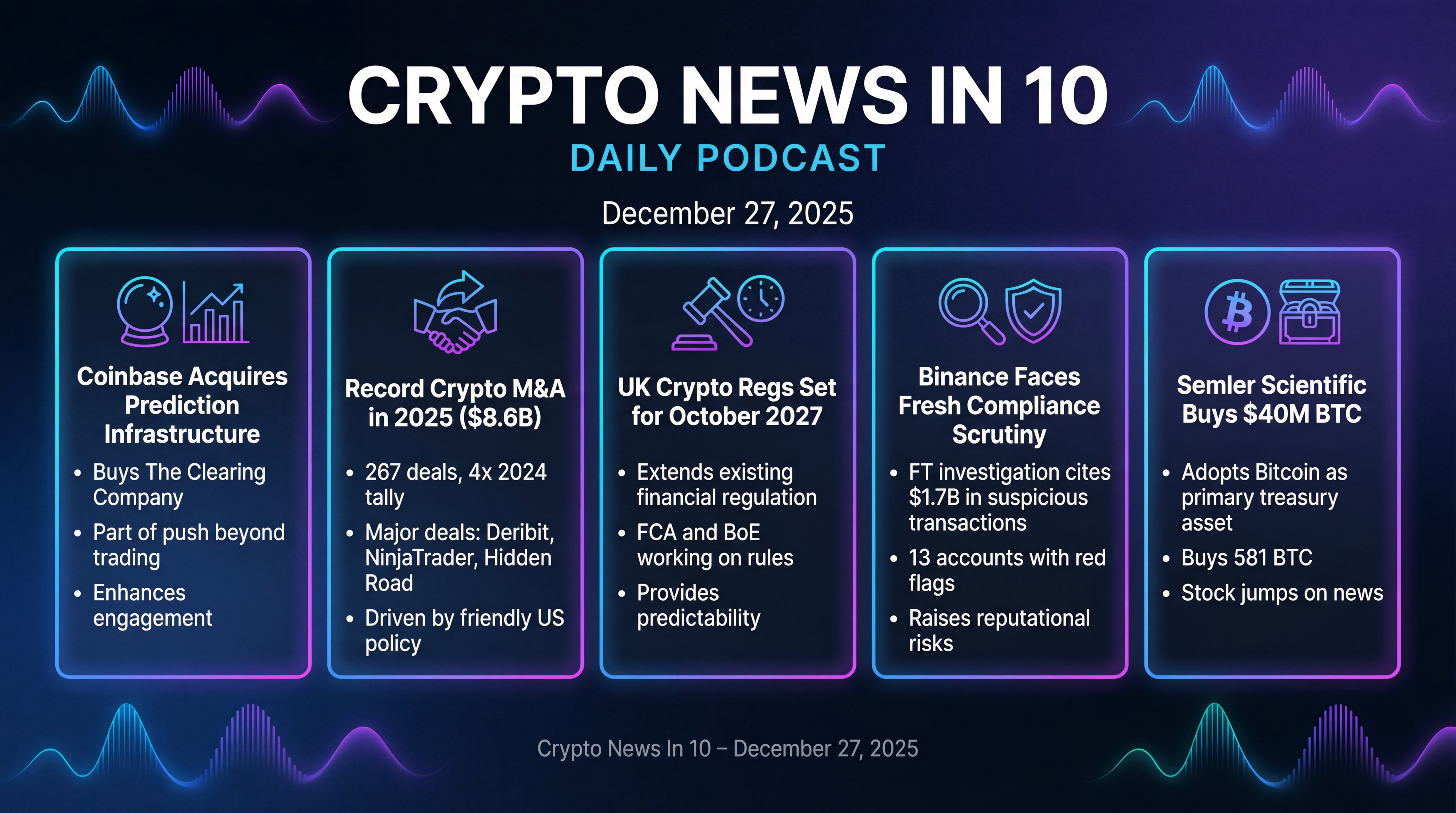
Show Notes
Welcome to our Crypto news in 10, a daily podcast bringing you the latest news about crypto in under 10 minutes.
It’s Saturday, December 27. Markets are quiet into the holiday weekend... but not sleepy.
Bitcoin is hovering in the upper eighty-thousands, and total crypto market cap sits just under three trillion dollars. The headlines are moving — especially around exchanges, regulation, and one unusual corporate treasury play.
Here’s what we’re diving into today: Coinbase makes another acquisition to double down on prediction markets. A Financial Times deep-dive says 2025 was a record year for crypto mergers and acquisitions. The UK has finally circled a date to switch on broad crypto regulation. A new investigation raises more compliance questions for Binance. And a mid-cap healthcare tech company just made Bitcoin its primary treasury asset.
Quick market check before we start: BTC around $87,500, Bitcoin dominance near 59 percent, and total volume light as year-end approaches. Source: CoinCodex.
[BEGINNING_SPONSORS]
Story one — Coinbase is leaning into prediction markets. The company announced a deal to acquire The Clearing Company, a startup focused on prediction-market infrastructure. It’s Coinbase’s tenth acquisition of 2025 — part of a broader push beyond pure crypto trading. Remember, Coinbase rolled out its own prediction markets platform earlier this month, and it added stock trading to compete more directly with brokerages like Robinhood.
Terms weren’t disclosed, and the plan is to close in January. Strategically, this is about engagement — prediction markets keep users in-app and trading around real-world events, from elections to macro data. On the regulatory side, it matters too: the C F T C has been taking a closer look at prediction platforms this year, so buying infrastructure rather than a live, consumer-facing book could give Coinbase more flexibility as rules evolve. Shares even ticked up on the news. Source: Reuters.
Story two — If 2024 was the year of ETF normalization, 2025 was the year dealmakers took the wheel. According to the Financial Times, crypto mergers and acquisitions sprinted to roughly 8.6 billion dollars across 267 deals — about four times 2024’s tally.
The piece cites three of the year’s blockbusters: Coinbase’s 2.9 billion dollar purchase of Deribit, Kraken’s 1.5 billion dollar deal for NinjaTrader, and Ripple’s 1.25 billion dollar acquisition of Hidden Road. On the capital-markets side, Gemini, Circle, and Bullish all went public, raising a combined 14.6 billion dollars.
The driver behind the deal flood, per the report, is a more permissive U.S. policy backdrop — industry-friendly regulators, a unifying stablecoin framework, and the administration’s push to bring more of digital assets onshore. Looking into 2026, the FT expects stablecoins and tokenization licenses to stay at the center of the mergers and acquisitions chessboard. Source: Financial Times.
Story three — the UK finally put a stake in the ground for comprehensive crypto rules. The finance ministry says it will start regulating cryptoassets from October 2027, extending existing financial regulation to crypto businesses rather than building a bespoke regime like the European Union’s MiCA framework.
The Financial Conduct Authority and the Bank of England are working on complementary rules for trading, custody, and stablecoins through 2026, and industry groups have welcomed the timeline — even if some lawyers want clearer drafting. For global firms, the key is predictability: a public date for switch-on means compliance teams can plan licensing, capital, and product roadmaps over the next 18 to 24 months. It also nudges London closer to the U.S. model — important for cross-listed firms and for stablecoin issuers weighing where to domicile. Source: Reuters.
[MIDPOINT_SPONSORS]
Story four — a Financial Times investigation is turning up the heat on Binance again. Despite the exchange’s 4.3 billion dollar U.S. plea deal in 2023 and the addition of monitors to oversee compliance, the FT reports that internal data show more than 1.7 billion dollars in transactions tied to just 13 accounts displaying suspicious patterns — think improbable logins, failed know-your-customer checks, and links to sanctioned entities.
Binance has pushed back, saying it runs robust compliance systems and cooperates with law enforcement. Still, for institutions, reputational and counterparty risks matter — especially if monitors ultimately corroborate the findings. For traders, the practical question is the same as always: is liquidity worth the legal and operational uncertainty? With competitors now offering deeper regulated perpetual futures and improved fiat on-ramps and off-ramps, the cost-benefit calculus is slowly changing. Source: Financial Times.
Story five — a healthcare tech company just joined the Bitcoin-as-treasury club... again. Semler Scientific says it adopted Bitcoin as its primary treasury reserve asset and bought 581 BTC for roughly 40 million dollars. The stock jumped as much as 27 percent on the announcement earlier this week.
The rationale is familiar — scarcity, liquidity, and a perceived hedge against currency debasement — but the timing is interesting. Semler bought into a choppy market as Bitcoin slid from six-figure highs into the 80s and 90s. Corporate adoption isn’t a monolith — most CFOs still prefer short-duration Treasuries — but every additional public company helps normalize the accounting, custody, and governance playbook. The bigger question for 2026 is whether we’ll see more firms use Bitcoin in capital markets — for example, issuing convertibles tied to BTC, or layering staking yield from Ether into treasury strategies. For now, chalk this up as one more data point that corporate demand isn’t just a MicroStrategy story. Source: The Block.
Quick pulse check before we close: prices remain range-bound into the weekend, with light volume and thinner order books exaggerating intraday moves. If you’re trading, watch for year-end rebalancing flows and reduced liquidity during U.S. afternoon hours... those can produce sharp wicks even on modest news. Source: CoinCodex.
That’s a wrap — Coinbase expands into prediction markets, mergers and acquisitions had a banner 2025, the UK pins an October 2027 start for comprehensive crypto rules, Binance faces fresh scrutiny from an FT probe, and Semler Scientific adds 581 BTC to its balance sheet. We’ll be back tomorrow with the next wave of headlines as the market tiptoes into the final trading days of the year.
Thanks for listening and see you tommorow!
