
New Year, New Crypto Rulebook
Five major crypto rules flip on across the UK, EU, U.S., and Turkmenistan — from CARF and DAC8 to Basel bank disclosures and a new IRS data trail. Here’s what changes today, what to expect in 2026, and how it affects users, platforms, and banks.
Episode Infographic
Show Notes
Welcome to our Crypto news in 10, a daily podcast bringing you the latest news about crypto in under 10 minutes.
Happy New Year... and welcome to a very regulatory first day of 2026.
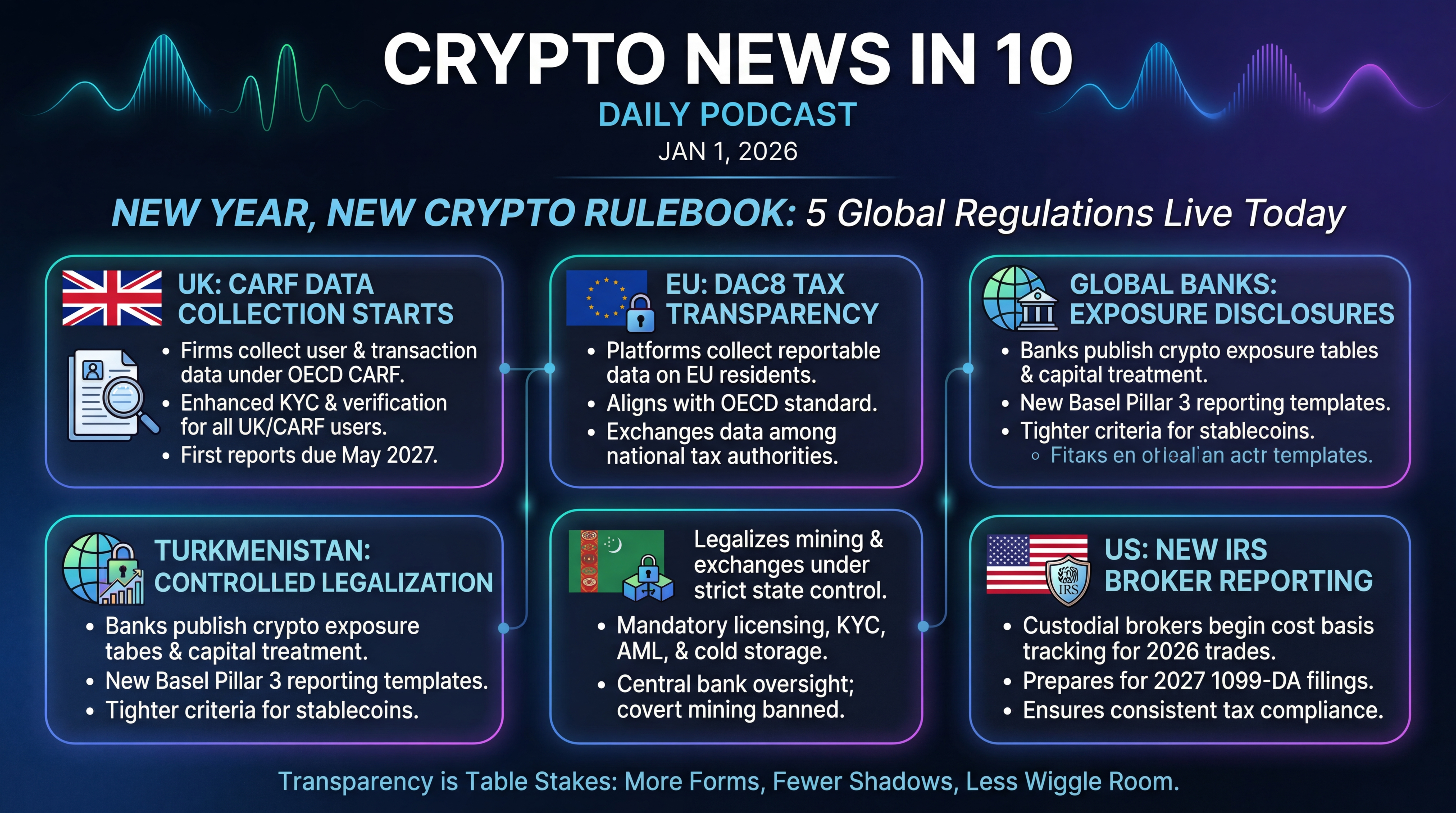
Today, five big rules go live that will shape the year. The UK starts collecting crypto user data under the OECD’s new framework. The European Union’s DAC8 tax transparency rules take effect. Global bank regulators switch on crypto exposure disclosures. Turkmenistan legalizes — but tightly controls — crypto activity. And in the U.S., brokers begin a new phase of IRS reporting for anyone trading on custodial platforms.
Let’s jump in.
[BEGINNING_SPONSORS]
Story one: the UK’s tax authority, HMRC, is turning the CARF switch on.
Starting today — Thursday, January 1, 2026 — any firm providing crypto asset services in the UK must begin collecting standardized user and transaction data under the OECD’s Crypto-Asset Reporting Framework, often called CARF.
In plain English... exchanges, brokers, and certain wallet providers now have to verify who you are and track what you do — asset type, units, value, and whether it’s a buy, sell, or transfer — starting with this 2026 calendar year.
The first reports are due by May 31, 2027. Penalties can reach up to three hundred pounds per user for inaccurate or missing information. HMRC also expects platforms to notify customers about the new reporting by January 31, 2027.
The rules apply to UK users and to users in other jurisdictions that adopt CARF. The UK is also extending CARF to domestic reporting — so even if data isn’t moving cross-border yet, firms still have to collect it.
What should UK users expect? More KYC prompts, more requests to confirm your tax residency, and tighter verification to close historical data gaps. And if you’re a platform — it’s time to finalize those XML pipes into HMRC’s portal and tighten your due diligence workflows.
Big takeaway: today starts the data collection clock for the 2026 reporting year.
Story two: across the Channel, the EU’s DAC8 rules take effect.
DAC8 is Brussels’ companion to CARF. Member states had to transpose it by December 31, 2025. Starting today — January 1, 2026 — crypto platforms operating in the EU must begin collecting reportable data on EU resident users, with first filings due in 2027.
The European Commission says DAC8 expands the automatic exchange of information to cover crypto assets, aligning with the OECD standard. Advisories from the big accounting firms point to likely single-state registration if you’re not already MiCA authorized, enhanced due diligence, and data pipelines into national tax authorities for onward exchange across EU countries.
Bottom line — whether you call it CARF or DAC8, today is day one for EU data collection as well.
Story three: bank transparency steps up, globally.
The Basel Committee on Banking Supervision’s final disclosure framework for banks’ crypto asset exposures goes live today. Banks will now publish standardized tables and templates showing their crypto exposures and the related capital treatment — part of Pillar 3 market discipline disclosures.
Basel also tightened the criteria for stablecoins to qualify for the more favorable Group 1b bucket. Higher risk exposures — think many permissionless chain assets — still attract steep capital charges.
The upshot... investors, counterparties, and regulators will get a clearer look at which banks actually touch crypto, how much, and under what risk weights. Expect some interesting appendices in Q1 earnings.
[MIDPOINT_SPONSORS]
Story four: Turkmenistan just entered the chat — with one of the tightest crypto laws anywhere, now in force.
As of today, the country legalizes cryptocurrency mining and exchange operations, but only under strict state control. The law requires licensing for exchanges and custodians, mandatory KYC and AML, and cold storage safeguards. Covert mining is banned. Authorities can halt — or even force refunds of — token issuances.
Credit institutions are barred from offering crypto services, and the central bank retains broad oversight powers over the use of distributed ledgers. The stated policy goal is to attract investment and push digitalization beyond the natural gas economy... but for builders it reads as legal, yet heavily permissioned — and for users, don’t expect Western style open platforms.
Story five: new year, new IRS data trail in the United States.
Treasury and the IRS finalized the broker reporting regime for digital assets last year, and several pieces click into place between the 2025 and 2026 tax cycles.
Here’s the punchline for today: for custodial brokers, cost basis reporting begins for certain transactions executed on or after January 1, 2026 — generally when the assets are acquired from, and held with, that same broker from this date. Gross proceeds reporting covers 2025 trades, which means 1099-DA statements in 2026. The basis layer shows up in 2027 filings for 2026 trades.
The IRS materials lay out the phased approach and backup withholding timing, and Treasury emphasizes that the rules mirror traditional 1099 reporting to make tax prep simpler and compliance more consistent.
If you’re a U.S. trader using a centralized platform, this is the year to make sure your W-9 or W-8 is current... and that you understand how FIFO or specific ID basis methods will apply under your broker’s policies.
Quick recap...
Today marks a global step change. The UK and EU begin collecting crypto tax data for the 2026 reporting year. Banks worldwide start disclosing their crypto exposures under Basel’s templates. Turkmenistan legalizes crypto within a tightly controlled regime. And U.S. brokers begin tracking cost basis for 2026 trades ahead of 2027 filings.
For users, that means more forms and fewer shadows. For institutions, more templates and less wiggle room... and for the industry, a year where transparency isn’t optional — it’s table stakes.
Thanks for listening and see you tommorow!
