
ETFs Surge, SEC Shifts, Dealmaking Returns
U.S. spot ETFs cross two trillion in volume and kick off 2026 with fresh inflows, as the SEC turns all-Republican and Congress eyes prediction markets after a controversial trade. We also break down crypto’s 2025 M&A and IPO comeback and preview Do Kwon’s long-awaited trial later this month.
Episode Infographic
Show Notes
Welcome to our Crypto news in 10, a daily podcast bringing you the latest news about crypto in under 10 minutes.
Here’s what’s moving crypto this Sunday, January 4, 2026.
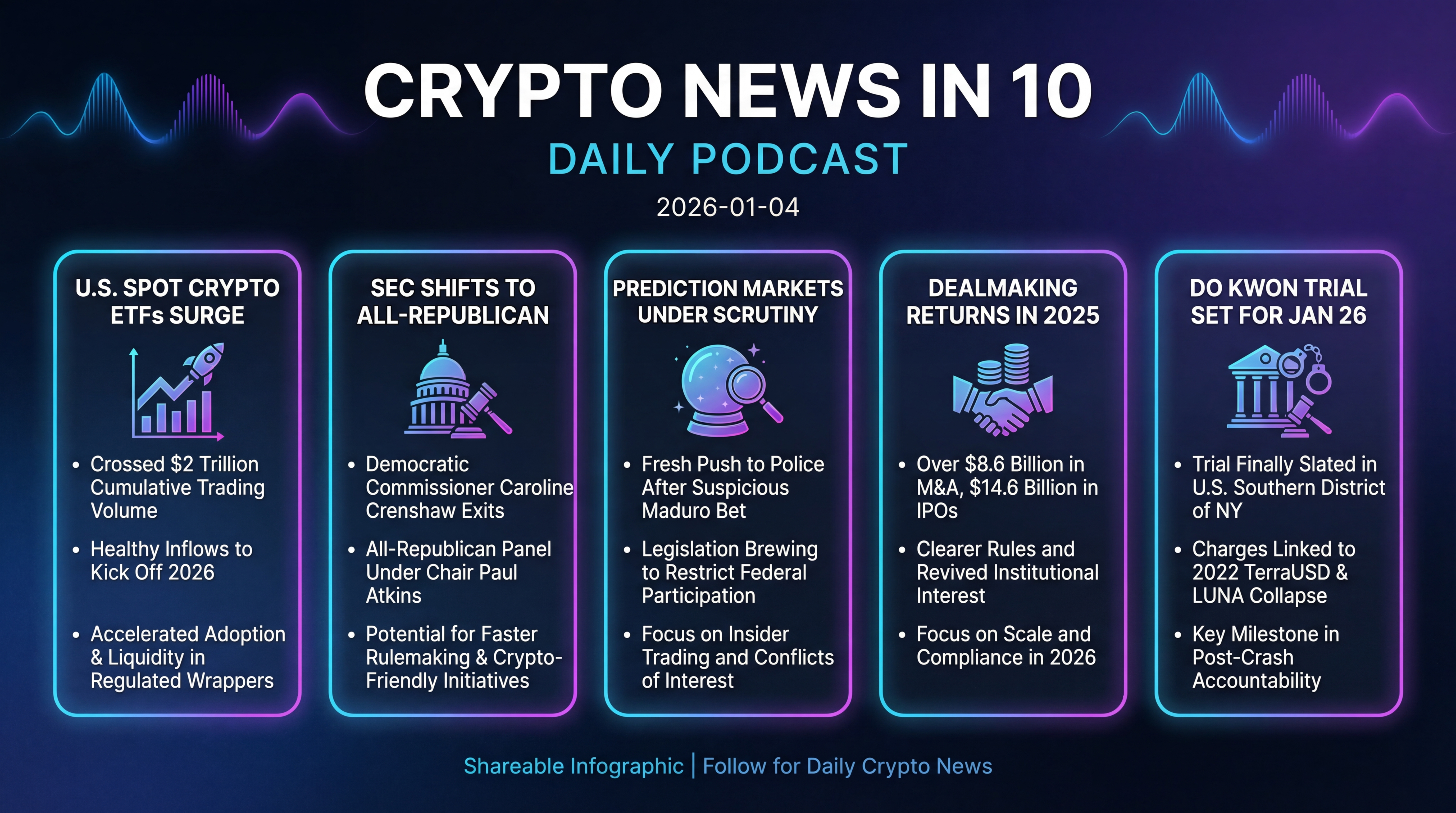
U.S. spot crypto ETFs just blasted through two trillion dollars in cumulative trading volume... and they kicked off the year with healthy inflows.
Washington is shifting — the SEC’s only Democratic commissioner, Caroline Crenshaw, has exited, leaving an all-Republican panel.
On Capitol Hill, a fresh push to police prediction markets is brewing after an eyebrow-raising profit tied to bets on Nicolás Maduro’s capture.
Meanwhile, 2025 closed with a boom in crypto mergers, acquisitions, and IPOs — and insiders say that deal energy is rolling into 2026.
And later this month, Terraform Labs founder Do Kwon is finally slated to face a U.S. jury.
[BEGINNING_SPONSORS]
Let’s start with the ETFs. The Block’s data desk says U.S. spot crypto ETFs crossed two trillion dollars in cumulative trading volume on January 2... the second trillion took about eight months — half the time of the first. That acceleration matters — more of crypto’s price discovery and liquidity are migrating into regulated wrappers.
On day one of trading for 2026, bitcoin and ether ETFs together pulled in about 646 million dollars of net inflows, with BlackRock’s IBIT still dominating by share of volume.
And the ETF pipeline isn’t slowing. Bloomberg’s James Seyffart counts well over a hundred crypto ETP filings as issuers keep throwing new products at the wall. If approvals continue, analysts warn we could see closures late this year as weaker funds fail to gather assets — but for now, the market is absorbing new supply.
That mix — rising cumulative volumes, steady early-year inflows, and a crowded pipeline — suggests ETFs remain the primary on-ramp for mainstream demand.
Now to D.C. The SEC just lost its last Democratic voice. Caroline Crenshaw — a frequent dissenter on crypto ETFs and a critic of what she called “regulatory Jenga” — has officially departed the Commission, leaving Chair Paul Atkins with a three-member, all-Republican panel. That’s rare... and it’s significant for rulemaking pace.
With vacancies unfilled, observers expect a quicker push on crypto-friendly initiatives from an SEC that’s been signaling a softer stance since last year. Even Crenshaw’s farewell sounded alarms about thinning enforcement and reduced disclosure.
For markets, the headline is simple: fewer internal roadblocks could mean faster movement on listing standards, tokenization guidance, and cleanup of legacy enforcement overhangs — though any purely partisan rule may be vulnerable to future reversal.
Story three: prediction markets are squarely in the policy crosshairs after an eye-popping trade. Axios reports that a newly created Polymarket account bet around seven cents per share that Venezuela’s Nicolás Maduro would be out by January 31... just hours before the U.S. announced his capture — and reportedly cleared more than 400,000 dollars as prices spiked.
Representative Ritchie Torres is preparing legislation dubbed the Public Integrity in Financial Prediction Markets Act to restrict federal officials and political figures from participating — aiming to reduce the risk of insider trading and conflicts of interest.
Whether you’re bullish on prediction markets as information platforms or wary of them as regulatory headaches... expect a noisy debate that touches CFTC jurisdiction, state anti-gambling laws, and how to prevent misuse of non-public information.
[MIDPOINT_SPONSORS]
Number four: 2025 was the year dealmaking came back to crypto. PitchBook data, cited by The Block, shows more than 265 M&A transactions totaling about 8.6 billion dollars — nearly four times 2024 — and at least 11 crypto IPOs raising roughly 14.6 billion globally.
Executives told The Block that clearer rules and revived institutional interest reopened the window. Importantly, public listings favored companies with evident product-market fit and recurring revenue — like exchanges and stablecoin infrastructure. Insiders expect that momentum to carry into 2026, with consolidation around regulated, cash-flow-positive platforms and, yes, some attrition for earlier-stage ventures that can’t clear profitability hurdles.
The read-through is simple: we’re moving from a growth-at-all-costs phase to scale and compliance as competitive advantages.
And finally... a courtroom date that’s been years in the making. A federal judge in the Southern District of New York set Terraform Labs founder Do Kwon’s trial for January 26, 2026 — encouraging plea talks and noting the unprecedented gap between the initial conference and trial date to accommodate a mountain of evidence, roughly six terabytes, gathered across multiple devices and accounts. Prosecutors say the case could take up to six weeks.
The charges tie back to the 2022 collapse of TerraUSD and LUNA, which vaporized tens of billions and helped trigger a cascade of failures across lenders and trading firms. With extradition hurdles cleared and discovery underway, this trial will revisit key questions around alleged market support, public statements about stability, and the line between ambitious design and fraud. However it resolves, it will be a milestone in the post-crash accountability arc.
Quick recap. ETFs are still the main engine — two trillion in lifetime volume and fresh 2026 inflows underscore that. The SEC’s composition just tipped fully Republican, setting the stage for faster rulemaking — or at least fewer internal roadblocks. Prediction markets drew congressional attention after a suspiciously well-timed Maduro bet. Dealmaking is back, with 2025’s M&A and IPO surge likely carrying into this year. And the Do Kwon trial is finally on the calendar for January 26. We’ll keep tracking how these threads shape liquidity, policy, and the narratives that drive the next leg of crypto adoption.
Thanks for listening and see you tommorow!
