
Japan's Digital Push and Ethereum's ZK Roadmap
Japan signals a push to integrate digital assets into traditional exchanges, PwC leans into crypto, and Bitcoin holds near ninety-three thousand while Coinbase pauses peso services in Argentina. Vitalik Buterin outlines how ZK EVMs and PeerDAS could reshape Ethereum from 2026 to 2030.
Episode Infographic
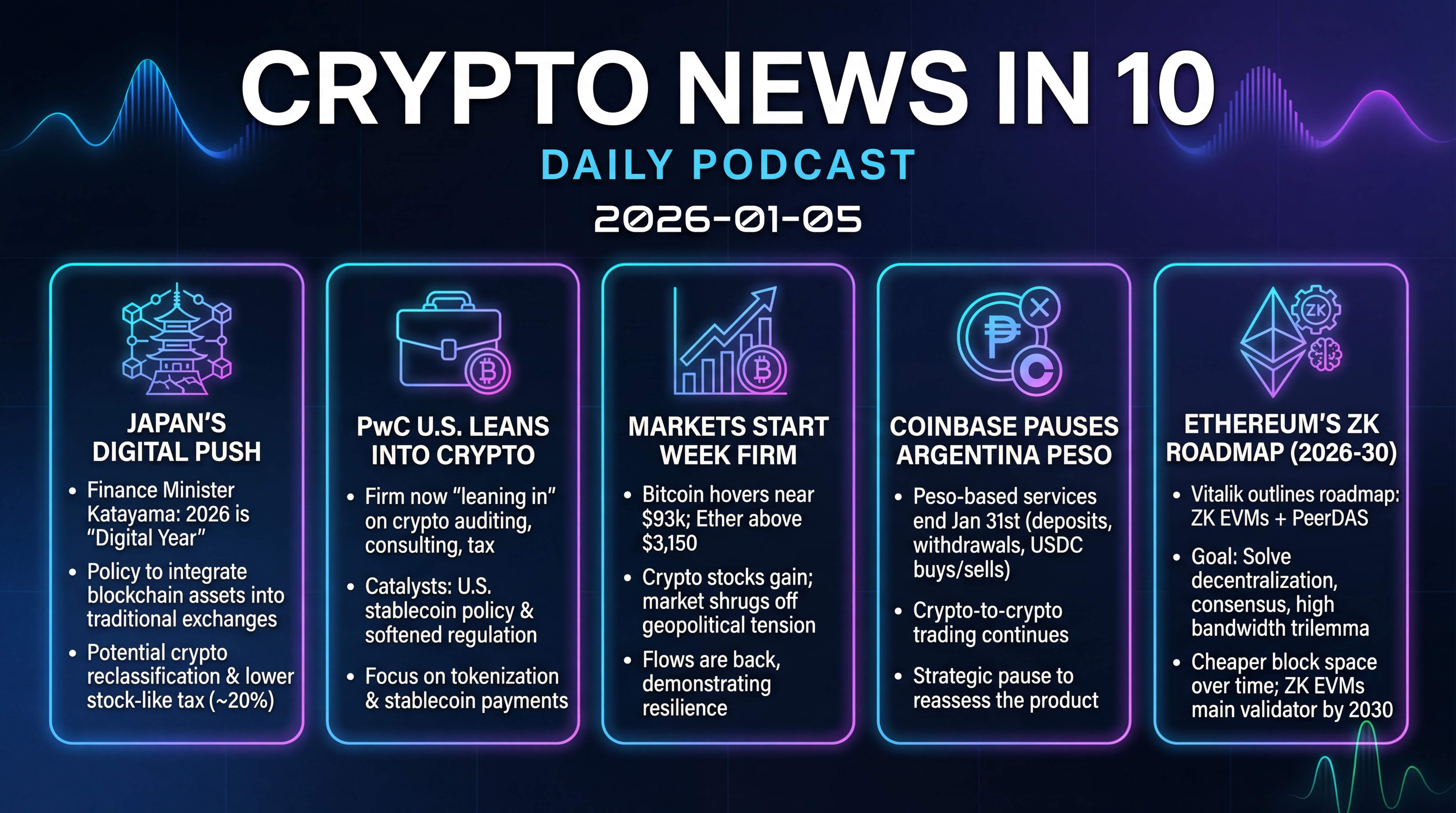
Show Notes
Welcome to our Crypto news in 10, a daily podcast bringing you the latest news about crypto in under 10 minutes.
Here’s what’s moving crypto on Monday, January fifth. Japan just sent a high-profile policy signal about integrating digital assets into its stock and commodity exchanges... PwC says it’s finally leaning in on crypto work stateside... markets start the week firm, with Bitcoin hovering near ninety-three thousand despite geopolitical tension... Coinbase steps back from peso services in Argentina... and Vitalik Buterin lays out how ZK EVMs plus PeerDAS reshape Ethereum’s next four years.
[BEGINNING_SPONSORS]
Let’s start in Tokyo.
Japan’s finance minister, Satsuki Katayama, used her New Year’s address at the Tokyo Stock Exchange to call 2026 the nation’s “digital year,” and to back integrating blockchain-based assets into traditional exchanges. The point wasn’t a meme line — it was policy direction. Exchanges, she said, are crucial to giving the public access to digital assets — citing the popularity of U.S. crypto ETFs as a model.
Japan doesn’t yet have domestic crypto ETFs, but regulators spent late 2025 preparing reforms — including reclassifying major tokens as financial products, and discussing lower, stock-like tax treatment around twenty percent. That would be a shift from top rates around fifty-five percent, and would pull crypto deeper into Japan’s regulated markets.
According to reporting by The Block and Reuters on the coming reclassification, the thrust is clear — bring crypto into the existing securities-law plumbing, and let exchanges — and investors — do the rest.
In the United States, one of the Big Four moved from foot-dragging to full throttle. PwC’s U.S. leader, Paul Griggs, told the Financial Times the firm is now “leaning in” to crypto work — auditing, consulting, and tax — after last year’s policy shift in Washington clarified stablecoin rules and softened the posture of market watchdogs.
He pointed to the new stablecoin law and ongoing rulemaking as catalysts, and highlighted tokenization as a focus area — think stablecoin-enabled payments and real-world asset rails.
For context, PwC kept crypto at arm’s length for years amid headline enforcement actions. Bringing the franchise to bear now signals that blue-chip corporates expect crypto infrastructure to be part of their 2026 planning, not a side experiment.
Markets next...
Bitcoin started the week firm near ninety-three thousand dollars — even as headlines about U.S. operations in Venezuela kept risk on edge. Barron’s called it a continuation of crypto’s strong start to 2026 — Bitcoin up roughly one to two percent on the day, about six percent year to date. Ether held above three thousand one hundred fifty, XRP perked up, and crypto-exposed stocks like Coinbase gained after a Wall Street upgrade.
The takeaway from multiple market notes: flows are back, and the tape is shrugging off geopolitics... at least for now. The Economic Times added that analysts in India saw the move as resilience against a backdrop that would normally pressure risk assets.
Keep an eye on Friday’s jobs data — anything that nudges rate-cut odds tends to matter for crypto beta.
[MIDPOINT_SPONSORS]
Down to Latin America.
Coinbase told users in Argentina it will pause peso-based services at month-end — just a year after the big launch. Starting January thirty-first, Argentines won’t be able to buy or sell USDC with pesos, or withdraw to local bank accounts via Coinbase’s fiat rails. Crypto-to-crypto trading continues, and Coinbase framed the decision as a deliberate pause to reassess the product and return with something stronger. Funds are not affected.
Local media first flagged the notices, and outlets including The Block and Cointelegraph confirmed the details. For context, Argentina remains one of the world’s most active crypto markets because of chronic inflation, so any retrenchment by a major U.S. venue is notable — especially as stablecoin usage has become day-to-day utility for many.
And to the protocol layer — Vitalik Buterin laid out a 2026 to 2030 roadmap where zero-knowledge EVMs plus PeerDAS push Ethereum into what he calls a fundamentally new kind of decentralized network.
The short version is this — ZK EVMs are at alpha with production-quality performance while safety work continues. PeerDAS — data availability sampling — went live with the Fusaka upgrade. Together, he argues, these components solve the long-standing trilemma in practice — decentralization, consensus, and high bandwidth at once.
The near-term milestones he sketched are pragmatic. In 2026, expect gas-limit increases that don’t depend on ZK EVM, and the first chances to run a ZK EVM node. From 2026 to 2028, look for gas repricing, state restructuring, and moving execution payloads into blobs. From 2027 to 2030, ZK EVMs become the main way to validate blocks — unlocking larger gas limits.
If you build on Ethereum, that roadmap implies cheaper block space over time, and a gradual shift in how clients validate the chain. Coverage from Crypto News and Blockchain News captured the highlights from Vitalik’s posts.
Quick wrap-up... Japan puts digital assets squarely on the stock-exchange agenda, PwC puts Big Four weight behind crypto services, the market starts the week with Bitcoin steady around ninety-three thousand and crypto stocks bid, Coinbase trims its Argentina fiat rails while keeping crypto online, and Ethereum’s next act focuses on ZK EVMs plus PeerDAS moving from theory into practice. We’ll be back tomorrow with the next wave of crypto in ten.
Thanks for listening and see you tommorow!
