
Scaling Quietly: Blobs, Privacy, and Bank Rails
Ethereum boosts blob capacity, Stellar rolls out native ZK primitives, Barclays backs stablecoin plumbing, U.S. spot bitcoin ETFs see a brief outflow day, and Ripple stays private. A fast, six-minute rundown on pragmatic scaling, privacy momentum, and where institutional money is building the rails.
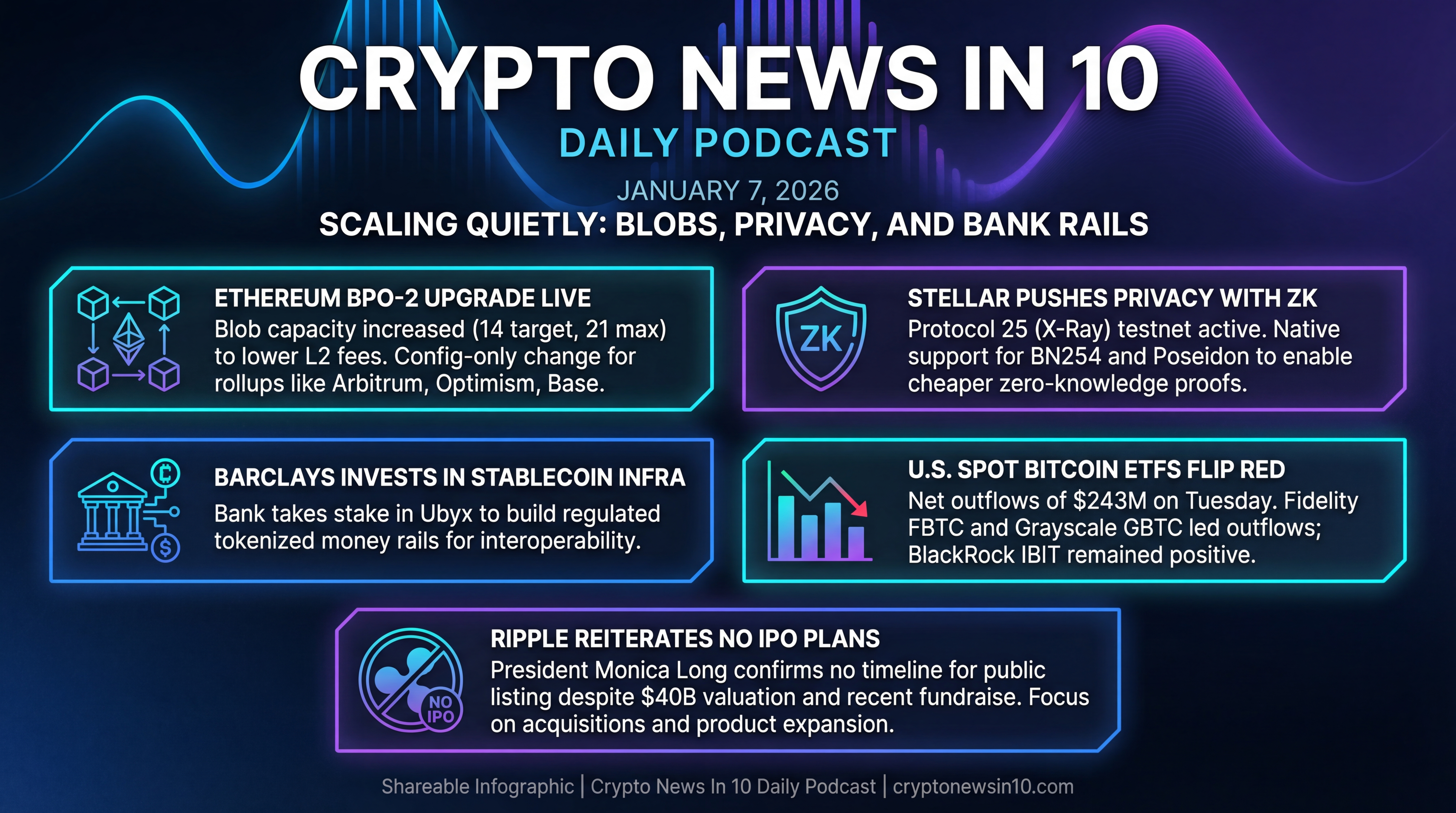
Episode Infographic
Show Notes
Welcome to our Crypto news in 10, a daily podcast bringing you the latest news about crypto in under 10 minutes.
It’s Wednesday, January 7th, 2026... Here’s what’s shaking in crypto today. Ethereum just turned up the throughput dial again. Stellar is pushing privacy into its smart contract stack. A major UK bank is buying into stablecoin infrastructure. U.S. spot bitcoin ETFs briefly flipped red. And Ripple says it’s still not going public — even after that hefty late 2025 raise. Let’s unpack five stories that matter, in about six minutes.
[BEGINNING_SPONSORS]
Story one... Ethereum’s second Blob Parameter Only upgrade — BPO-2 — hit mainnet overnight, right on schedule. The tweak raises the per-block blob target to 14 and the maximum to 21, widening the data lanes that layer-two rollups use to post transaction data. It’s a config-only change, but a meaningful one for fees and capacity on rollups like Arbitrum, Optimism, and Base.
The Ethereum Foundation’s Fusaka post set the activation for epoch 419,072 — January 7th at about 01:01 UTC — and documents the step up from last month’s BPO-1 to today’s 14 target and 21 max parameters. Translation... more room for L2s to breathe without a heavy hard fork, and another incremental step on the PeerDAS-powered scaling path.
Why it matters... Blobs are the cheapest way for layer twos to publish data to layer one, so bumping capacity should help stabilize — or even lower — rollup fees as demand surges. Because the change was pre-programmed in Fusaka, the network can ratchet throughput gradually, observe health, then decide on the next increase. If you’re building on an L2, watch gas dynamics over the next week to see how quickly the savings flow through.
Story two... Stellar is making a privacy play. Protocol 25 — nicknamed X-Ray — hits testnet today at 21:00 UTC, with a mainnet validator vote slated for January 22nd.
The upgrade adds native support in Soroban for BN two fifty four elliptic-curve operations and Poseidon hash functions — two workhorse primitives used across zero-knowledge systems. In plain English... verifying zero-knowledge proofs on Stellar gets faster and cheaper, unlocking private transfers, confidential business logic, and easier porting of ZK apps from ecosystems like Ethereum that rely on similar precompiles.
The Stellar Development Foundation laid out the dates and the technical scope, and it’s urging developers and infrastructure providers to update ahead of the votes.
If you’re a fintech or payroll platform eyeing on-chain settlement but needing confidentiality by default, this kind of under-the-hood capability reduces friction. It also dovetails with a broader 2026 narrative — privacy becoming a first-class feature, not an afterthought... we’ll come back to that.
Story three... a big bank just bought a ticket to the stablecoin plumbing layer. Barclays has taken a stake in Ubyx, a U.S. startup that clears and reconciles stablecoins and tokenized deposits across different issuers — think interoperability for regulated digital money. The bank didn’t disclose the size, but called it its first investment linked to stablecoins, and framed it as building tokenized money within the regulatory perimeter. Reuters reports Ubyx launched in 2025 and has backing from Coinbase Ventures and Galaxy’s venture arm.
It’s another data point that traditional finance isn’t just exploring tokenization of assets — they’re also investing in the cash leg that makes those tokenized markets settle cleanly. Barclays’ digital assets lead emphasized interoperability as critical infrastructure — exactly the kind of rails banks will need if tokenized cash and stablecoins are to plug into existing payment and securities workflows. Expect more banks to buy the picks and shovels before they issue anything themselves.
[MIDPOINT_SPONSORS]
Story four... after two strong opening sessions to 2026, U.S. spot bitcoin ETFs swung back to outflows on Tuesday. Net flows totaled negative $243 million, led by a $312 million outflow from Fidelity’s FBTC and $83 million from Grayscale’s GBTC. BlackRock’s IBIT was the lone bright spot, pulling in about $229 million and tallying roughly $888 million year to date. That’s according to The Block, citing SoSoValue for the daily breakdown.
Zoom out, and it looks more like a breather than a regime change — flows have been volatile around round numbers, and IBIT’s leadership among issuers is intact.
For traders... these ETF flows remain a useful tell for marginal demand. When outflows don’t cascade into spot selling, it suggests rotation among products and some resiliency in direct buying. Keep an eye on whether negative days cluster, or whether this was a one-off pause after early-year enthusiasm.
Story five... Ripple is staying private. In a Bloomberg interview aired Tuesday, President Monica Long reiterated there’s no plan — no timeline — for an IPO, even after a November fundraise that valued the company at about $40 billion and brought in roughly $500 million from investors including Fortress and Citadel affiliates.
The company says its balance sheet and strategic backing let it pursue acquisitions and product expansion — stablecoins, custody, prime brokerage — without tapping public markets right now. For XRP watchers, the signal is continuity: focus on payments and institutional infrastructure, not a 2026 listing.
Taken together... today’s threads rhyme. Ethereum quietly adds more data room for L2s. Stellar readies native ZK building blocks. A global bank buys into stablecoin plumbing. ETFs remind us flows can zig and zag. And one of crypto’s biggest private companies says it doesn’t need Wall Street access. If there’s a theme for early 2026, it’s pragmatic scaling and privacy moving center stage — less hype, more pipes.
Quick recap... Ethereum’s BPO-2 is live, lifting blob capacity to a 14 target and 21 max to help rollups scale. Stellar’s Protocol 25 testnet brings native ZK primitives ahead of a January 22 mainnet vote. Barclays took a stake in Ubyx to build regulated tokenized money rails. U.S. spot bitcoin ETFs logged about $243 million in net outflows Tuesday, with IBIT still pulling capital. And Ripple reiterated it has no IPO timeline despite a $40 billion valuation. We’ll be back tomorrow with the next round of signals from across crypto.
Thanks for listening and see you tommorow!
