
Privacy on Trial, Restaking Takes Center Stage
Vitalik weighs in on criminalizing code, Colombia turns up tax reporting, and a16z lays out 2026's utility-first thesis. Plus, a $26.6M Truebit exploit and a $170M ETH restaking bet on Linea.
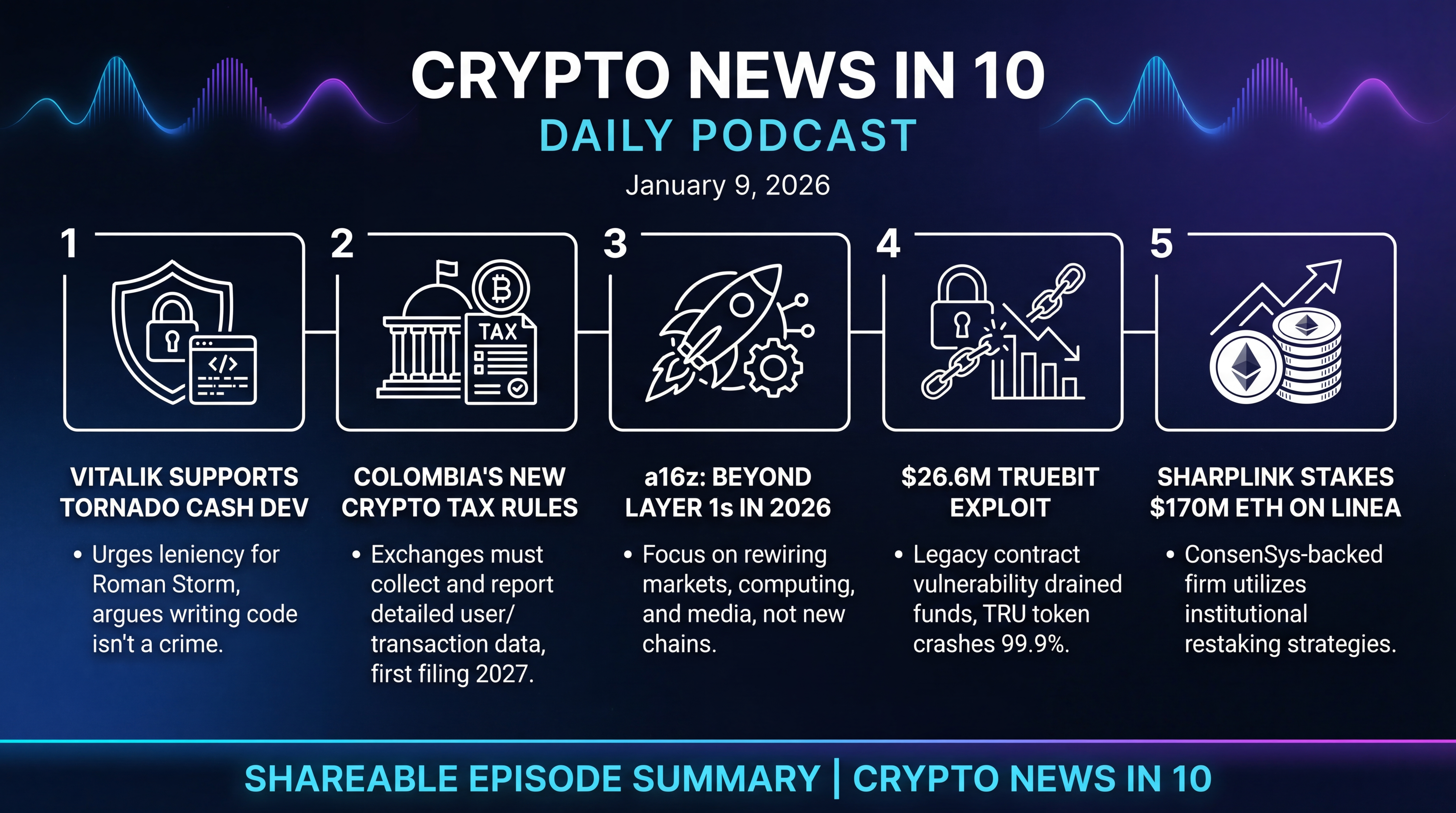
Episode Infographic
Show Notes
Welcome to our Crypto news in 10, a daily podcast bringing you the latest news about crypto in under 10 minutes.
Here’s your quick run-through of five crypto stories worth your time today — Friday, January 9, 2026.
First, Vitalik Buterin published a letter supporting Tornado Cash developer Roman Storm — arguing that punishing software authors is the wrong approach to privacy and security online.
Second, Colombia’s tax authority quietly flipped a big switch: exchanges serving Colombians now have to collect and report detailed user and transaction data, with the first comprehensive filing due in 2027 for this year’s activity.
Third, a16z crypto set the tone for 2026, saying the next phase isn’t about launching yet another Layer 1 or Layer 2 — it’s about how crypto rewires markets, computing, and media.
Fourth, a nasty exploit at Truebit drained about 26.6 million dollars and sent its token into a 99 point 9 percent tailspin.
And fifth, SharpLink — backed by ConsenSys — just staked 170 million dollars in ETH on Linea, showcasing how corporate ETH treasuries and restaking strategies are becoming a real pillar of the market.
[BEGINNING_SPONSORS]
Story one — Vitalik versus the criminalization of code.
In a letter published today, Ethereum co-founder Vitalik Buterin urged leniency — and, more importantly, clarity — in the case of Tornado Cash developer Roman Storm. Storm was convicted in August on a money-transmitting conspiracy count and faces up to five years.
He framed Storm’s work as building privacy tools that protect ordinary people, and argued that writing and publishing software should not, by itself, be treated like a crime.
The defense fund for Storm drew more than 6.3 million dollars last year, with contributions from Vitalik, the Ethereum Foundation, and other industry groups. Buterin’s wider point is simple: privacy tech is basic infrastructure in the digital era — not a niche cause. Source: The Block.
For context, a senior U.S. Justice Department official said last year that merely writing code without ill intent is not a crime — while emphasizing the DOJ will still pursue those who knowingly facilitate money laundering or sanctions evasion. And Tornado co-creator Alexey Pertsev received a 64-month sentence in the Netherlands in 2024 — underscoring how fractured global rules are right now. Expect this fight... what’s code, what’s conduct... to shape developer risk in 2026. Source: The Block.
Story two — Colombia tightens the tax net on crypto.
Under Resolution 000240, issued December 24, the national tax authority, DIAN, now requires exchanges and other platforms serving Colombian users — including foreign firms — to collect and report ownership details, volumes, number of units transferred, market value, and net balances for crypto transactions.
The first comprehensive report, covering calendar year 2026, is due by the last business day of May 2027. Noncompliance can trigger fines of up to one percent of the value of unreported transactions.
The move aligns with the OECD’s Crypto-Asset Reporting Framework and gives DIAN the data it needs to cross-check personal tax filings. For builders and exchanges in LatAm, this is a sign of the times... transparency mandates are arriving in force. Source: The Block.
Story three — a16z’s 2026 thesis: it’s not about new chains.
Andreessen Horowitz’s crypto arm says the industry’s next act won’t be scored by chain-counting. Instead, watch three fronts: markets — where prediction platforms and incentive design push skin in the game into more corners of the economy; computing — as cryptographic proofs and zero knowledge move into enterprise workflows; and media — as onchain ownership, payments, and distribution make content portable and programmable.
The common thread is utility that outlives hype cycles. Translation for founders: build for product-market fit and real-world integrations — not just throughput charts. Source: The Block.
[MIDPOINT_SPONSORS]
Story four — Truebit’s five-year-old contract comes back to bite.
The Ethereum computation protocol was hit for roughly 8,535 ETH — about 26.6 million dollars — after attackers exploited what researchers describe as a mispriced minting function in a legacy smart contract. Two actors appear to have been involved, with one netting the bulk of the haul.
The TRU token plunged from around 16 cents to fractions of a cent — down 99 point 9 percent — as the exploit rippled through liquidity. The team says it’s working with law enforcement. The broader lesson isn’t new, but it’s urgent: aging contracts are a growing attack surface, and the combination of automated exploit tooling and better reconnaissance means dormant bugs aren’t staying dormant for long. Source: The Block.
Story five — a 170 million dollar bet on Ethereum’s restaking stack.
ConsenSys-backed SharpLink deployed and staked 170 million dollars worth of ETH on Linea, ConsenSys’ Layer 2 — describing it as a first-of-its-kind enhanced-yield structure that layers native staking with restaking rewards and ecosystem incentives, with institutional-grade custody via Anchorage.
It’s part of a previously disclosed plan to allocate 200 million dollars across Linea and affiliated restaking partners. SharpLink’s ETH treasury has swelled into the high hundreds of thousands of ETH; the firm reported ongoing staking rewards and framed 2026 as Ethereum’s productive era.
Whether you love or loathe restaking, corporate treasuries tapping these stacked yields are now a real market force — and a risk vector that needs careful operations, custody, and risk management. Source: The Block.
That’s the lineup: Vitalik’s pushback on criminalizing code, Colombia’s new crypto reporting regime, a16z’s call to build for real-world impact, a hard lesson in smart contract longevity at Truebit, and a nine-figure institutional ETH deployment on Linea.
Keep an eye on the regulatory arc — from privacy cases to tax reporting — and on how corporate treasuries are quietly becoming power users of Ethereum’s yield stack. We’ll be back tomorrow with the next five stories you need to know.
Thanks for listening and see you tommorow!
