OCC Clarity, State Stablecoins, Raydium's Surge
Regulators move to clarify trust bank powers as Wyoming rolls out a state stablecoin and Rain raises $250M to bring crypto to everyday cards. Plus, Bitcoin cools under 90k while Solana's Raydium leapfrogs Uniswap in DEX volume.
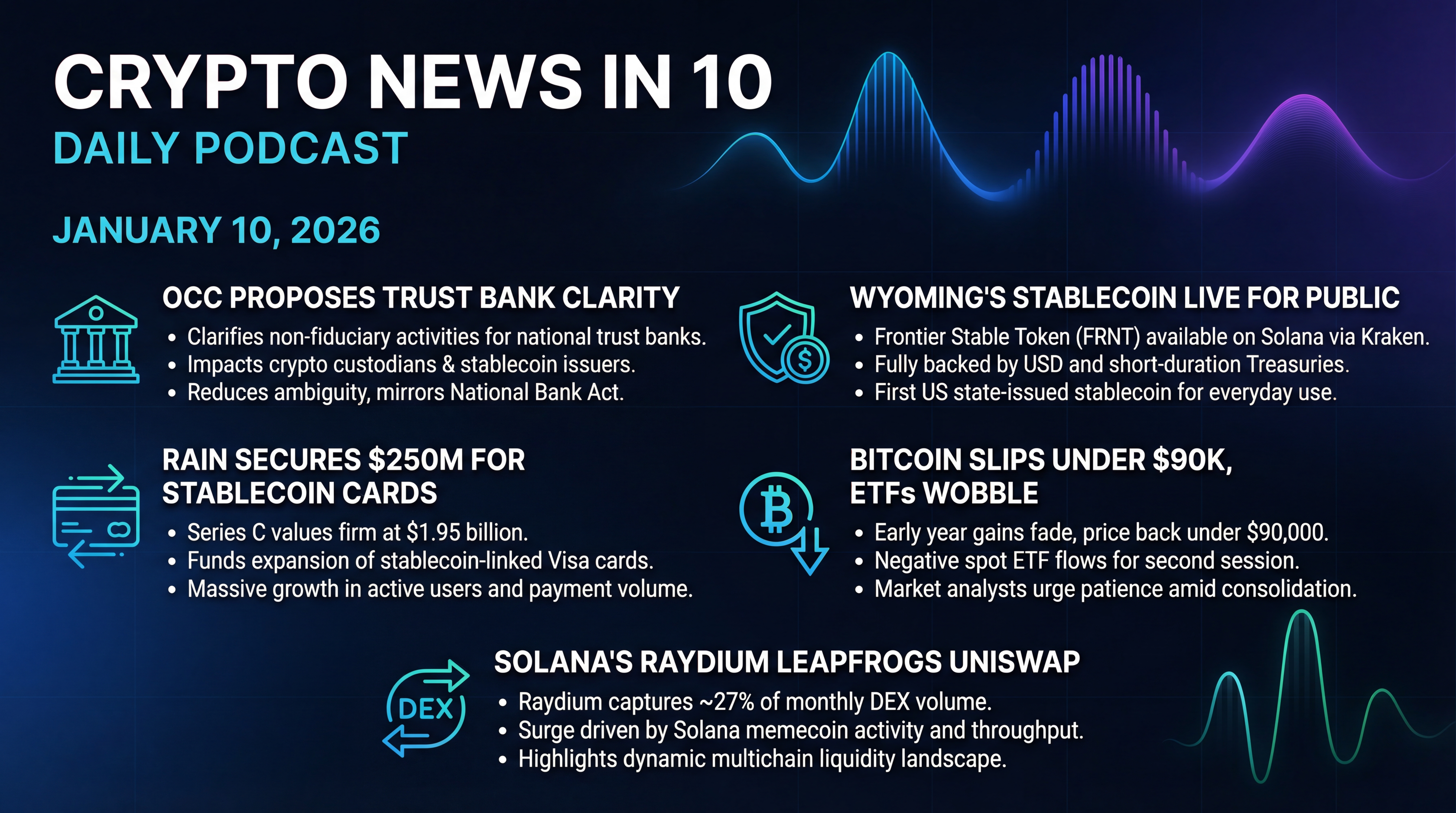
Episode Infographic
Show Notes
Welcome to our Crypto news in 10, a daily podcast bringing you the latest news about crypto in under 10 minutes.
It's Saturday, January tenth. Here's your quick tour of the crypto world...
U.S. bank regulators just moved to clarify what national trust banks can do — big news for crypto custodians and stablecoin issuers. Wyoming's government-issued stablecoin is now available to the public on major rails. A fast-growing stablecoin fintech called Rain just landed a quarter billion dollars. On the markets, Bitcoin gave back early-year gains, and in DeFi, Solana's Raydium just leapfrogged Uniswap on monthly volumes. Let's get into it.
[BEGINNING_SPONSORS]
Story one — the OCC quietly dropped a proposal this week that could have an outsized impact on crypto banking. The Office of the Comptroller of the Currency published a notice of proposed rulemaking on January eighth to clarify the longstanding authority of national banks limited to the operations of a trust company — the special-purpose charters many crypto custodians use — to also engage in non-fiduciary activities alongside fiduciary ones.
Translated: the OCC wants its chartering rule to mirror the National Bank Act language, replacing the narrow 'fiduciary activities' wording with 'the operations of a trust company and activities related thereto.' Comments are due 30 days after it hits the Federal Register.
Why it matters — crypto-focused trust banks, from institutional custody to stablecoin operations, have been operating in a gray area on what non-fiduciary services they can offer. Clarifying the scope could make it easier to launch compliant products without bespoke interpretive letters every time. The OCC stresses this does not expand its chartering power — it just eliminates ambiguity. Source: OCC bulletin.
Story two — Wyoming's state-issued stablecoin is now in the wild for everyday users. After piloting last year, the Frontier Stable Token — ticker FRNT — opened public access this week. Wyoming's program says FRNT is fully backed by U.S. dollars and short-duration Treasuries, and it's live on multiple chains.
Practically speaking, you can buy FRNT on Kraken via the Solana network, and spend or move it through Rain's Visa-integrated card platform on Avalanche. The broader design includes monthly attestations and a modest overcollateralization buffer, with infrastructure partners like LayerZero and Franklin managing key pieces. The punchline — this is the first U.S. state government to offer a dollar stablecoin at scale... a live experiment in public-sector digital money with auditable reserves and real payment rails. Source: PaymentsJournal.
Story three — speaking of payments, Rain just raised serious capital to chase stablecoin-powered cards and wallets. Reuters reports the company closed a 250 million dollar Series C led by ICONIQ, valuing Rain at about 1.95 billion dollars. Management says its active card base grew thirty times in the last year, and annualized payment volume climbed thirty-eight times, as businesses issued stablecoin-linked cards that work at traditional merchants via Visa's network.
Proceeds will fund new markets and enterprise launches, with a blue-chip investor list that includes Sapphire Ventures, Dragonfly, Bessemer, Galaxy, FirstMark, Lightspeed, Norwest, and Endeavor Catalyst. The takeaway — stablecoins are not just crypto-to-crypto liquidity anymore — they're becoming the settlement layer behind familiar card experiences, and capital is racing to firms that can bridge those worlds compliantly. Source: Reuters.
[MIDPOINT_SPONSORS]
Story four — markets. Bitcoin's early January pop faded, with the price slipping back under the 90,000-dollar level after nearly tagging 95,000 earlier in the week. The Block notes that after roughly 1.2 billion dollars of net inflows into spot bitcoin ETFs in the first two trading days of the year, flows turned negative for a second straight session — a reminder that macro and positioning still matter.
Analysts cited overhead resistance, a cautious derivatives posture, and the lingering need to rebuild market conviction after 2025's choppiness. If you're watching the tape, some are eyeing CME futures gaps and short-term areas around prior support as magnet levels — but for now... patience remains the theme. Source: The Block.
Story five — a changing of the DEX guard, at least for January's run rate. Solana-based Raydium grabbed roughly 27 percent of all decentralized exchange volume last month, topping Uniswap's about 22 percent, with PancakeSwap near 17 percent. The Block's data team attributes Raydium's surge to a wave of memecoin-led trading activity and heavy throughput on Solana. In raw terms, Solana DEXs processed eye-popping traffic — with Raydium, Orca, and Meteora all contributing.
Why it matters — market share is not a verdict on long-term quality, but it is a snapshot of where liquidity and developer energy are clustering. If you build or trade on DEXs, this is a signal that multichain liquidity is more dynamic than ever, and that blockspace economics — fees, latency, MEV — are actively reshaping user behavior month to month. Source: The Block.
Quick context to tie it together... The OCC's proposed trust bank clarification could lower legal friction for national trust banks that handle crypto custody, token administration, or stablecoin treasury functions — exactly the kinds of services Wyoming's FRNT and private players like Rain will lean on as they scale. Meanwhile, the trading side continues to shift toward chains and venues that can clear retail mania without clogging — hence Raydium's moment. And price-wise, Bitcoin's stall does not negate the structural trend toward regulated rails and real-world payment utility — it just reminds us that market cycles and infrastructure cycles do not move in lockstep. Source: OCC bulletin.
That's the rundown — the OCC nudges clarity for trust-chartered banks, Wyoming's government dollar token opens to the public, Rain raises 250 million dollars to bring stablecoin cards to everyday commerce, Bitcoin cools under 90,000 dollars as ETF flows wobble, and Raydium edges Uniswap in January DEX share. Keep your eyes on the Federal Register for the OCC comment window, on-chain for FRNT liquidity and flows, and on ETF data for the next sentiment shift.
Thanks for listening and see you tommorow!
