
Banks Go On-Chain, Ripple’s UK Greenlight
BNY Mellon debuts tokenized deposits, and Ripple secures UK permissions as Britain maps its crypto regime. Plus Uniswap’s browser wallet lands, Russia blocks OKX, and Tennessee targets sports prediction markets.
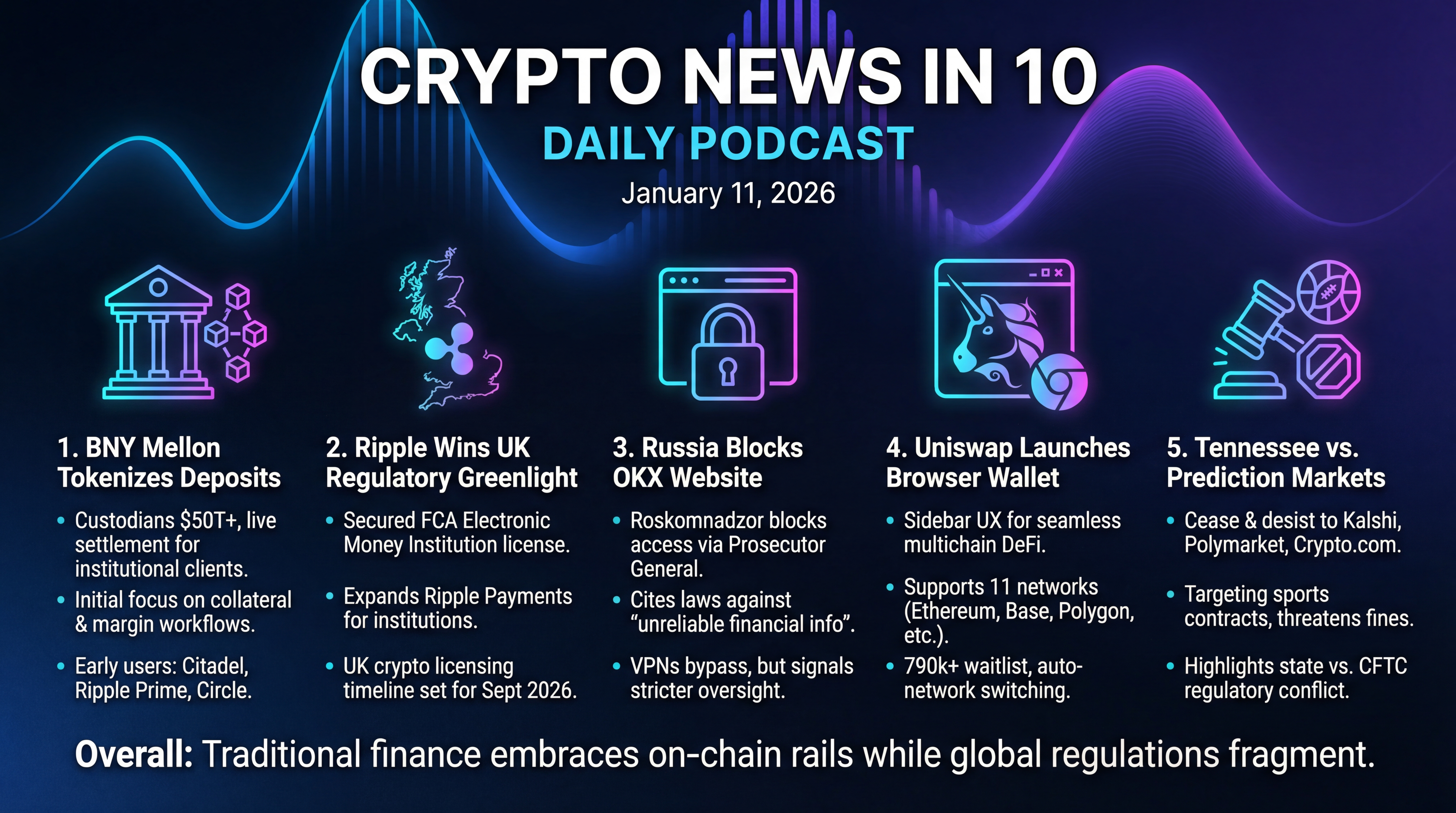
Episode Infographic
Show Notes
Welcome to our Crypto news in 10, a daily podcast bringing you the latest news about crypto in under 10 minutes.
Here’s what’s moving the crypto world on Sunday, January 11, 2026... A major Wall Street bank tokenizes deposits for live settlement. Ripple wins fresh regulatory permissions in the UK as Britain sketches its crypto licensing timeline. Russia blocks access to a top exchange’s website. Uniswap finally ships its long-awaited browser wallet to the masses. And Tennessee tells prediction markets to shut down sports contracts or face penalties. Let’s get into it.
[BEGINNING_SPONSORS]
First up, banks are putting cash on chain.
BNY Mellon — custodian to more than fifty trillion dollars in assets — has switched on a tokenized deposit capability for institutional clients. In practice, it mirrors a client’s demand deposits as entries on BNY’s permissioned ledger, initially for collateral and margin workflows. The goal is programmable, near real time movement with fewer bottlenecks, while the legal balances still sit on traditional ledgers.
Early participants include Intercontinental Exchange, Citadel Securities, D R W, Baillie Gifford, Ripple Prime, and Circle. The bank is emphasizing an always on model that keeps compliance and controls intact. As BNY’s product leadership puts it, this is about extending trusted bank deposits onto digital rails to speed payments and collateral — without leaving a bank grade framework. This lands as peers like J.P. Morgan and HSBC push similar rails, accelerating a clear, bank led digital cash trend.
Here’s why it matters — tokenized deposits differ from stablecoins. They’re direct liabilities of the issuing bank, which can make risk, accounting, and settlement rules more straightforward for institutions. If pilots graduate to 24/7 operations, intraday liquidity and collateral cycles could shorten dramatically across clearinghouses and prime brokerage... an infrastructure shift as important as any token price move.
Second, Ripple just picked up a regulatory win in London.
The company secured UK Financial Conduct Authority permissions — an Electronic Money Institution license, and a cryptoasset registration — allowing Ripple to scale its Ripple Payments offering for institutions in Britain. Ripple says it will manage the flow of funds and abstract blockchain complexity for clients pursuing cross border payouts, with leadership calling this “more than efficiency,” aiming to unlock faster movement of value across regulated corridors.
Importantly, the FCA also laid out a timeline. It expects to open a formal gateway for crypto firms to apply for full authorization in September 2026, ahead of a new regime slated for October 2027. So, for companies eyeing UK expansion, the path — and the clock — are clearer today than a week ago.
One nuance worth flagging: early UK permissions focus on institutional rails and A M L and K Y C compliance. Some consumer facing e-money activities have tighter limits today and may require further authorizations as the regime matures. Still, for X R P’s enterprise use case — as bridge liquidity where it’s efficient — this is a meaningful operational foothold in a G7 market.
Third, geopolitics meets market access.
Russia’s internet regulator, Roskomnadzor, has blocked the website of O K X at the request of the Prosecutor General’s Office, citing laws used to restrict sites over alleged unreliable financial information or threats to financial organizations. The block targets web access inside Russia — VPNs can still route around it — but it underscores how quickly national controls can impact exchange reach. Similar blocks have been reversed before via local courts, yet the immediate effect is user friction and a signal of stricter oversight. O K X hasn’t commented.
[MIDPOINT_SPONSORS]
Fourth, a product launch people have been waiting on since the waitlist exploded.
Uniswap Labs publicly rolled out its wallet browser extension on Chrome. The twist is the UX — the wallet lives in your browser’s sidebar, so you can swap, sign, and send without a pop up chasing you across tabs. It supports 11 networks out of the box: Ethereum, Base, Arbitrum, Optimism, Polygon, B N B Chain, Avalanche, Z K Sync, Blast, Zora Network, and Celo. Uniswap says more than 790,000 users had joined the waitlist ahead of general availability. For desktop DeFi users who juggle multiple chains, the auto network switching and unified asset view are the big draws.
Security wise, Uniswap points to audits and a self custody model. The extension uses the same recovery phrase and QR import flows the mobile app offers, and support docs are live if you’re moving over from another wallet. It’s a notable push to make multichain self custody feel less like a browser gymnastics routine.
And fifth, the prediction markets saga keeps evolving state by state.
Tennessee’s Sports Wagering Council sent cease and desist letters to Kalshi, Polymarket, and Crypto.com’s North American Derivatives Exchange, ordering them to stop offering sports event contracts to state residents, void pending contracts, and refund deposits by January 31. The letters threaten escalating fines — ten to twenty five thousand dollars per offense — injunctions, and potential criminal referrals if platforms don’t comply. It’s the first publicly known state level cease and desist targeting Polymarket since its U.S. relaunch, and it tees up the federal preemption question. These venues argue that C F T C oversight of event based derivatives should preempt state gambling law... a stance already producing mixed results in court. Lawsuits are likely.
Taken together, today’s slate shows two parallel tracks.
On one track, traditional finance is wiring itself into crypto rails — BNY’s tokenized deposits, Ripple’s UK permissions, and even consumer UX upgrades like Uniswap’s extension. On the other, jurisdictional fault lines are still very active — Russia’s block of O K X, and Tennessee’s aggressive stance on prediction markets. Expect more of both in 2026: more banks turning cash into code... and more regulators drawing lines over who can offer what, where, and to whom.
That’s it for today — banks tokenizing money, Ripple’s UK runway, O K X’s access squeeze in Russia, Uniswap’s desktop wallet for 11 chains, and Tennessee turning up the heat on sports prediction markets. We’ll keep tracking how the institutional buildout and the regulatory chess match shape crypto’s next leg.
Thanks for listening and see you tommorow!
