
Quantum-Safe Ethereum, Tether Freeze, Policy Push
Vitalik Buterin outlines a 'walkaway test' for a quantum-safe, self-sustaining Ethereum as Tether freezes $182 million on Tron. We break down $454 million in ETP outflows, a tight U.S. policy window, and Dubai’s new token rules — and what they signal for crypto’s next moves.
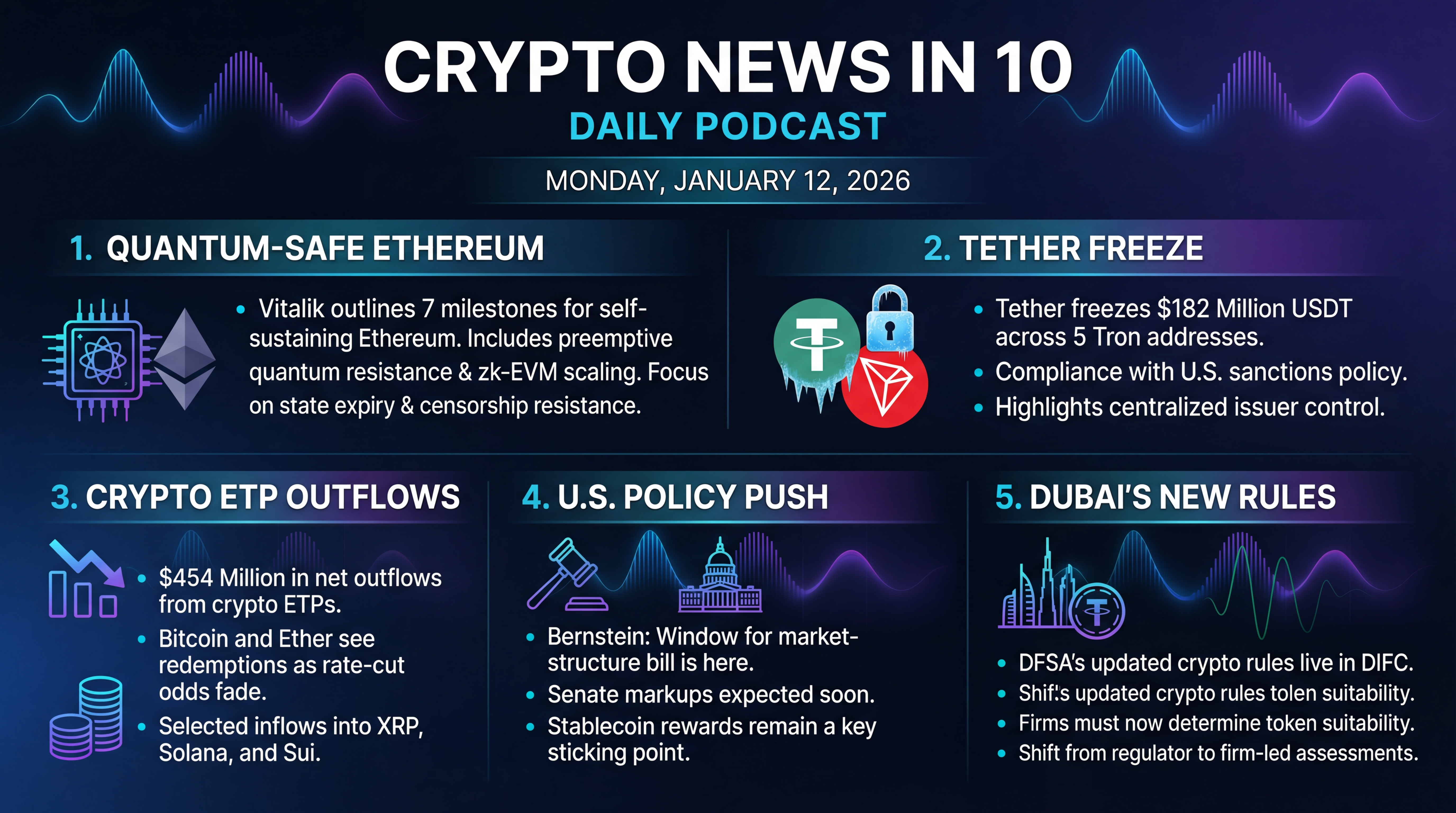
Episode Infographic
Show Notes
Welcome to our Crypto news in 10, a daily podcast bringing you the latest news about crypto in under 10 minutes.
Here’s what’s moving the crypto world on Monday, January 12, 2026... Vitalik Buterin just laid out seven milestones he says Ethereum needs to be truly self-sustaining — and quantum-safe. Tether froze 182 million dollars in USDT on Tron in a single day. CoinShares reports 454 million dollars in outflows from crypto exchange-traded products last week, as traders reassessed rate-cut odds. On policy, Bernstein says the U.S. market-structure bill’s window is here and now — but stablecoin rewards are a sticking point. And in Dubai, the DFSA’s updated crypto token rules kick in, shifting token vetting onto firms themselves. Let’s dive in.
[BEGINNING_SPONSORS]
First up, Vitalik Buterin’s “walkaway test” for Ethereum. In a new post, he argues the network should reach a point where the base protocol could run for a century — even if core developers stepped away.
He outlines seven requirements. One, preemptive quantum resistance. Two, scaling to thousands of transactions per second using ZK-EVM validation and PeerDAS. Three, statelessness and state expiry to keep the chain lean. Four, full account abstraction beyond ECDSA. Five, a denial-of-service resistant gas schedule. Six, long-term, healthy proof-of-stake economics. And seven, censorship-resistant block building.
Put together, it’s a roadmap toward ossification — fewer hard forks, more parameter tweaks — once those boxes are checked. If you’re tracking Ethereum’s long-term security, the headline is clear: build in quantum safety early, not at the last minute.
Second, Tether just executed one of its largest one-day freezes in months — over 182 million dollars in USDT across five Tron addresses, with individual wallets ranging from roughly 12 million to about 50 million. The company has a voluntary wallet-freezing policy, formalized in late 2023 to comply with U.S. sanctions, and it routinely cooperates with law enforcement.
Critics say moves like this prove fiat-backed stablecoins come with an issuer kill switch. Defenders argue it’s exactly what regulators expect. Either way, it’s a real-world example of how centralized stablecoins differ from fully permissionless assets.
Third, flows turned south. CoinShares says digital-asset exchange-traded products posted 454 million dollars of net outflows last week — a four-day run that almost erased early-year gains. Bitcoin products saw about 405 million out, ether about 116 million — yet there was selective risk appetite, with inflows into funds tied to XRP, Solana, and Sui.
Geographically, the U.S. led redemptions at roughly 569 million, while Germany, Canada, and Switzerland saw modest inflows. The driver, according to CoinShares’ James Butterfill: fading odds of a March Fed rate cut after hotter-than-expected economic data. Flows matter... and macro still sets the rhythm.
[MIDPOINT_SPONSORS]
Fourth, policy momentum — or a narrow window. Bernstein tells clients the opportunity to pass a U.S. crypto market-structure bill is here and now, with Senate markups expected soon and the administration aiming to get this done by the end of Q1.
The fault line to watch is stablecoin rewards. After last year’s law barred issuers from paying yield directly, banks are pushing to restrict crypto platforms from sharing rewards on customer stablecoin balances. Exchanges counter that reopening the issue undermines the compromise — and stifles competition. If Congress can’t bridge that gap, Bernstein warns, the whole package could slip.
Fifth, new rules take effect today in Dubai’s financial free zone. The DFSA’s updated crypto token framework for the Dubai International Financial Centre is now live. The headline change is big: firms — not the regulator — must determine and document whether a token meets suitability criteria.
That means the DFSA is retiring its official “recognized token” list, replacing it with firm-led assessments alongside enhanced investor safeguards, refined conduct and custody requirements, and proportionate reporting. For teams operating in the DIFC, it’s more flexibility — and more responsibility.
Quick recap... Vitalik set a high bar for when Ethereum can walk away from frequent base-layer upgrades — century-scale quantum safety included. Tether froze 182 million in USDT on Tron in a single day, underscoring the compliance levers built into centralized stablecoins. CoinShares tallied 454 million in weekly outflows from crypto ETPs as markets cooled on near-term rate cuts. Bernstein says the U.S. market-structure bill’s moment is now — but stablecoin rewards could be the snag. And in Dubai’s DIFC, the DFSA’s revamped token regime is officially in force, pushing token suitability assessments onto firms.
We’ll keep watching how these stories evolve over the week.
Thanks for listening and see you tommorow!
