Stablecoin Pilots, ETF Surge, Ripple’s EU Push
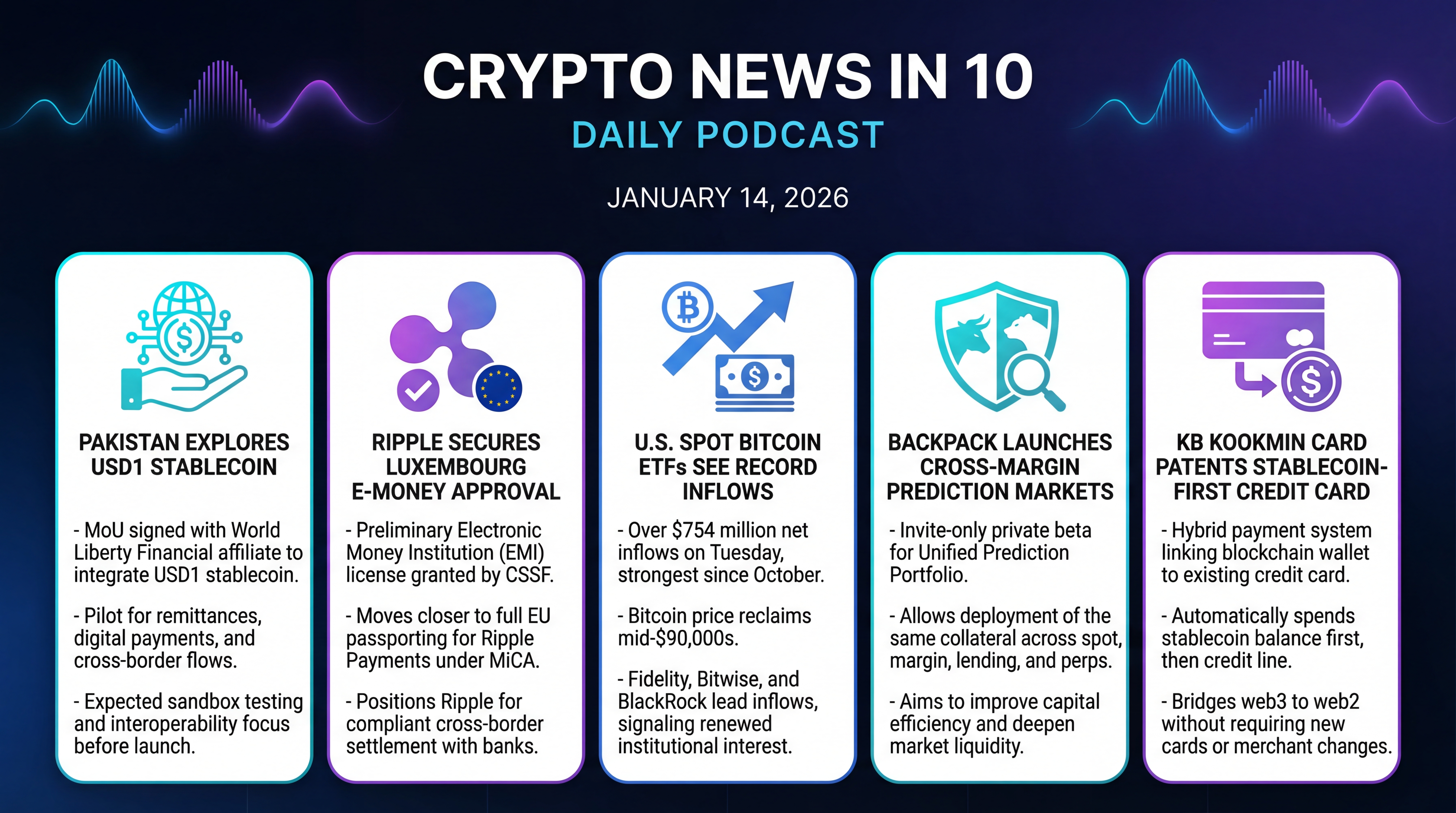
Pakistan explores a USD-pegged stablecoin, Ripple secures preliminary EMI approval in Luxembourg, and U.S. spot bitcoin ETFs notch their strongest inflows in three months. Plus, Backpack debuts cross-margined prediction markets and KB Kookmin Card patents a stablecoin-first credit card.
Episode Infographic
Show Notes
Welcome to our Crypto news in 10, a daily podcast bringing you the latest news about crypto in under 10 minutes.
Here’s what’s moving the crypto world on Wednesday, January 14, 2026.
Pakistan just signed a memorandum of understanding to explore a dollar-pegged stablecoin for remittances and digital payments. Ripple notched fresh regulatory progress in Europe with preliminary electronic-money approval in Luxembourg. In markets, U.S. spot bitcoin ETFs saw their biggest single-day net inflows in three months as bitcoin popped back above 95,000. On the product front, Backpack opened a private beta for cross-margined prediction markets. And in Asia, South Korea’s KB Kookmin Card filed a patent for a stablecoin-linked credit card that spends your digital dollars first — and your credit line second.
Let’s break it down.
[BEGINNING_SPONSORS]
Story one: Pakistan and USD1.
Pakistan’s Ministry of Finance and its new Virtual Asset Regulatory Authority signed a memorandum of understanding with SC Financial Technologies — an affiliate of World Liberty Financial — to explore integrating the USD1 stablecoin into a regulated payments framework.
The pilot would put USD1 alongside Pakistan’s central bank digital currency rails — for cross-border flows and domestic use. The signing coincided with a visit by World Liberty Financial CEO Zach Witkoff, who met senior stakeholders in Islamabad.
It’s one of the first state-level tie-ups for the Trump-family-linked venture, and it underscores how stablecoins are being evaluated for remittances and foreign-exchange efficiency in emerging markets.
Pakistan framed the agreement as a technical understanding phase rather than a launch — so expect sandbox work, interoperability testing, and guardrails before real money moves. Reuters first reported the deal, and Pakistan’s regulator published photos of the signing.
A quick bit of context... last week, World Liberty Financial said a subsidiary applied to the U.S. OCC for a national trust bank focused on issuing and redeeming USD1 — a move that, if approved, could bolster its compliance posture for partnerships like this. For now, Pakistan’s exploration is early — but it’s notable that a major remittance market is publicly kicking the tires on a U.S.-linked stablecoin.
Story two: Ripple’s EU runway just lengthened.
Ripple says it has secured preliminary approval for an Electronic Money Institution license in Luxembourg from the CSSF — a Green Light Letter that moves it closer to full authorization. The company says it now holds more than 75 licenses globally and intends to use the EMI to scale Ripple Payments across the European Union, riding the clarity of MiCA.
Ripple also highlighted operational scale — covering over ninety percent of daily FX markets and more than 95 billion dollars processed to date — positioning the firm to serve banks that want always-on cross-border settlement without wrestling with blockchain plumbing themselves. This Luxembourg nod lands just days after Ripple’s EMI license and cryptoasset registration in the U.K., suggesting a coordinated European push for 2026.
One practical takeaway: with Luxembourg recognized as a finance hub — and the CSSF now the MiCA competent authority — this preliminary approval sets up EU passporting options once full authorization lands. That’s useful for banks and payment service providers that want one compliant counterparty for digital-asset-enabled payouts across the bloc.
Story three: flows are back.
U.S. spot bitcoin ETFs logged about 754 million dollars in net inflows on Tuesday — the strongest day since early October. Fidelity’s FBTC led with roughly 351 million, Bitwise’s BITB took in about 159 million, and BlackRock’s IBIT added around 126 million, according to third-party tallies.
The risk-on tone helped bitcoin reclaim the mid-90,000s, with majors firming as well. For ETF watchers, that three-month high in daily net buying hints that year-end de-risking may be fading — and institutions are redeploying.
Price check while we’re here: bitcoin traded back above 95,000 earlier today as optimism around regulation and macro data supported sentiment. It’s still below the October all-time high... but a few strong ETF days can change positioning quickly.
[MIDPOINT_SPONSORS]
Story four: Backpack’s prediction markets — reimagined with cross-margin.
The exchange — which has been building a vertically integrated stack across spot, perps, and lending — opened an invite-only private beta for its Unified Prediction Portfolio.
The idea is simple: prediction markets typically wall off capital until an event settles. Backpack says it fixes that by letting traders deploy the same collateral across spot, spot-margin, lending, perps, and predictions — all inside one risk engine and one subaccount.
CEO Armani Ferrante framed it this way: prediction markets are inefficient because capital gets stuck. Cross-collateralization aims to unlock that, so you can place a bet, hedge it with perps, and keep other positions alive — without fragmenting balances. Early access will go to active users as the team tests the risk model before a broader rollout.
The company teased the launch on social channels and community forums, emphasizing it’s a native Backpack system — not a wrapper over existing venues. Keeping order flow, collateral, and risk management in one venue could deepen liquidity for markets on crypto events... and eventually on macro and sports, if permitted in the relevant jurisdictions.
Story five: swipe your stablecoins — literally.
South Korea’s KB Kookmin Card, part of the country’s largest financial group, filed a patent for a hybrid payment system that links a blockchain wallet to an existing credit card. At checkout, the system would first deduct from your stablecoin balance; if it’s short, the rest automatically routes to your standard credit line — no new card issued, same rewards and protections.
The pitch is to slide stablecoins into familiar card rails without retraining consumers or rebuilding merchant acceptance. For issuers, it’s a way to test real-world stablecoin spend while preserving interchange economics and chargeback frameworks.
If the patent moves forward, watch two things: how South Korea’s evolving stablecoin rules treat on-card conversions — and how issuers manage FX, settlement timing, and any volatility between wallet balances and card clearing. The direction is clear... bridging web3 money to web2 rails is a 2026 theme.
That’s a wrap for today’s rundown.
We saw a sovereign explore a U.S.-linked stablecoin for cross-border payments, Ripple secure a key EU approval, ETFs flash a three-month inflow high, Backpack push prediction markets into a cross-margined stack, and a top Korean card issuer prototype a stablecoin-first swipe. Big picture... stablecoins and institutional rails are converging, and product teams are re-tooling capital efficiency across the board. We’ll keep tracking what ships next — and how it hits your portfolio.
Thanks for listening and see you tommorow!
