
Policy Paused, Payments Tokenize, Chains Speed Up
Markets digest a Senate pause on a key U.S. crypto bill as the BIS moves tokenized wholesale payments into live bank testing, BNB Chain accelerates blocks, India tightens KYC, and Robinhood pressures Congress on staking. We connect the rails, the rules, and the real-world impact for investors and builders.
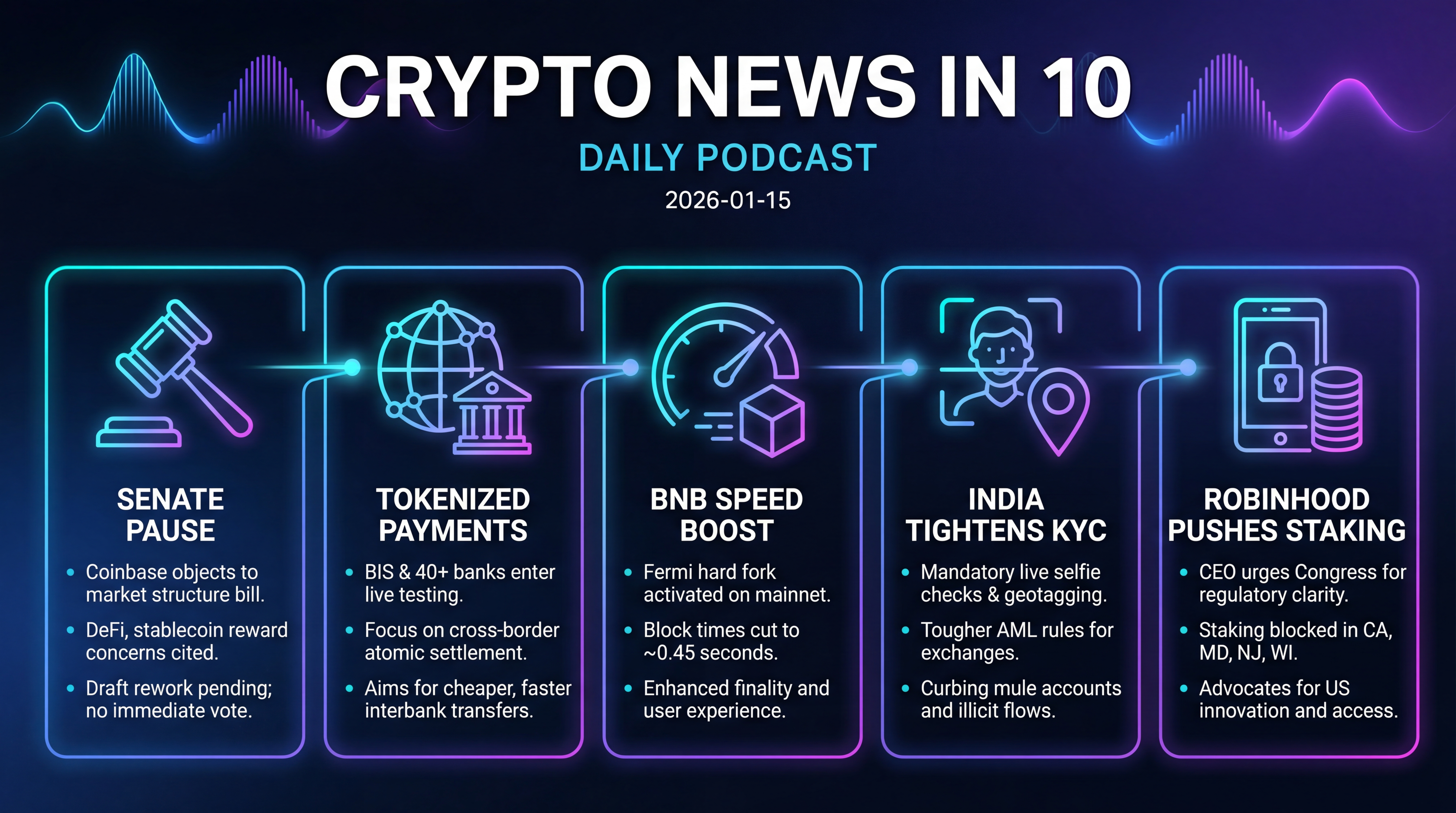
Episode Infographic
Show Notes
Welcome to our Crypto news in 10, a daily podcast bringing you the latest news about crypto in under 10 minutes.
It’s Thursday, January fifteenth. Here’s your quick map of the crypto landscape today: a Senate pause on the most-watched U.S. market structure bill after a last-minute broadside from Coinbase... the Bank for International Settlements shifts a major cross-border tokenized payments project into live bank testing... BNB Chain speeds up block production with the Fermi hard fork... India tightens exchange onboarding with live selfie checks and geotagging... and Robinhood’s CEO leans on lawmakers as staking remains unavailable in four U.S. states. Let’s unpack what matters — and why.
[BEGINNING_SPONSORS]
Story one — the Senate hit pause. Just hours before a scheduled session, the Senate Banking Committee postponed discussion of a draft crypto market structure bill after Coinbase CEO Brian Armstrong said the company cannot support the bill in its current form.
The draft aims to clarify when tokens are securities versus commodities and to give the CFTC explicit authority over spot markets — a long-standing industry ask. But Armstrong warned of unintended consequences: a de facto ban on tokenized equities, heavy limits on DeFi, and curbs on stablecoin rewards.
Committee chair Tim Scott called the delay a brief, good-faith pause to keep negotiations moving. The details are still fluid, but two design choices are already drawing heat — first, language that restricts interest paid merely for holding stablecoins, while still permitting certain customer incentives... and second, where to draw the line between the SEC and the CFTC as assets evolve.
Markets wobbled on the headline, then stabilized as traders bet a revised draft will re-emerge later this month. Near-term takeaway: no breakdown, but no green light yet. Sources: Reuters and Barron’s.
Why this matters: if the Senate lands durable guardrails on custody, token listings, and stablecoins, it could unlock larger pools of U.S. institutional capital. If it overreaches — or stalls — expect the status quo: regulation by guidance and a state-by-state patchwork.
Story two — wholesale payments go tokenized, at scale. The Bank for International Settlements says top central banks, working with more than forty global banks, have moved the Agora project into a new user-testing phase — aimed at real cross-border atomic settlement.
Unlike retail CBDCs, Agora targets interbank pipes — think bank-to-bank settlement with programmable cash and tokenized assets. Participants include authorities from the U.S., Europe, Korea, Mexico, and Japan, with the Institute of International Finance coordinating bank involvement, and SWIFT exploring interoperability hooks. The test window runs about six months. The goal is cheaper, faster settlement without ripping out today’s risk controls. Source: Reuters.
A quick connection: this dovetails with last month’s SEC no-action letter letting DTCC pilot tokenization of DTC-custodied assets — stocks, ETFs, and Treasuries — later this year. If market plumbing and post-trade tokenization move together, we get end-to-end programmability... not just wrapped assets on islands. Sources: DTCC and Morgan Lewis.
Story three — speed boost on BNB Chain. The Fermi hard fork activated on mainnet and shortened block times from about three quarters of a second to roughly 0.45 seconds. It also tightened finality rules and smoothed execution under load. Validators were told to upgrade to version 1.6.4 or later ahead of activation.
The aim isn’t bigger blocks — it’s lower latency, steadier confirmations, and better UX for time-sensitive apps like decentralized exchanges, liquidations, and payments. If the network holds steady under real-world traffic, you should see fewer hiccups during peak memecoin and perpetual trading rushes. Source: BNB Chain’s official blog.
Zooming out on these first three stories: Washington’s rulebook — still to be finalized — will decide who can list what, while the BIS and DTCC are laying the rails for tokenized value to move like the internet. And layer-ones are racing to make that experience feel instantaneous.
[MIDPOINT_SPONSORS]
Story four — new KYC muscle in India. The Financial Intelligence Unit rolled out tougher AML and onboarding norms for exchanges — effective January eighth — requiring live selfie verification and collection of users’ geolocation during sign-up.
The objective: curb mule accounts, tighten identity assurance, and give investigators stronger, standardized data trails when they chase laundering or terror-finance cases. For Indian users, that means more friction at account creation — but also a clearer path for banks and payment partners to support compliant platforms. Sources: Times of India and Economic Times.
This pushes India closer to the OECD’s Crypto-Asset Reporting Framework momentum we’ve seen in the U.K., and increasingly in Nigeria’s new identity-linked tax reporting approach — another sign 2026 is the year of formal reporting pipes for crypto, not just voluntary disclosures. Source: Nigeria CommunicationsWeek and related coverage.
Story five — Robinhood’s Vlad Tenev to Congress: let the U.S. lead. Tenev says staking is one of the most requested features on Robinhood, yet it’s still blocked for customers in four states — California, Maryland, New Jersey, and Wisconsin — due to ongoing regulatory gridlock.
He also contrasted the firm’s EU rollout of stock tokens with the lack of a U.S. pathway, arguing Congress needs to finish a market structure bill that supports innovation without sacrificing consumer protection. For context, Robinhood’s help center confirms the state-by-state staking limits today. Sources: CoinCentral and Robinhood’s published guidance.
Here’s how to think about it: pressure is rising from two ends — central banks and market infrastructures are moving forward with tokenization and atomic settlement, while retail-facing platforms are asking for rules of the road so they can ship features evenly across the U.S. Without a federal framework, you get uneven access — and capital follows the path of least resistance offshore.
Quick recap: the Senate’s crypto bill isn’t dead — it’s being reworked after Coinbase’s pushback. The BIS’s Agora test brings atomic settlement a step closer to production. BNB Chain just shaved block times under half a second. India tightened KYC with live selfies and geotags. And Robinhood’s CEO put fresh public pressure on lawmakers as staking remains blocked in four states.
Net-net... the pipes are getting faster, the institutions are getting braver, and regulators are finally standardizing the paperwork. Now it’s on Congress to catch up.
Thanks for listening and see you tommorow!
