Quantum Fears, Tokenized Finance, Solana’s Five-Hour Pause
A Wall Street strategist dumps Bitcoin over quantum concerns as State Street goes live with a tokenized asset platform. We break down Solana’s latest outage, the U.K.’s CARF rollout, and new research tightening Bitcoin’s security proofs.
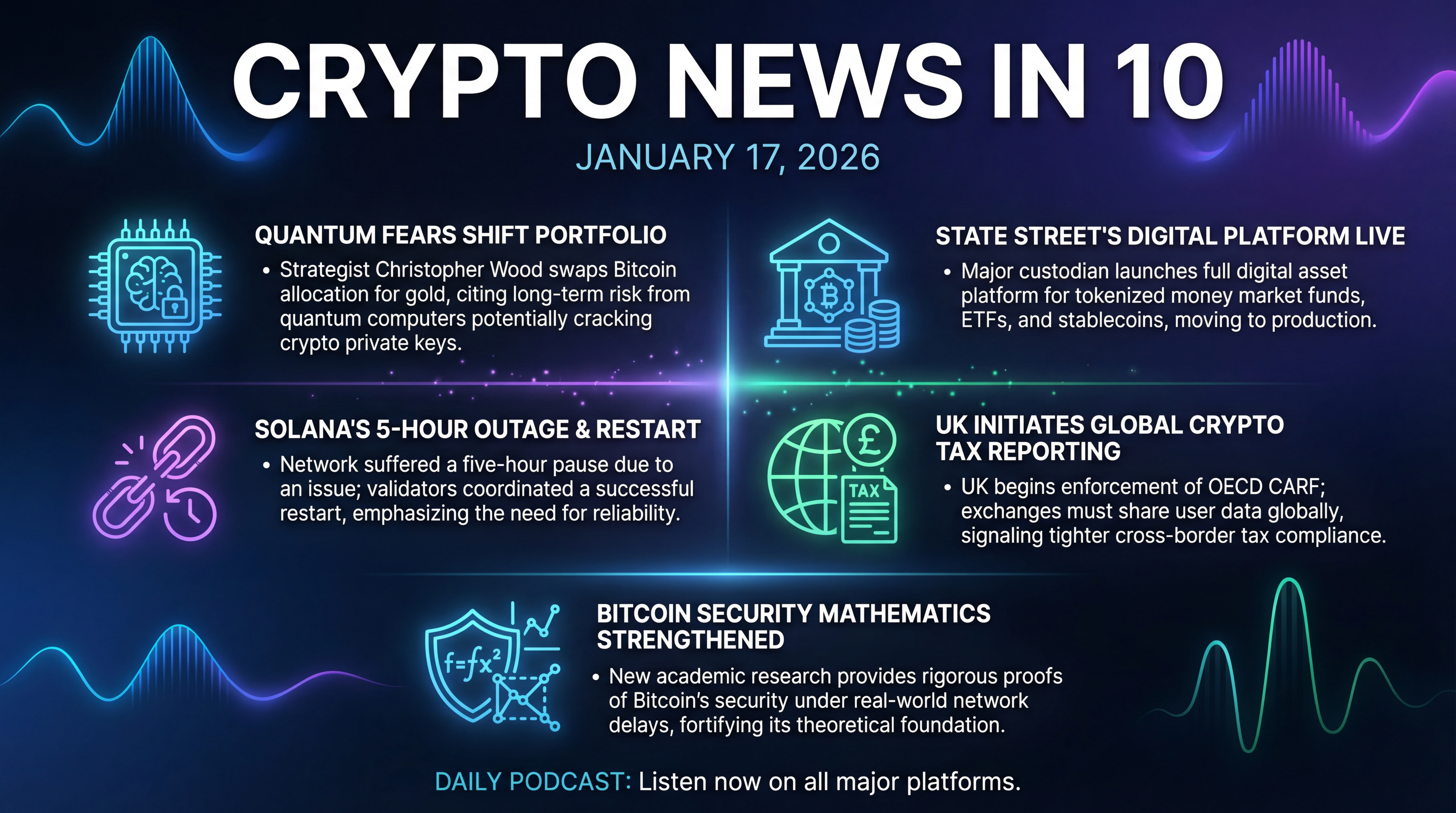
Episode Infographic
Show Notes
Welcome to our Crypto news in 10, a daily podcast bringing you the latest news about crypto in under 10 minutes.
Here’s a quick tour of today’s biggest crypto stories. A well known Wall Street strategist just yanked Bitcoin from his model portfolio, warning that quantum computers could eventually crack today’s crypto. State Street, a custody giant with more than fifty trillion dollars under administration, is moving from pilots to production with a full digital asset platform for tokenized money market funds, ETFs, deposits, and even stablecoins. Solana endured a five hour outage, then restarted — we’ve got the key takeaways. The U.K. switched on the OECD’s global tax reporting regime for crypto — here’s what that means for investors worldwide. And fresh academic research tightens the math behind Bitcoin’s security in the real world. Let’s jump in.
[BEGINNING_SPONSORS]
Story one: Jefferies’ longtime crypto bull Christopher Wood just pulled Bitcoin out of his flagship model portfolio, citing the long term risk that cryptographically relevant quantum computers could one day derive private keys from public ones. Wood had kept a five to ten percent allocation to BTC for years. Now he’s moved that entire slice into gold and gold miners — shifting the portfolio to roughly 45 percent physical gold, 25 percent gold equities, and 30 percent Asian equities excluding Japan. He also suggested Bitcoin likely peaked around 126,000 dollars in the last cycle, and flagged a Chaincode Labs analysis suggesting up to 10 million BTC — about half the circulating supply — could be vulnerable if truly powerful quantum machines arrive. That’s a big if... but it’s a real debate among security researchers and allocators. Business Insider first reported the move and the details.
A couple of quick context notes. Quantum risk is not a today problem — no one has built a quantum computer that can actually do this. Migration paths to quantum resistant signatures exist and are being studied across ecosystems. Still, when a visible strategist deallocates on this thesis, CIOs pay attention.
Story two: Tokenization just got a serious vote of confidence from traditional finance. State Street launched its Digital Asset Platform — think secure wallet management, custody, and cash capabilities — to support tokenized money market funds, ETFs, deposits, and stablecoins across both private and permissioned public chains. Executives say the bank is moving beyond experimentation to scalable, compliant products. Remember, State Street services more than 51.7 trillion dollars in assets under custody and administration, and 5.4 trillion in assets under management. When a firm like that builds the plumbing for tokenized assets, it signals growing institutional demand to settle, service, and report positions on chain with bank grade controls. This is a step from proofs of concept to real product rails.
Why it matters in practice: tokenized money market funds and other short duration cash products are the low friction wedge. They run on familiar economics, but gain 24/7 settlement and programmability. Pair that with standardized KYC and AML, and you can see where corporate treasurers — and eventually retail wrappers — could follow.
Story three: Solana’s network suffered a five hour outage this week. Block production halted, and a validator coordinated restart restored service at 14:57 UTC after an upgrade to version 1.17.20. A preliminary read from community researchers pointed to a BPF related issue in the program deployment path. A full root cause report is pending. Outages aren’t new to Solana, but the remediation playbook — diagnose, patch, coordinate a cluster restart — was executed in hours, not days. Markets took the hit and partially recovered. For builders, the lesson is twofold: throughput ambition invites gnarly edge cases, and having a practiced restart protocol remains part of Solana’s operating reality.
Zooming out, the chain has also seen boom and bust participation swings over the past year alongside memecoin waves and DEX volume surges. This incident will keep pressure on client diversification and runtime hardening efforts like Firedancer — because reliability is now the gating factor for the next cohort of institutional users.
[MIDPOINT_SPONSORS]
Story four: The taxman cometh — globally. The U.K. kicked off enforcement of the OECD’s Crypto Asset Reporting Framework on January 1, 2026. Exchanges and wallet providers must now collect and share detailed user transaction data with HMRC — and, crucially, that information will be shared across participating jurisdictions starting as early as 2027. In plain English, cross border crypto under reporting just got a lot harder. If you’re a U.K. resident — or you interact with U.K. registered platforms — expect tighter data collection, clearer prompts on gains, and fewer gray areas about what gets reported. Financial Times has the scope and timeline, and MoneyWeek has a practical rundown for U.K. investors.
Two takeaways for listeners anywhere. First, CARF isn’t just a British thing — it’s a template many countries are adopting. Second, if you’ve been relying on opaque offshore platforms, the window is closing. Good record keeping — cost basis, transfers between your own wallets, and taxable disposals — matters more than ever.
Story five: New academic work quietly bolsters Bitcoin’s theoretical foundations. A paper posted January 14 proposes a rigorous, generalized proof of security for Bitcoin’s protocol when an adversary can delay block propagation by a bounded time delta. It critiques some prior random walk arguments and instead models a punctured block arrival process — proving, intuitively, that if the honest mining rate, even with worst case delays, still exceeds the adversary’s, then with probability one the chain grows with infinitely many honest blocks. Why you should care: this sharpens the math in conditions closer to real networks — where delays, congestion, and partial partitions happen — and it helps formalize the safety margin engineers target when they set confirmation policies or design relay improvements.
It also lands the same week quantum risk hit headlines, underscoring a broader theme. Bitcoin’s security is a moving frontier, with active research on both cryptographic assumptions and network dynamics. Security engineering is a process, not a destination — and the literature keeps getting better.
Quick recap. A high profile strategist just swapped his model Bitcoin stake for gold on long term quantum concerns. State Street lit up a production grade tokenization platform that could bring real fund plumbing on chain. Solana’s latest five hour outage ended with a coordinated restart and more lessons for client diversity. The U.K. flipped on global CARF reporting — the clearest sign yet that tax transparency is going worldwide. And researchers tightened Bitcoin’s security proofs for networks with real world delays. That’s your crypto in ten... see you tomorrow.
Thanks for listening and see you tommorow!
