AI Agents, Ripple Treasuries, and Censorship Resistance
Five big crypto moves this week: ERC-8004 brings identity for on-chain agents, Ripple rolls out always-on treasury rails, Google Play Korea tightens exchange apps, South Dakota revives a Bitcoin allocation, and Ethereum eyes FOCIL to enforce inclusion. Hear why they matter and what to watch next.
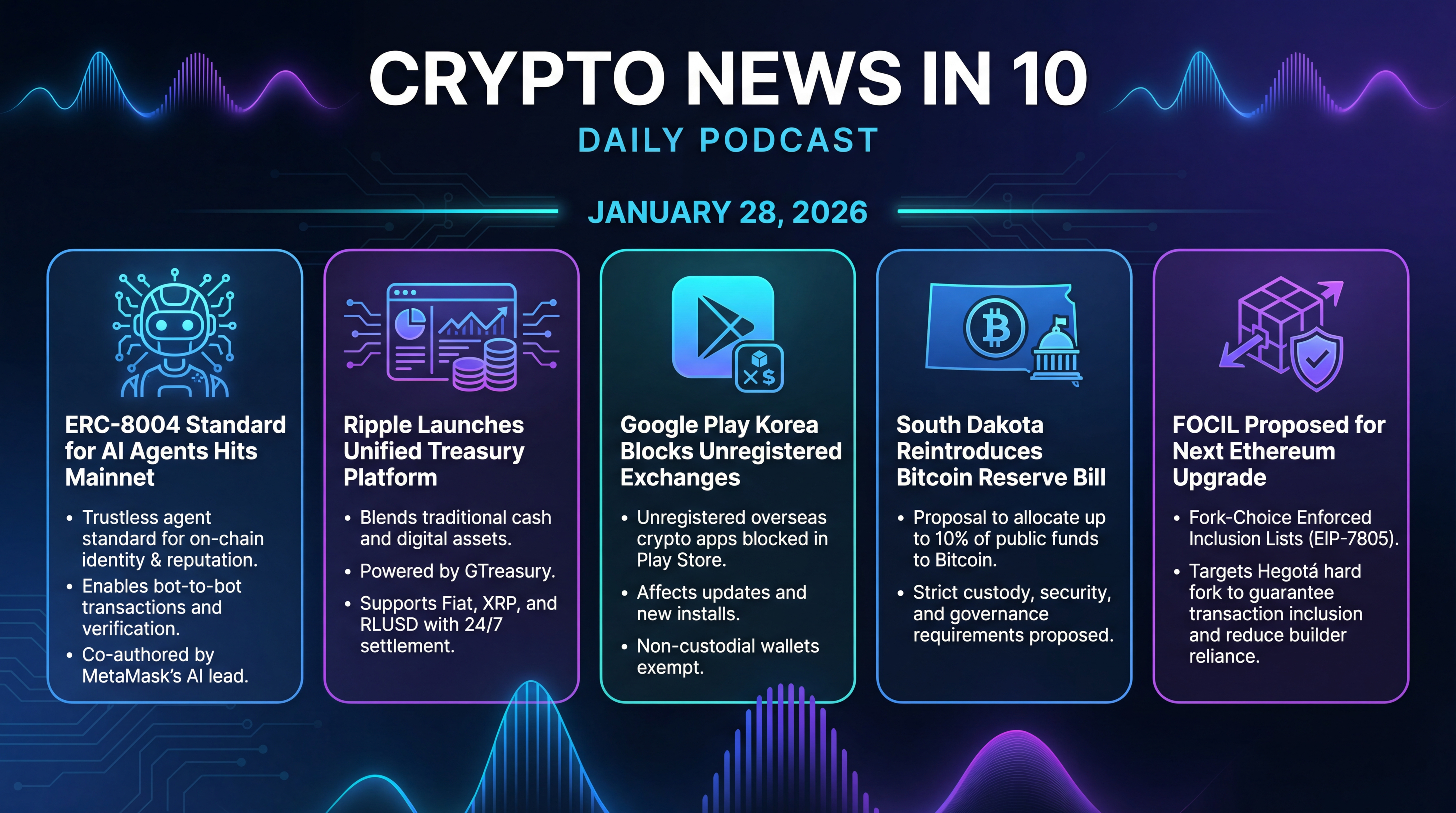
Episode Infographic
Show Notes
Welcome to our Crypto news in 10, a daily podcast bringing you the latest news about crypto in under 10 minutes.
Here’s your quick run-through of the five biggest crypto stories for Wednesday, January 28, 2026.
First, Ethereum’s new ERC-8004 standard for AI agents is heading to mainnet this week — think on-chain identity and reputation for bots that can transact.
Second, Ripple is rolling out an enterprise treasury platform that unifies cash and digital assets.
Third, Google Play’s Korea store begins blocking unregistered overseas exchange apps today — a big deal for mobile traders there.
Fourth, South Dakota lawmakers reintroduced a bill to let the state put up to 10% of public funds in Bitcoin.
And fifth, Ethereum researchers want FOCIL — an inclusion guarantee mechanism — to headline the next big network upgrade, Hegotá.
[BEGINNING_SPONSORS]
Story one: Ethereum’s agent economy is getting real.
The ERC-8004 trustless agents standard — co-authored by MetaMask’s AI lead, Marco De Rossi — has its spec locked and is slated for a mainnet deployment window around Thursday morning, U.S. time. The goal is simple: let autonomous agents discover each other, prove who they are, and carry portable reputations across apps — with Ethereum as the neutral trust layer.
It’s an ERC, not a base protocol change. So expect registry contracts to be deployed, addresses published, and indexers tracking agent identities and trust signals.
Why it matters: AI agents are starting to move money, fetch data, and trigger trades... but outside a walled garden, it’s hard to know who to trust. ERC-8004 creates on-chain registries and verification hooks — identity via ERC-721, typed signatures via EIP-712, and smart contract signature checks via EIP-1271 — so agents can prove themselves and build reputation in a way other agents can verify. That’s a prerequisite for agent-to-agent marketplaces and automated payment flows without a centralized gatekeeper.
Story two: Ripple just launched an enterprise treasury platform that blends traditional cash management with digital assets — one dashboard, real-time balances, 24/7 settlement rails, and rule-based liquidity deployment.
GTreasury — which Ripple agreed to acquire for about $1 billion last year — is the engine here. Ripple says the system can coordinate fiat, XRP, and its RLUSD stablecoin, automate short-term allocations, and send programmable, tokenized disbursements. Early messaging highlights unified visibility and instant cross-border settlement — replacing batch files and slow cutoffs with continuous workflows.
Context helps: Ripple’s treasury push follows its 2025 acquisitions — GTreasury for treasury software, Hidden Road for prime brokerage, and Rail for stablecoin infrastructure. The strategy is to make treasury operations natively multi-asset — cash, stablecoins, and tokenized paper — while keeping enterprise compliance intact. If it works, we could see corporates route more vendor payments and working capital cycles over always-on rails.
Story three: Starting today in South Korea, Google Play is blocking unregistered overseas crypto exchange and custodial wallet apps from being listed or updated unless they’re registered as virtual asset service providers with the Financial Intelligence Unit.
Practically, that means Android users can’t freshly install or update apps for giants like Binance, Bybit, or OKX via the Play Store — though the web still works. Non-custodial wallets are reportedly exempt. This is a major app distribution lever, and it tightens a regulatory perimeter that already limits Korean won market access and local marketing by unregistered platforms.
[MIDPOINT_SPONSORS]
Story four: A U.S. state is kicking the Bitcoin reserve idea back into gear.
South Dakota Representative Logan Manhart filed HB 1155 to let the State Investment Council allocate up to 10% of eligible public funds into Bitcoin — via direct holdings, qualified custodians, or regulated exchange-traded products. The text lays out custody and governance requirements: exclusive key control, encrypted hardware storage, geographically distributed secure facilities, and multi-party approvals. The bill was first read yesterday and sent to the House Commerce and Energy Committee. It echoes a 2025 attempt that died on Day 41 and follows other state reserve efforts.
Why it matters: While Texas, Arizona, and New Hampshire have passed some form of state-level crypto reserve or holdings legislation, most proposals stall over volatility and custody risk. South Dakota’s approach focuses on a capped allocation, institutional-grade controls, and the option to use exchange-traded products — more like an investment policy tweak than a mandate. If it advances, expect debates about auditor standards, fair value measurement, and how to benchmark Bitcoin inside public portfolios.
Story five: Ethereum researchers want to make censorship resistance a protocol-level guarantee in the next big upgrade.
Thomas Thiery — known as soispoke — has proposed FOCIL, Fork-Choice Enforced Inclusion Lists — EIP-7805 — as the headliner for the Hegotá hard fork targeted after Glamsterdam this year. The idea is to reduce reliance on a small set of centralized block builders by allowing multiple validators to enforce that any valid transaction gets included on-chain within a bounded window via the fork-choice rule. Specs have been reviewed, and prototype implementations exist across several clients — but trade-offs remain, like handling data blobs and private MEV — maximal extractable value — flows.
Zooming out: FOCIL stems from concerns that builder relay concentration could quietly filter transactions. By pushing inclusion guarantees into consensus, Ethereum would harden neutrality — even if dominant builders tried to censor. The formal proposal thread is live on Ethereum Magicians. Watch that space — and the All Core Devs calls — as Hegotá’s scope gets hammered out.
That’s a wrap: Ethereum is leaning into an AI-ready agent standard and tougher anti-censorship guarantees. Ripple is moving treasuries onto 24/7 rails. South Korea is turning app stores into compliance gates. And South Dakota is reviving the state reserve debate.
New rails, new rules, new governance... all converging fast. We’ll keep you posted as ERC-8004 hits mainnet and as the Hegotá roadmap crystallizes.
Thanks for listening and see you tommorow!
