
Prediction Markets Return, Binance Tilts to Bitcoin
Binance shifts its $1 billion SAFU into Bitcoin as Washington advances CFTC-led crypto oversight and opens the door to regulated prediction markets. Plus, a Fed chair nomination jolts markets and the UK launches a high-stakes stablecoin inquiry.
Episode Infographic
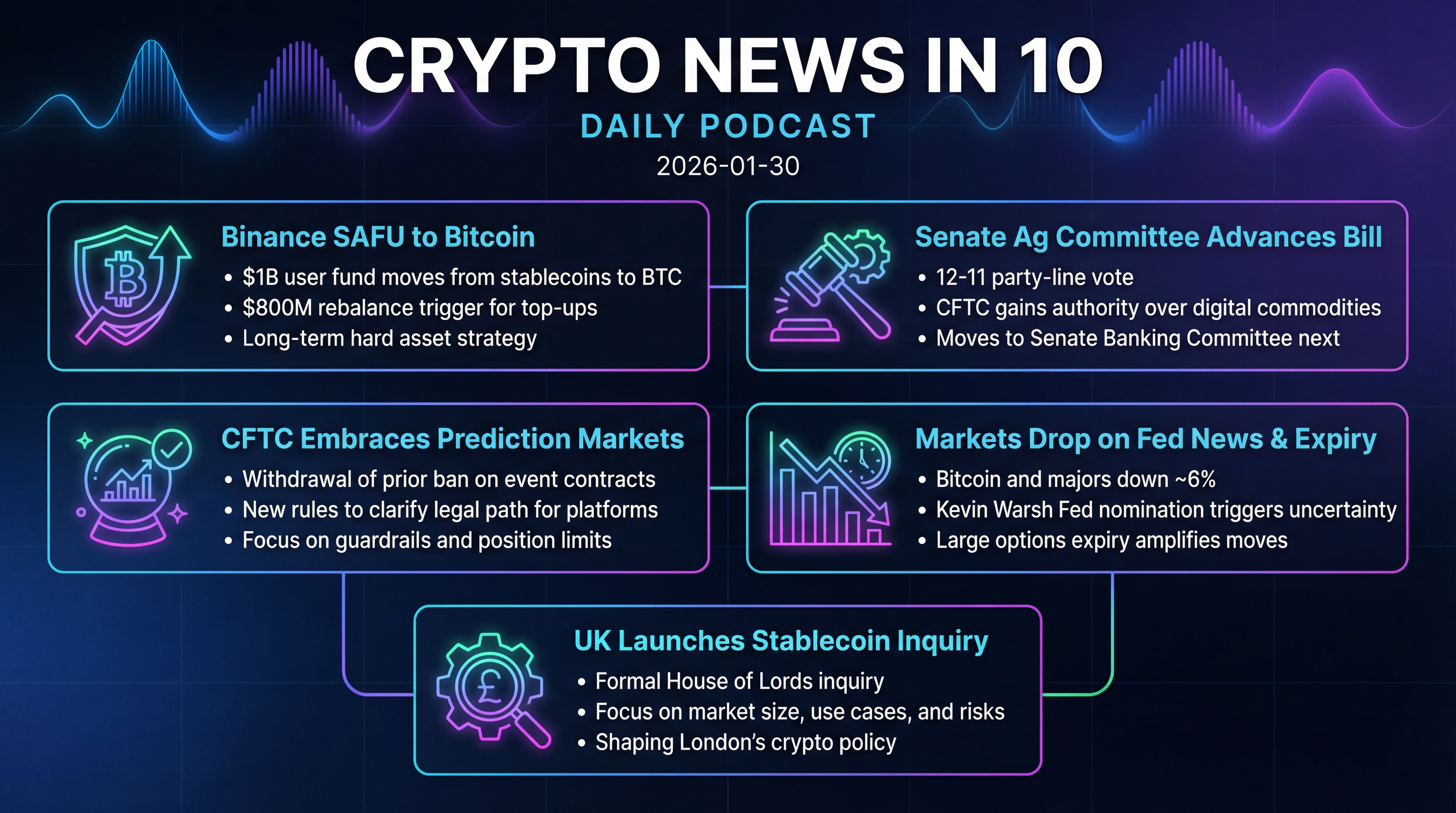
Show Notes
Welcome to our Crypto news in 10, a daily podcast bringing you the latest news about crypto in under 10 minutes.
Here's your quick rundown for Friday, January 30, 2026.
Binance just made a bold treasury move — shifting its one billion dollar user-protection fund into Bitcoin.
In Washington, the Senate Agriculture Committee advanced a market structure bill that would put more of crypto under the CFTC, while the CFTC chair signaled brand-new rules for prediction markets... rolling back prior restrictions on politics and sports betting contracts.
Markets are wobbly. Bitcoin and the majors slid today as President Trump nominated Kevin Warsh to chair the Fed — and it's happening into one of the year's biggest options expirations.
And across the pond, the UK House of Lords kicked off a formal stablecoin inquiry that could shape policy in London.
[BEGINNING_SPONSORS]
Let's start with Binance's headline move.
The exchange says it will convert the entire Secure Asset Fund for Users — SAFU for short — about one billion dollars in total — out of stablecoins and into Bitcoin over the next 30 days.
Binance also pledged to keep the fund topped up. If Bitcoin volatility drags SAFU's value below 800 million dollars, it will rebalance back to one billion.
That's a big philosophical shift — away from dollar pegs and toward Bitcoin as a long-term reserve — and, at current prices, it implies more than twelve thousand Bitcoin of incremental buying once the conversion is complete.
Previously, Binance disclosed that SAFU sat in USDC. Today's change increases market exposure, but aligns the fund with the asset Binance calls the industry's core.
One more data point: Binance says its proof of reserves covered roughly 162 to 163 billion dollars across 45 assets by late 2025.
If you're wondering about mechanics... the SAFU conversion will be gradual to avoid disrupting markets, and Binance will use treasury resources to replenish the fund when needed.
The big question: does tying an insurance backstop to Bitcoin's price add risk precisely during stress events? Supporters say transparency and a hard-asset reserve outweigh that concern. Critics point to volatility.
We'll watch how quickly those wallets migrate to Bitcoin — and whether Binance publishes on-chain references during the month-long shift.
Story two: Congress in motion.
The Senate Agriculture Committee voted 12 to 11 — strictly along party lines — to advance its piece of a crypto market-structure bill.
This draft would give the CFTC explicit authority over digital commodities and intermediaries, while SEC-related provisions are expected to be handled in the Senate Banking Committee.
Republicans framed it as long-overdue clarity. Democrats objected over ethics and consumer-protection gaps, and over concerns about CFTC independence under new leadership.
The path forward runs through Banking before any floor vote, and the text could still change through a manager's amendment.
Still, it's a notable step. The House moved its version last year — and now the Senate process is live again.
To capture the mood, Senator Cynthia Lummis said we're one step closer to getting digital asset market-structure legislation to the President's desk, while signaling more bipartisan work ahead.
Translation... lots of wrangling left, but the momentum is real.
Story three: the CFTC is rewriting the rules of the prediction-market game.
In his first major remarks, Chair Michael S. Selig said he's directing staff to withdraw the 2024 proposal that would have banned political and sports event contracts — and to draft a new rulemaking to bring clarity to this space.
He also told staff to reassess the agency's posture in ongoing court fights, and to defend the Commission's jurisdiction over commodity derivatives where appropriate.
Practically, that could open a clearer federal path for platforms that let you trade on elections, sports outcomes, or macro events — areas where Kalshi, Polymarket, and even mainstream brokers have been circling.
Keep an eye on pre-rulemaking signals — and on whether the Commission proposes guardrails around contract settlement, position limits, and anti-manipulation.
Axios reports Selig will also vacate a 2025 staff advisory — aiming to end the regulation-by-uncertainty dance and build a durable framework.
It's a big pivot from the whiplash of the past few years... and it will likely trigger a robust comment period once a proposal is noticed in the Federal Register.
[MIDPOINT_SPONSORS]
Story four: markets.
Crypto sold off into the weekend. Bitcoin slipped roughly six percent today, with Ethereum and XRP down similar amounts, as risk assets broadly weakened.
Two catalysts are in the mix.
First, President Trump nominated former Fed governor Kevin Warsh to succeed Jerome Powell when his term ends in May. Warsh has worn both hawk and dove hats over the years, but markets hate uncertainty — and nomination headlines often force a repricing of rate-path odds.
Second, we're bumping into one of the biggest expiry clusters of the year — roughly eight to nine billion dollars of Bitcoin and Ether options settling today, with a lot of open interest pinned around the 90,000 strike for Bitcoin. That can amplify moves as dealers rebalance into the close.
For a bit more color on the derivatives side, Deribit's analytics showed a January 30 expiry curve with modestly bearish near-term skew — more demand for downside protection — even as longer-dated positioning remained constructive.
If that sounds technical, here's the plain-English version... traders were hedged for a chop lower, but not panicking about the medium term.
We'll see whether post-expiry flows let Bitcoin wander back toward those max pain levels next week — or if macro headlines keep the pressure on.
And story five: London is taking comments on stablecoins.
The UK House of Lords Financial Services Regulation Committee launched a formal inquiry into the growth and proposed regulation of stablecoins in the UK — with a call for evidence open through Wednesday, March 11, 2026.
The committee wants input on market size, use cases, risks to payments and banking models, and how the Bank of England and FCA frameworks stack up against the U.S. and the EU. First oral evidence is slated for Wednesday, February 4.
For builders with UK ambitions — issuers, wallets, payment firms — this is a chance to get views on the record while the scaffolding is going up.
Zooming out, the UK process mirrors what we're seeing globally — regulators moving from abstract principles to concrete plumbing.
With EU MiCA implementation under way and U.S. stablecoin law already on the books, London's choices on reserves, redemption rights, and systemic oversight will determine how competitive sterling-linked tokens become in cross-border settlement and commerce.
That's a wrap.
Today we covered Binance betting its billion-dollar safety net on Bitcoin... the Senate Agriculture Committee nudging a CFTC-focused market bill forward... the CFTC chair opening the door to regulated prediction markets... a rate-policy plot twist and a massive options expiry pressuring prices... and the UK kicking off a stablecoin consultation sprint.
We'll keep tracking what turns from headline to hard rule next week.
Thanks for listening and see you tommorow!
