India Doubles Down, Bitcoin Wobbles, MegaETH Nears Launch
India extends strict crypto taxes with new penalties as Bitcoin’s haven narrative wobbles and gold hits records, while MegaETH targets a February 9 mainnet after 10.7 billion test transactions. Plus, a UK ad ban on Coinbase and new research on stablecoin peg mechanics and an eclipse attack on Ethereum nodes.
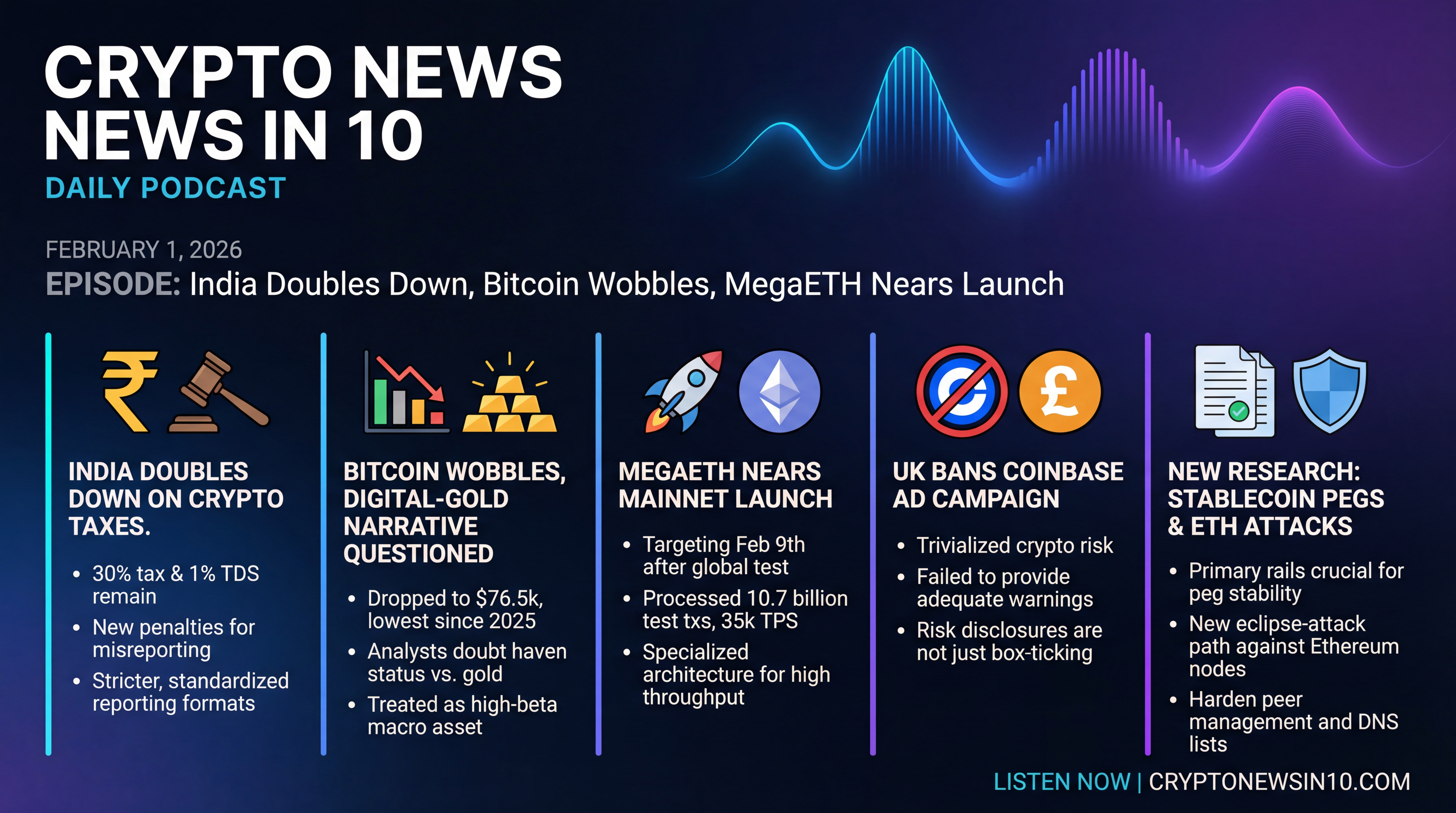
Episode Infographic
Show Notes
Welcome to our Crypto news in 10, a daily podcast bringing you the latest news about crypto in under 10 minutes.
Here’s the quick run-through... India just locked in another year of strict crypto taxes — and added new penalties for misreporting.
Bitcoin, meanwhile, touched its lowest level since the 2025 tariff shock, with analysts openly questioning the digital-gold narrative.
On the tech front, a buzzy Ethereum Layer-2 called MegaETH is targeting a February 9 mainnet after blasting through 10.7 billion test transactions.
In the UK, ad regulators slapped down a Coinbase campaign for trivializing risk.
And we’ll close with two fresh research papers — one that models who actually restores a stablecoin’s peg during stress, and another that demonstrates a new eclipse-attack path against Ethereum nodes.
Buckle up... it’s a busy Sunday in crypto.
[BEGINNING_SPONSORS]
Let’s start in New Delhi. The Union Budget 2026 kept India’s high-friction crypto rules intact — a 30 percent flat tax on gains, 1 percent TDS on trades, and no loss offsets — despite months of lobbying from exchanges and investors.
The Finance Ministry also proposed new penalties to force cleaner reporting: 200 rupees per day for failing to furnish required statements, plus 50,000 rupees for submitting inaccurate details and not correcting them.
Officials flagged stricter, standardized reporting formats for platforms — think exchanges and marketplaces — which will need to upgrade compliance processes before the changes take effect in the new fiscal year.
Industry leaders called it a missed chance to boost onshore liquidity, but welcomed clarity on reporting... and yes, the penalties are meant as a deterrent.
Zooming out to markets... Bitcoin slipped to roughly $76,500 at one point this weekend — its lowest since last year’s tariff shock — before clawing back toward the high $78,000 range.
What’s notable is the narrative reset. As gold ripped to record highs above $5,600 per ounce, then cooled, analysts told the Financial Times that Bitcoin’s haven status is wobbling in risk-off tapes.
From Marex, Ilan Solot described BTC as an asset still searching for a clear valuation model, while Pimco’s Pramol Dhawan argued it’s no longer viewed as a revolutionary monetary asset in flight-to-safety moments.
Whether you agree or not, the market’s message is clear: in stress, metals still get the bid... and Bitcoin, for now, is being treated more like a high-beta macro asset.
Now to the builders. MegaETH — an Ethereum Layer-2 aiming for real-time performance — says it will open public mainnet on February 9 after a seven-day global stress test.
The numbers were eye-popping: about 10.7 billion transactions processed, with bursts up to roughly 35,000 transactions per second, as latency-sensitive apps like Smasher, Crossy Fluffle, and Stomp dot G G ran live.
Co-founder and CTO Lei Yang teased the fastest EVM chain yet, and the team highlighted a specialized architecture that separates sequencers, provers, and full nodes to push throughput without choking.
Big claims, of course... sustaining that performance permissionlessly, under real economic load, is the real test. Still, the early telemetry — and that February 9 date — give devs a near-term target to ship against.
[MIDPOINT_SPONSORS]
Across the pond, the UK’s Advertising Standards Authority banned a Coinbase campaign that cheekily suggested crypto could help with the cost-of-living crisis.
Regulators said the ads trivialized risk and presented complex, high-volatility products as simple answers — without adequate warnings.
Coinbase pushed back, arguing the campaign critiqued the financial system rather than pitching crypto as a silver bullet... but the ruling stands.
The takeaway for marketers is simple: in the UK — now shifting toward authorization for full-service crypto firms — risk disclosures aren’t box-ticking. They’re the point. Expect more scrutiny of tone and context, not just the fine print.
And to wrap, two pieces of research that matter for the rails we all use.
First, a study titled Who Restores the Peg — a mean-field game model of fiat-backed stablecoins — dissects de-peg events across primary mint-redeem rails and secondary exchanges.
Calibrated on three real episodes, the authors find that primary-market arbitrage does most of the stabilizing in normal stress. But when redemptions are impaired, recovery needs a tandem push from both primary and secondary channels.
There’s also a non-linear breakdown threshold: once frictions in the primary rails pass it, secondary liquidity becomes more an amplifier than a fix.
Translation... if you run a stablecoin, or trade them professionally, obsess over your primary rails and their frictions — those are the real circuit breakers.
Second, security researchers implemented an end-to-end eclipse attack against Ethereum execution-layer nodes in post-Merge settings.
They show how an adversary can isolate a target on restart by poisoning discovery tables, manipulating the DNS-seed peer list, and hijacking idle inbound slots.
In tests on Sepolia — and measurements on mainnet — the attack proved feasible at modest IP scale. The authors outline countermeasures already shared with Ethereum’s security team.
If you operate infrastructure — clients, validators, RPC fleets — the message is immediate: harden peer management, watch DNS-list hygiene, and rethink default slot policies before an attacker does.
That’s the slate... India doubling down on compliance with fresh penalties, Bitcoin’s digital-gold debate back at center stage, a high-TPS L2 aiming for prime time in days, UK ad enforcers setting the tone for risk comms, and research that could shape how stablecoins and Ethereum nodes behave under stress.
Keep your eyes on those primary rails, your peer lists clean, and — this week — on February 9.
Thanks for listening and see you tommorow!
