
Stablecoin Truce Talks, ETNs Go Retail, ETF Bounce
Washington pushes a stablecoin-yield compromise while ING opens retail crypto ETNs and KBank signals a wallet push ahead of its IPO. Bitcoin ETFs swing back to inflows, and January’s security losses spike—here’s what matters and what to watch next.
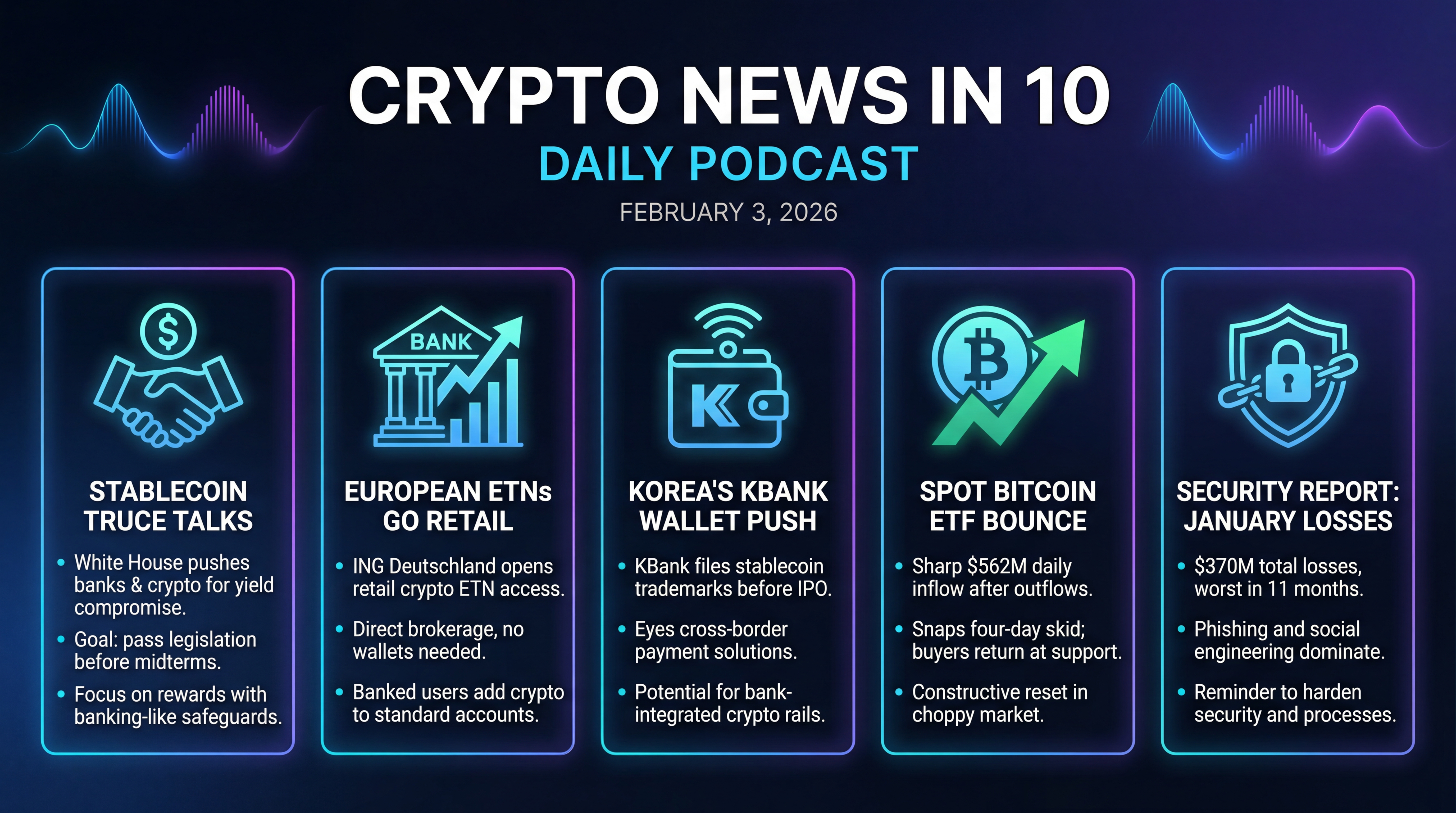
Episode Infographic
Show Notes
Welcome to our Crypto news in 10, a daily podcast bringing you the latest news about crypto in under 10 minutes.
It’s Tuesday, February 3, 2026, and today’s slate has a bit of everything... Washington is huddling with Wall Street and crypto to revive a stalled bill. A major European bank just flipped the switch on retail crypto ETNs. South Korea’s Upbit-banking partner is teeing up a stablecoin wallet push before its IPO. U.S. spot Bitcoin ETFs are showing a sharp daily inflow after days of red. And security researchers are tallying the industry’s costliest month in almost a year. Let’s dig in.
[BEGINNING_SPONSORS]
First—Washington. The White House hosted crypto companies and banking groups on February 2 to break a deadlock over a flagship digital assets bill... specifically, a fight over whether stablecoin issuers and exchanges can pay rewards—yield—on dollar-pegged tokens. Banks argue those rewards siphon deposits unless crypto firms follow bank-like safeguards. Parts of the industry want room to innovate.
The administration’s message is simple: find a compromise this month so legislation can move before midterms throttle the calendar. The meeting comes after a party-line vote in the Senate Agriculture Committee on a related market-structure bill—and amid fresh political crosswinds.
If a deal lands, watch for language that allows rewards under banking-style reserve and disclosure rules—pulling stablecoins closer to money-market plumbing. It’s not a done deal... but it’s the clearest path we’ve seen in weeks, according to coverage in Barron’s.
To Europe, where ING Deutschland just made crypto exposure feel like buying an ETF. The bank opened retail access to physically backed crypto ETNs—exchange-traded notes—through its Direct Depot brokerage. No wallets, no private keys. Customers route orders over regulated venues for assets like Bitcoin, Ether, and Solana, with issuers including 21Shares, Bitwise, and VanEck.
ING stresses these are exchange-traded instruments, custody happens at the product level, and trading sits inside the standard securities account flow. It’s a small usability shift with big implications—millions of banked users can now add crypto exposure alongside stocks and funds, under familiar disclosures and tax treatment.
Staying in the banking lane, South Korea’s KBank—the internet-only bank behind real-name deposits for Upbit—filed 13 trademarks for stablecoin wallet brands such as KSC Wallet and Kstable Wallet. The filings flag software and financial services for remittances, payments, and settlements.
It’s another breadcrumb in KBank’s digital-asset roadmap as it eyes a March 5 KOSPI listing and expands cross-border experiments—including a stablecoin solution with Thailand’s Kasikorn Bank aimed at tourists and migrant workers. If approved, KBank could become a bellwether for bank-issued wallet experiences tightly integrated with domestic crypto rails, as reported by The Block.
[MIDPOINT_SPONSORS]
Markets next. After a bruising run of outflows, U.S. spot Bitcoin ETFs flipped green on Monday with about $562 million in net inflows—snapping a four-day skid. Fidelity’s FBTC led the way, while Ether products still saw small outflows.
It’s one day, so don’t overread it... but buyers did step back in near widely watched support levels after Bitcoin briefly dipped below $75,000 over the weekend. Strategists say sustained daily inflows—think a few hundred million per day—and price reclaiming and holding key ranges would be the better tell for a durable turn. For now, chalk it up to a constructive reset in an otherwise choppy tape, according to Cointelegraph.
And finally, a security reality check. CertiK’s January tally puts total crypto losses at roughly $370 million—the worst month in 11 months—with phishing and social engineering responsible for about $311 million of that, including one $284 million incident targeting an individual.
On-chain exploits didn’t disappear. Step Finance on Solana saw about $29 million drained, and a flaw at Truebit led to roughly $26 million in losses. The lesson isn’t new, but the numbers are stark—technical audits matter, but so does basic operational hygiene: hardware wallets, multi-factor authentication, allow-listed withdrawal addresses, and treating unsolicited support messages as toxic waste. Teams should harden treasury processes and continuously test incident response, according to CryptoNews, citing CertiK.
Quick recap... In D.C., the White House is pressing banks and crypto firms for a stablecoin-yield compromise this month. In Europe, ING Deutschland just normalized bank-brokered crypto ETNs for retail. In Seoul, KBank staked out stablecoin wallet trademarks ahead of a March IPO. In markets, U.S. spot Bitcoin ETFs posted a $562 million inflow day. And on security, January’s $370 million in losses was a sober reminder that human-layer risks still dominate.
We’ll keep watching which of these storylines turns from headline... into habit.
Thanks for listening and see you tommorow!
