
CFTC Reset, Coinbase Clash, and Solana Shock
The CFTC scraps its ban plan and promises new rules as Nevada clashes with Coinbase over event contracts. Plus, MetaMask adds tokenized U.S. stocks, India pilots e-rupee subsidy vouchers, and Step Finance suffers a major treasury breach.
Episode Infographic
Show Notes
Welcome to our Crypto news in 10, a daily podcast bringing you the latest news about crypto in under 10 minutes.
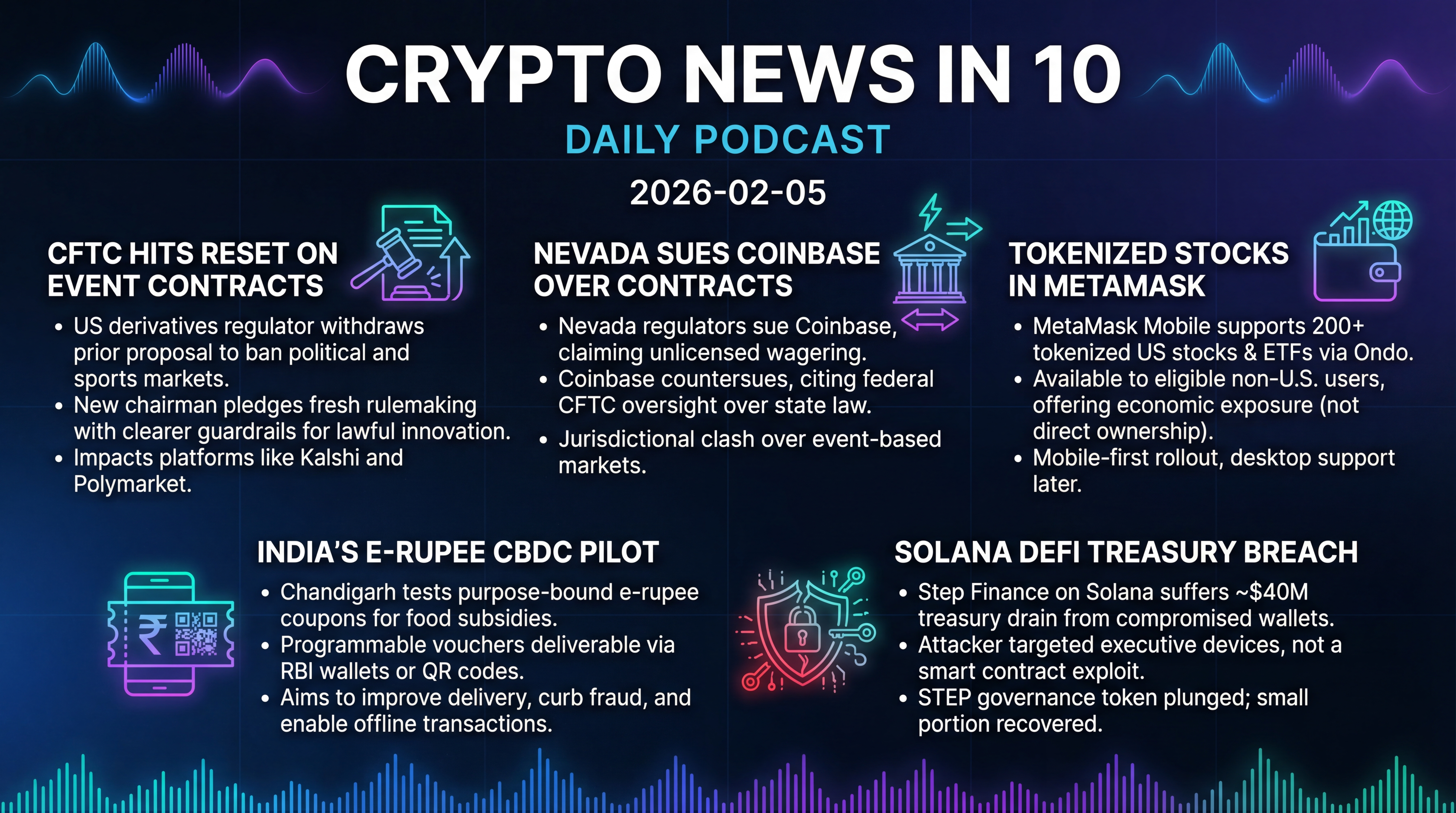
Here’s the quick run-through of what we’re covering today... The U.S. derivatives regulator just tore up a prior plan to ban political and sports prediction markets and says new, clearer rules are coming. Nevada, meanwhile, is suing Coinbase over event contracts — and Coinbase is suing back. On the product front, MetaMask now lets eligible users trade tokenized U.S. stocks and ETFs right inside the wallet via Ondo. Globally, India is about to test e-rupee coupons for food subsidies in Chandigarh. And we close with a security alert: Step Finance on Solana confirms a treasury breach that drained tens of millions.
[BEGINNING_SPONSORS]
Story one — the CFTC hits reset on event contracts.
Late Wednesday, February 4, the Commodity Futures Trading Commission — the CFTC — formally withdrew its 2024 proposal that would have effectively banned political and sports contracts. It also scrapped a 2025 staff advisory that warned against sports markets. The new chairman, Michael Selig, called the old approach a frolic into merit regulation and pledged a fresh rulemaking grounded in the Commodity Exchange Act — translation: the agency wants lawful innovation... with clearer guardrails.
That matters for platforms like Kalshi and Polymarket, and for brokerages and exchanges experimenting with prediction markets. A CFTC press release says the commission will not finalize the prior ban and will pursue a new framework. Legal memos this week echo it — a comprehensive rule set is coming next.
Story two — state pushback continues: Nevada versus Coinbase.
The Nevada Gaming Control Board filed a civil enforcement action arguing that Coinbase’s sports and other event-based contracts are unlicensed wagering under state law. The complaint seeks an injunction to halt those markets for Nevada residents. Coinbase fired back by suing Nevada’s regulator to block the action, pointing to its federal oversight and arguing these are CFTC-regulated derivatives — not state-regulated bets.
It’s a jurisdictional clash to watch — federal derivatives law versus state gambling statutes — with users caught in the middle. Reports this week detail the Nevada filing, note that ARK made a small dip buy in Coinbase shares despite the headlines, and confirm Coinbase’s countersuit in Carson City District Court.
[MIDPOINT_SPONSORS]
Story three — tokenized stocks land inside MetaMask.
Consensys says MetaMask Mobile now supports more than two hundred tokenized U.S. stocks, ETFs, and some commodity-linked products via Ondo Global Markets. Think Tesla, Apple, NVIDIA... plus QQQ and gold and silver ETFs — available to eligible users in supported non-U.S. jurisdictions. The rollout is mobile-first, with desktop support coming later. Trading windows mirror market hours, but the tokens can move 24/7.
One important caveat from MetaMask’s help center: these tokens provide economic exposure, but they’re not the same as directly owning the underlying securities — no voting rights, and significant regional restrictions apply. Still, it’s a notable real-world-assets moment inside one of the most widely used self-custody wallets.
Story four — a CBDC pilot with real-world purpose.
Starting mid-February, the Indian city of Chandigarh will test purpose-bound e-rupee coupons for food subsidies under the public distribution system, with similar trials slated for Puducherry and parts of Gujarat. These programmable e-rupee vouchers — delivered by RBI-enabled wallets or QR codes — are redeemable only for authorized goods at registered shops, with time limits and optional geofencing to curb leakage and fraud.
Authorities say the pilot aims to improve last-mile delivery while enabling offline transactions and direct funding flows from the central bank to beneficiaries. If successful, this could become a template for targeted transfers in other programs.
Story five — a security incident rocks Solana DeFi.
Step Finance confirmed that multiple treasury and fee wallets were compromised on January 31 during Asia-Pacific hours, with on-chain data showing roughly 261,854 SOL moved — about twenty-seven to thirty million dollars at the time — and the team later said losses could be closer to forty million after full reconciliation. The attacker reportedly compromised executive devices to gain privileged access — this was not a smart contract exploit.
The STEP governance token plunged after the disclosure, and Step says it has recovered a small portion with partner help and Token 22 protections. The lesson here is evergreen: treasury keys and device hygiene matter as much as audited contracts.
Quick recap...
In the U.S., the CFTC just reopened the door to a rules-based path for prediction markets — even as Nevada tests that boundary in court with Coinbase. MetaMask’s new integration pushes tokenized securities deeper into Web3 wallets — mind the eligibility and rights distinctions. India’s e-rupee trial shows a concrete public-sector CBDC use case. And Solana’s Step Finance breach is a stark reminder: sophisticated attackers often go after people and keys... not code. That’s your crypto news in ten.
Thanks for listening and see you tommorow!
