
CME Alt Futures, MegaETH Live, ENS Stays Mainnet
CME launches futures on Cardano, Chainlink, and Stellar as MegaETH’s mainnet goes live with token unlocks tied to real usage. We also break down South Korea’s 2026 crackdown plans, ENS’s decision to remain on Ethereum Layer 1, and bitcoin’s bounce after last week’s flush.
Episode Infographic
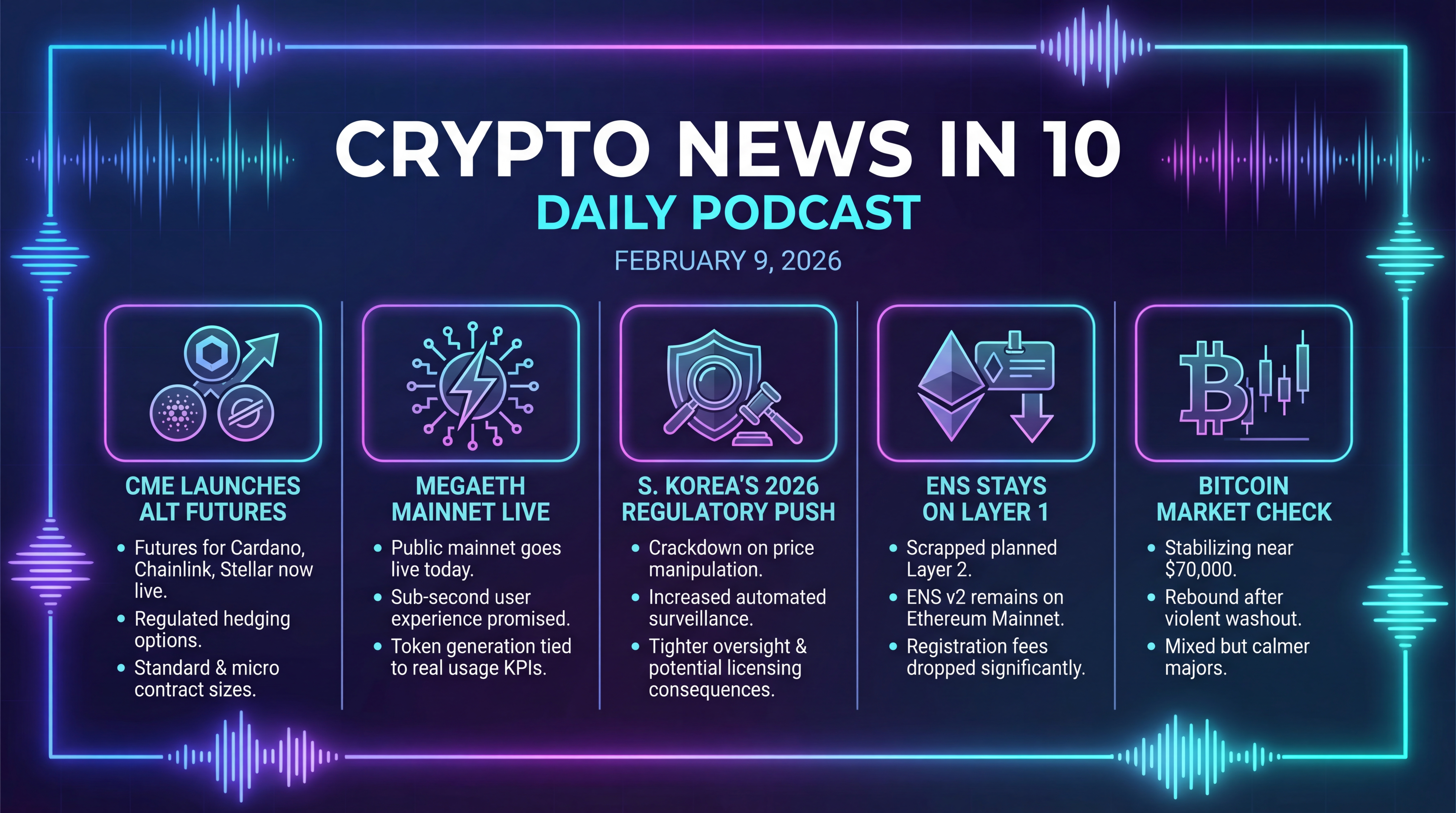
Show Notes
Welcome to our Crypto news in 10, a daily podcast bringing you the latest news about crypto in under 10 minutes.
Here’s what’s moving crypto on Monday, February 9, 2026. We’ve got three fresh product and protocol stories, a major regulatory push out of South Korea, and a quick market check. Let’s dive in.
First, CME is switching on new futures for Cardano, Chainlink, and Stellar — giving traders more regulated hedging options.
Second, MegaETH says its public mainnet goes live today after eye‑popping stress tests — and it’s tying its token generation to real usage.
Third, Korea’s top markets regulator outlines a 2026 plan to crack down on price manipulation with more automated surveillance.
Fourth, the Ethereum Name Service scraps its planned Layer 2 and keeps ENS version two on Ethereum Layer 1 after fees plummeted.
And to close, bitcoin is catching its breath near seventy thousand after last week’s violent washout.
[BEGINNING_SPONSORS]
Let’s start with Chicago. CME Group is switching on futures for Cardano, Chainlink, and Stellar today — in both standard and micro sizes. Contract specs are straightforward: For Cardano, one standard contract is 100,000 coins and one micro is 10,000. For Chainlink, 5,000 on the standard and 250 on the micro. For Stellar Lumens, 250,000 on the standard and 12,500 on the micro.
CME’s goal is more precise exposure and capital efficiency — all on a CFTC‑regulated venue. That matters for funds that want hedges beyond bitcoin and ether, especially after the last two weeks of volatility.
Trading is slated to begin today, February 9, following the January 15 launch notice and a subsequent product advisory. Watch open interest and the futures basis over the next few sessions to see how quickly liquidity builds. That’s according to CME press materials and product notices.
Zooming to infrastructure: MegaETH says its public mainnet is going live today after a seven‑day stress test that reportedly pushed 10.7 billion transactions, with sustained throughput in the tens of thousands of transactions per second. The promise is real‑time, sub‑second user experience for things like gaming and high‑frequency apps.
The team and early testers say apps ran smoothly at scale… now the big question is whether open access converts hype into sticky usage. One notable wrinkle: the MEGA token’s launch isn’t on a fixed calendar — MegaETH has tied its token generation to key performance indicators, including app adoption and fee generation, with unlocks kicking in only after targets are met. Also watch integrations: Infinex says it will route first‑time user flows through MegaETH at launch. Claims and timelines come from project posts and industry coverage.
Regulation — South Korea is sharpening its knives for 2026. The Financial Supervisory Service governor says the agency will run planned investigations into coin price manipulation and fraudulent trading this year, citing recent exchange incidents and promising tighter oversight — including potential licensing consequences for platforms with weak controls.
This lines up with prior moves to boost automated surveillance. The watchdog has been upgrading models that flag abnormal price bursts and coordinated behavior, shifting more detection from manual review to AI‑assisted systems. Expect probes to focus on whale tactics, API‑driven manipulation, and misinformation campaigns — with findings likely to ripple across local exchanges and market makers.
[MIDPOINT_SPONSORS]
On the protocol side, a notable pivot: ENS Labs is scrapping its bespoke Namechain Layer 2 and committing ENS version two entirely to Ethereum mainnet. Why? The team says Ethereum’s base layer has scaled far faster than expected — registration gas for ENS reportedly dropped around 99% over the last year as Ethereum’s gas limit doubled in 2025 — so the cost‑benefit case for a dedicated Layer 2 isn’t there.
Keeping ENS version two on Layer 1 simplifies resolution and leverages Ethereum’s security, while still letting ENS interoperate with other chains via the app and resolver stack. It’s a fascinating example of reversing the Layer 2 reflex in response to real fee dynamics. Details come via ENS Labs’ update and industry reporting.
And a quick market check to close. After Thursday and Friday’s brutal flush that briefly tagged the sixty‑thousand handle, bitcoin has stabilized and is consolidating near seventy thousand as risk assets rebound and the forced‑selling overhang eases.
Traders point to a classic long‑liquidation cascade followed by a relief rally — bitcoin even posted its largest single‑day gain since 2023 during the snapback. As of this morning, majors are trading mixed but calmer, and some analysts argue the sixty‑to‑seventy‑thousand zone could become a base if macro doesn’t deteriorate further. Context and prices were cited by Reuters and Barron’s, with last week’s volatility noted by Bloomberg.
Quick recap: CME’s new Cardano, Chainlink, and Stellar futures go live — watch volumes and spreads as liquidity forms. MegaETH opens its doors and links its token launch to real usage — key performance indicators, not calendars. South Korea’s Financial Supervisory Service maps out manipulation probes with more automated surveillance. ENS version two sticks to Ethereum Layer 1 as fees collapse and scaling improves. And after last week’s whipsaw, bitcoin is catching its breath around seventy thousand. That’s your crypto news in ten… see you tomorrow.
Thanks for listening and see you tommorow!
