
Stablecoin Yields, CFTC Squeeze, Hong Kong Signals
Washington revives the stablecoin-yield debate as CFTC enforcement thins, Consensus Hong Kong opens its institutional track, Solana crowns privacy builders, and Robinhood’s earnings offer a clean read on retail crypto and prediction markets. Quick, clear, and packed with the signals that matter today.
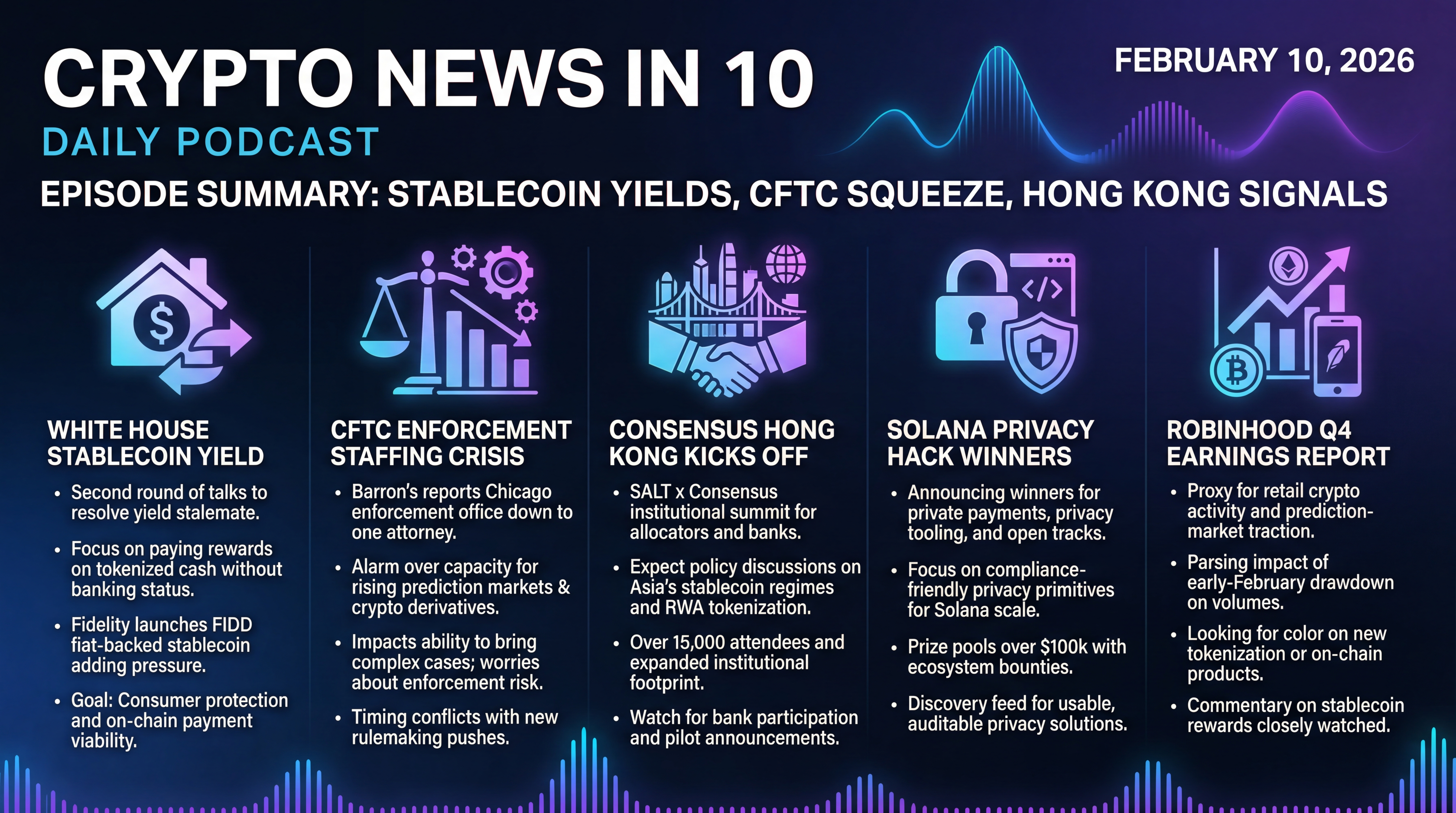
Episode Infographic
Show Notes
Welcome to our Crypto news in 10, a daily podcast bringing you the latest news about crypto in under 10 minutes.
Here’s your quick tour of what matters today... Tuesday, February 10, 2026.
Washington is back at the table on stablecoins. The White House is hosting a second round of talks to break the stalemate over whether platforms can pay yield on stablecoin balances. Over in markets policy, a Barron’s investigation says the CFTC’s Chicago enforcement office has dwindled to a single attorney... just as prediction markets and crypto derivatives are heating up. In Asia, Consensus Hong Kong 2026 kicks off — including a one day SALT x Consensus institutional summit aimed at allocators and banks. On the builder side, Solana’s Privacy Hack announces its winners today, with prize tracks for private payments and tooling. And after the bell, we’ll get Robinhood’s Q4 — a report that often serves as a proxy for retail crypto activity and prediction‑market traction. Let’s dig in.
[BEGINNING_SPONSORS]
First up, the White House’s second stablecoin yield summit this afternoon.
Staff from major banks — invites reportedly went to Bank of America, JPMorgan, and Wells Fargo — will join crypto trade groups and industry reps to hash out new language for the Clarity Act’s stablecoin section. The sticking point is whether platforms can share yield — think rewards on tokenized cash balances — without turning stablecoins into de facto bank deposits. The administration asked both sides to bring text that protects consumers while not kneecapping on‑chain payments. If today produces a handshake, the bill could move again in the Senate. If not... several D.C. watchers warn the timeline may slip into the next Congress.
For context, this debate isn’t happening in a vacuum. Fidelity just launched its own fiat‑backed stablecoin — the Fidelity Digital Dollar, ticker F I D D — on February 4, with daily reserve disclosures and one dollar redemption inside Fidelity’s platforms. More TradFi entrants mean real pressure to clarify who may pay what — and how those rewards are treated under banking law versus the GENIUS Act’s payment stablecoin rules.
Second, enforcement capacity at the CFTC.
Barron’s reports the agency’s Chicago enforcement division — once staffed with roughly 20 trial lawyers — now has just one remaining attorney after departures and reductions in force. Former officials say they’re alarmed, given rising activity in prediction markets and crypto derivatives that traditionally fall under the CFTC’s purview. The timing is awkward — the agency is talking up harmonization with the SEC and a new Project Crypto rulemaking push — but without courtroom muscle, bringing and winning complex cases could get harder in the near term. Markets care because lighter perceived enforcement risk can change behavior around event contracts, perpetual futures venues, and where the line gets drawn between commodities and securities.
Third, Consensus Hong Kong is officially open.
The three‑day conference returns to the Hong Kong Convention and Exhibition Centre, with organizers touting 15,000 attendees from more than 100 countries and an expanded institutional footprint. Before the main floor opens, there’s a one day SALT x Consensus institutional summit at the Grand Hyatt — held under the Chatham House Rule — aimed at connecting digital‑asset managers with allocators. Expect policy chatter on Asia’s stablecoin regimes, real world asset tokenization panels, and tomorrow’s Solana Accelerate track focused on developer pitches and regulatory roundtables. If you’re hunting signals, watch which banks sit on stage... and which tokenization pilots get named.
[MIDPOINT_SPONSORS]
Number four — builders, it’s trophy day.
Solana’s Privacy Hack, a weeks‑long online hackathon, announces winners today across three tracks: private payments, privacy tooling, and an open category. Submissions closed February 1, and prize pools top 70 to 100 thousand dollars, with ecosystem sponsors adding bounties. The goal is straightforward — push confidential transfers and compliance‑friendly privacy primitives that can work at Solana scale. If you’re a PM or investor, this shortlist is your discovery feed for teams trying to make privacy usable, auditable, and fast. Results should hit Solana’s channels later today.
And fifth, Robinhood reports after the close.
Options markets are pricing roughly a 9 to 12 percent move on earnings, and previews flag two swing factors for crypto: one, how much the early‑February drawdown dented first‑quarter activity... and two, whether prediction‑market volume can smooth seasonality now that football is over. Through last fall, crypto still represented about a third of transaction‑based revenue at Robinhood — so any color on volumes, custody flows, and new tokenization or on‑chain products will be closely parsed. Keep an ear out for commentary on stablecoin rewards too — that’s squarely in today’s White House crosshairs.
Quick recap... Washington tries again to land a stablecoin‑yield compromise. The CFTC’s enforcement bench looks thin just as event markets surge. Consensus Hong Kong opens with a deeper institutional track. Solana spotlights privacy builders, with winners announced today. And Robinhood’s report should offer a clean read‑through on retail crypto and prediction markets. We’ll keep watching the headlines — and the footnotes — so you don’t have to.
Thanks for listening and see you tommorow!
