
Policy Pivots, Digital Gilts, and SAFU in Bitcoin
Washington hints at a rules-first crypto reset, the UK pilots tokenized gilts with HSBC, Thailand opens regulated crypto derivatives, Binance finishes moving SAFU into bitcoin, and Israel files insider-betting charges tied to Polymarket. Here’s what it all means for markets, custody, and on-chain settlement in the weeks ahead.
Episode Infographic
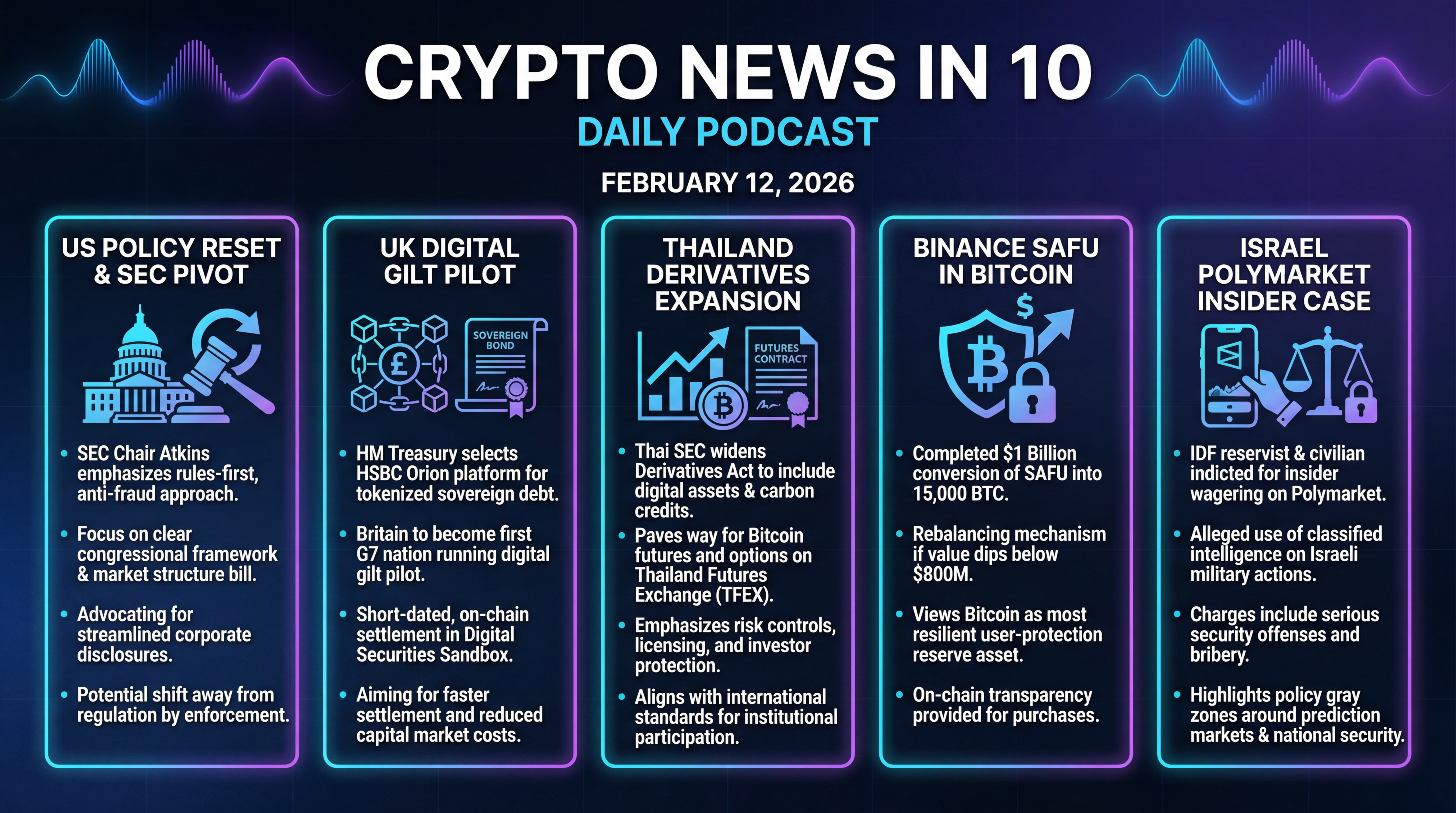
Show Notes
Welcome to our Crypto news in 10, a daily podcast bringing you the latest news about crypto in under 10 minutes.
Here’s what’s moving crypto today... We’ve got a potential policy pivot out of Washington, a landmark step toward tokenized sovereign debt in the UK, Thailand widening access to crypto via its derivatives market, Binance finishing a billion-dollar reserve rotation into Bitcoin, and a striking legal case in Israel tied to alleged insider wagering on Polymarket. Settle in... lots to unpack.
[BEGINNING_SPONSORS]
Let’s start in D.C. SEC Chairman Paul Atkins is back on Capitol Hill today — Thursday, February 12 — for a Senate Banking oversight hearing.
In prepared remarks — and in yesterday’s House session — Atkins drew a sharp contrast with the prior era. He wants to move away from regulation by enforcement, focus enforcement on clear fraud, and work with Congress on a durable framework that clarifies SEC and CFTC boundaries.
He’s also backing streamlined corporate disclosures to spur IPOs and growth — hot-button ideas likely to draw pushback from Democrats on transparency grounds.
For crypto specifically, he’s emphasizing coordination until broader legislation lands. His tenure has already seen notable case reversals — a signal of a reset in approach. According to Barron’s and Senate notices, the hearing starts at 10 a.m. Eastern.
The bigger market question is what follows. Will Congress move a comprehensive market-structure bill this year — one that draws bright lines for tokens, exchanges, and custodians? The SEC’s posture today suggests at least an openness to a rules-first path rather than a case-first approach. Investors will be listening for any hints around custody, disclosure, and how the agency interprets token classifications under existing law.
Across the Atlantic, the UK just took a decisive step toward issuing a sovereign bond on a blockchain. HM Treasury selected HSBC’s Orion platform for its Digital Gilt Instrument — the DIGIT pilot — positioning Britain to be the first G7 country to run a tokenized gilt issuance inside its Digital Securities Sandbox.
The pilot will be digitally native, short-dated, and designed for on-chain settlement — separate from the main debt-management program — while the government brings in additional suppliers to build the secondary-market plumbing. HSBC says Orion has already powered more than three and a half billion dollars in digital-bond deals in other jurisdictions.
The message is clear: the UK wants to test whether distributed-ledger tech can accelerate settlement and cut costs across its capital markets.
Why this matters... Tokenized sovereigns are a credibility flywheel. If gilts can settle faster with robust controls, that sets a template for banks and asset managers to bring more of their fixed income, repo, and collateral workflows on-chain — without asking investors to change what they buy, only how it’s issued and moved. Watch for details on issuance timing and secondary-trading access as the pilot firms up.
In Asia, Thailand just widened the door for regulated crypto derivatives. Following a Cabinet decision on February 10, the Thai SEC says it will expand the scope of permissible goods and variables under the Derivatives Act to include digital assets and carbon credits — paving the way for futures, options, and other contracts tied to assets like Bitcoin on the Thailand Futures Exchange.
Regulators emphasized risk controls, licensing, and investor protection, and said they’ll work with TFEX on contract specifications and with clearing houses on supervisory updates. It’s another brick in Thailand’s broader digital-asset strategy — aligning with international standards and inviting institutional participation.
Zooming out... this positions Thailand alongside a growing group of markets building compliant pipes for crypto exposure via derivatives. The near-term tells: which coins get first-wave contracts, how margin and collateral are set, and whether offshore liquidity migrates onshore once products launch.
[MIDPOINT_SPONSORS]
Exchange news — Binance says it has finished converting its Secure Asset Fund for Users — SAFU — from stablecoins into Bitcoin. The final tranche was 4,545 bitcoin, bringing SAFU to 15,000 bitcoin in total and wrapping a one-billion-dollar plan within the promised 30-day window.
At completion, Binance pegged the fund’s value just over one billion dollars — based on a bitcoin price of 67,000. The company says SAFU will be rebalanced if its value dips below 800 million, aiming to preserve a user-protection backstop during extreme events. It’s a notable signal about what the world’s largest exchange views as the most resilient reserve asset — especially after a volatile start to the year.
For traders, two angles. First, on-chain transparency — Binance has shared addresses and transaction details around the purchases. Second, market impact — staggered execution helped minimize slippage, but a steady, price-insensitive buyer in the background can change tape dynamics during dips. Keep an eye on any follow-up disclosures about SAFU governance and rebalancing triggers in the weeks ahead.
And a legal shocker from Israel underscores the policy gray zones around prediction markets. Prosecutors indicted an IDF reservist and a civilian, alleging they used classified operational intelligence to place bets on Polymarket related to Israeli military actions.
A court lifted a gag order as the case moved forward. Reports say the investigation involved the Shin Bet and other agencies, with charges that include serious security offenses, bribery, and obstruction. It’s an extraordinary intersection of national-security secrecy and on-chain markets — raising questions about how platforms can police insider behavior when the material nonpublic information is literally state secrets.
If you follow prediction markets, expect louder calls for tighter KYC, stricter geofencing, and clearer event-selection policies — especially for markets tied to military or intelligence outcomes — while regulators weigh whether existing insider-trading concepts map cleanly to decentralized betting venues.
Quick recap... Washington is signaling a rules-first reset as SEC Chairman Paul Atkins testifies; the UK picked HSBC’s Orion to pilot digital gilts; Thailand is opening the door to crypto-backed derivatives; Binance finished moving a full one billion dollars of SAFU into Bitcoin; and Israel charged two people over alleged insider betting on Polymarket. Plenty here for markets to digest — policy rails are forming, real-world assets are getting real, and the compliance bar for crypto-adjacent markets keeps rising.
Thanks for listening and see you tommorow!
