BlackRock Hits DeFi, Bitcoin Eyes Post-Quantum
BlackRock’s tokenized cash hits UniswapX, Bitcoin advances a plan for post-quantum safety, Aave pushes an all-revenue-to-DAO realignment, and new ETF filings spotlight staking. We wrap with a sober look at downside risk — and what today’s moves say about a maturing crypto market.
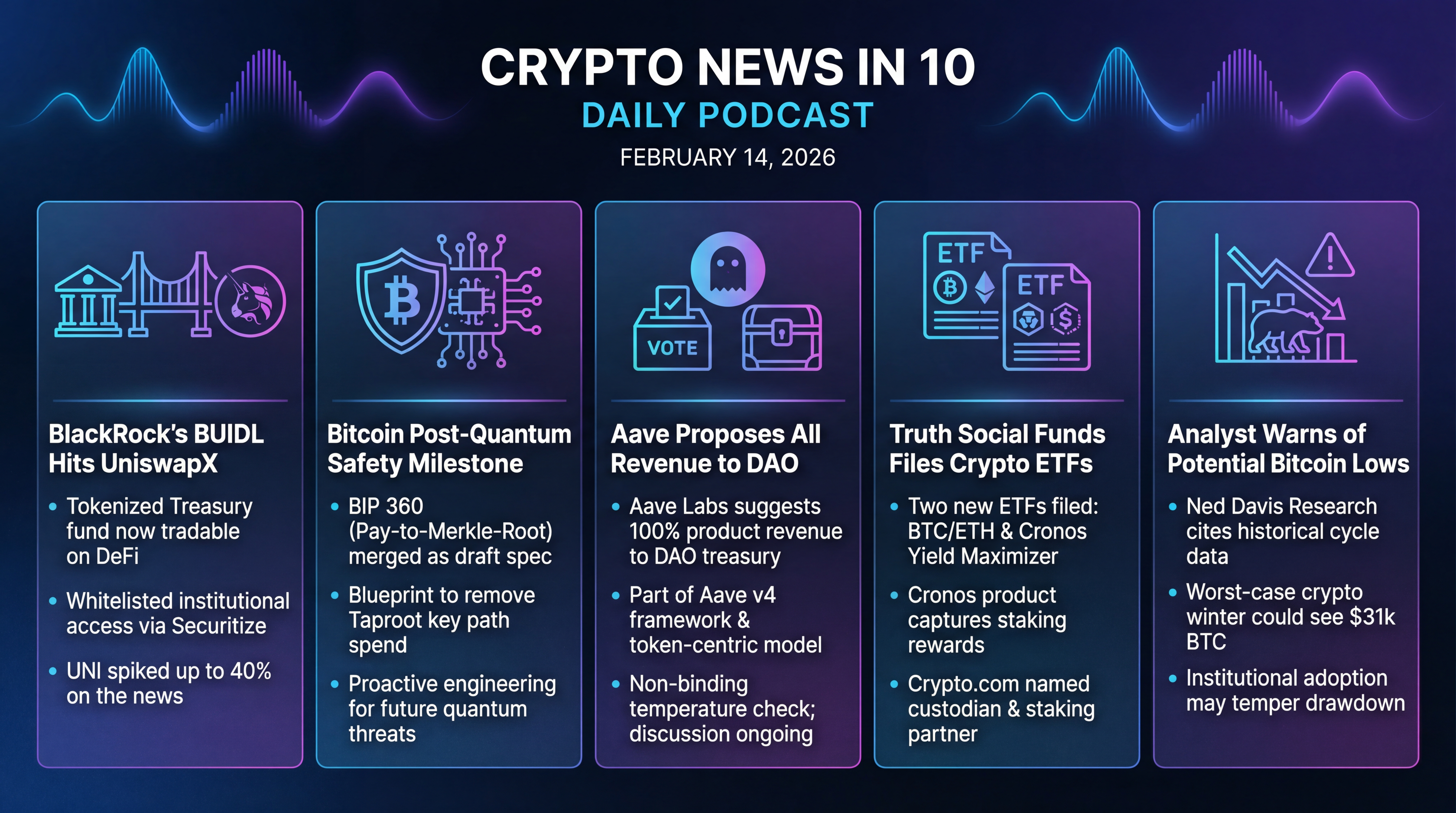
Episode Infographic
Show Notes
Welcome to our Crypto news in 10, a daily podcast bringing you the latest news about crypto in under 10 minutes.
It’s Saturday, February 14, 2026, and we’ve got a tight lineup. BlackRock brings its tokenized Treasury fund into DeFi and gives UNI a jolt. Bitcoin takes a concrete step toward post-quantum safety. Aave proposes routing all product revenue to its DAO. Truth Social Funds files two new crypto ETFs — including a yield-focused Cronos product. And a major research house says Bitcoin could, in a worst case, revisit the low thirty-thousands. Let’s get into it.
[BEGINNING_SPONSORS]
BlackRock just turned a big institutional narrative into on-chain reality. In partnership with Securitize, Uniswap Labs says BlackRock’s USD Institutional Digital Liquidity Fund — BUIDL — is now tradable via UniswapX. Eligible, whitelisted investors can swap tokenized fund shares against USDC, with quotes from approved market makers and atomic on-chain settlement. It’s not open to retail yet — but it’s a first-of-its-kind bridge between a top asset manager’s tokenized cash product and a leading DeFi venue. Uniswap pegs the integration to February 11 and describes an RFQ-style flow through Securitize’s marketplace.
The market took notice. Reports put BUIDL’s size between 2.2 and 2.4 billion dollars, and UNI spiked as much as 25% to 40% intraday before retracing as larger holders took profits. On-chain trackers flagged about 5.9 million UNI distributed by whales near the peak. Access to BUIDL liquidity, though, remains gated to whitelisted participants — for now.
Zooming out, this is tokenization getting more tangible — real-world assets with compliant rails tapping DeFi’s always-on liquidity. If you’re an institution, the pitch is simple: near-instant settlement, better price discovery, and fewer intermediaries… with all the usual KYC and AML checks intact. Uniswap’s post makes that design choice explicit.
Second — Bitcoin security, and specifically the quantum question. Developers just merged BIP 360, a draft called Pay-to-Merkle-Root, into the official BIPs repository. Important nuance: nothing has activated on the network. This is a specification milestone — not a live soft fork. But it’s a concrete blueprint that would remove Taproot’s key path spend — and with it, the most commonly cited exposure to future quantum key-recovery attacks — while preserving script-path flexibility. It’s opt-in, coordination-heavy, and likely years in the making.
Why it matters today: credible estimates say only a sliver of coins are at near-term risk, but long-exposure addresses remain a concern. CoinShares estimates the currently vulnerable pool at about 10,230 bitcoin, out of roughly 1.63 million with exposed keys. Research discussed alongside the merge pegs a one-day key-recovery attack at a fantastical 13 million physical qubits — well beyond today’s machines — yet the community is moving now to avoid an emergency scramble later. In other words… prudent engineering, not panic.
If you’re tracking the spec itself, the public changelog shows a February 10 rename from P2TSH to P2MR, with roots in iterations dating back to 2025 — useful context for developers and wallet makers planning years ahead.
Third — DeFi governance is having a moment. Aave Labs floated the Aave Will Win framework, asking the community to endorse Aave v4 as the protocol’s core and — headliner — to send 100% of product revenue to the Aave DAO treasury under a token-centric model. It’s a non-binding temperature check for now, but the details matter. The plan also contemplates a foundation to hold Aave’s brand and intellectual property, and frames Labs as a service provider funded by an annual DAO-approved budget.
Numbers time. The initial ask includes 25 million dollars in stablecoins and 75,000 AAVE, with additional tranches tied to deliverables. Media summaries peg current v3 fees around nine figures annually, with product revenue — swaps, front-end monetization, card plans — adding incremental upside over time. Not everyone is rubber-stamping the idea: governance leaders are already urging clearer, DAO-controlled revenue definitions and independent audits before funds move. That’s the process working as intended — alignment first, math and mechanics in the open.
[MIDPOINT_SPONSORS]
Fourth — a fresh ETF storyline heading into the long weekend. Truth Social Funds, an affiliate of Trump Media, filed SEC registration statements for two crypto ETFs: one targeting a 60% Bitcoin and 40% Ether allocation, and the Cronos Yield Maximizer ETF designed to hold CRO and capture staking rewards. The documents list Crypto.com as custodian, liquidity provider, and staking services partner, with Yorkville America Equities as adviser, and a stated 0.95% management fee. The filings landed Friday, February 13, and can’t launch until declared effective.
Traders reacted quickly to the CRO angle, with market trackers logging a mid single-digit pop as the filing circulated. For the broader ETF complex, it’s another data point — product variety is expanding from pure spot exposure toward funds that embed on-chain mechanics like staking, especially on networks where validator economics are core to the asset.
Fifth — a reality check on the macro and cycle front. Ned Davis Research warned that if this slump turns into a full crypto winter, Bitcoin could — in a severe scenario — tumble toward 31,000 dollars. Their historical lens: past winters have averaged an 84% peak-to-trough drawdown over roughly 225 days, and by their count we’re only 129 days into the current downturn. They do note that institutional adoption could temper the blow versus prior cycles, but the base message is caution — especially if ETF flows don’t re-accelerate.
For balance, other analysts this week pointed out that the structural rails are sturdier than in 2022 — think tokenized cash instruments now tapping DeFi, and blue-chip protocols openly realigning value to token holders. But price is a patient teacher… so size your risk — and your time horizons — carefully.
Quick recap. BlackRock brought tokenized cash to UniswapX and gave UNI a jolt; Bitcoin’s BIP 360 set a measured course for post-quantum safety; Aave floated a bold all-revenue-to-the-DAO realignment; Truth Social Funds filed two new ETFs — including a staking-powered Cronos product — and Ned Davis Research mapped out a colder, if unlikely, path to 31,000. Whatever your bias — builder, trader, or long-term allocator — today’s through-line is the same: the pipes keep getting more institutional, while the governance and risk math get more sophisticated.
See you tomorrow for another ten.
Thanks for listening and see you tommorow!
