RWA Boom, Stablecoin Rails, and DeFi Reckoning
With markets quiet, we break down Solana’s Lightspeed IR for allocators, TON’s APAC payments rail with Banxa/OSL, Ethereum’s RWA milestone, ZeroLend’s shutdown, and the legal clash over U.S. prediction markets. What it all signals for builders, traders, and institutions — and where the next catalysts might emerge.
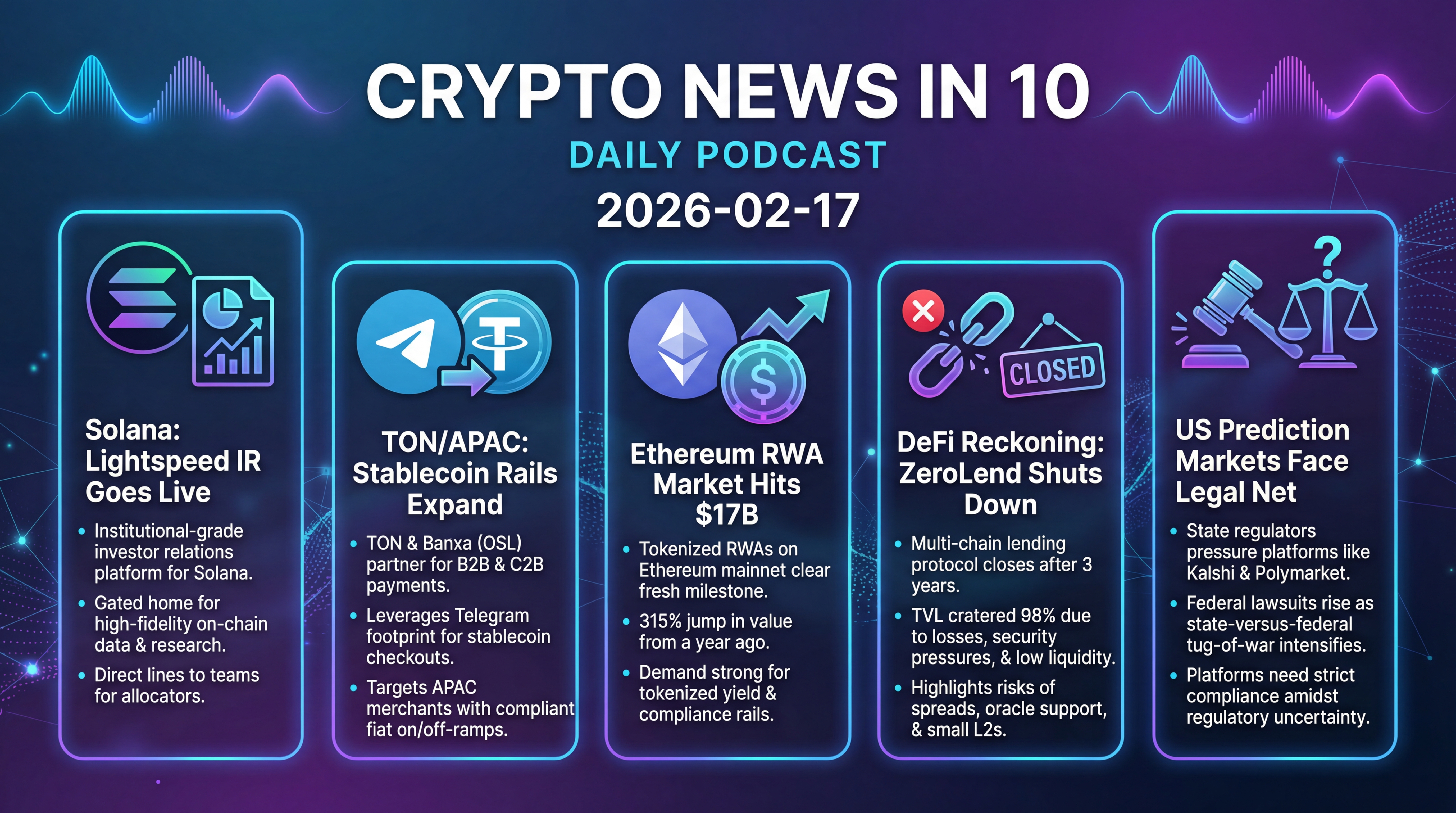
Episode Infographic
Show Notes
Welcome to our Crypto news in 10, a daily podcast bringing you the latest news about crypto in under 10 minutes.
It’s Tuesday, February 17th, and crypto is serving a mix of enterprise adoption and hard lessons.
Markets are steady to soft. Bitcoin is hovering in the upper sixty-thousands after failing to reclaim seventy thousand over the long weekend, while ether sits just under two thousand... a quiet backdrop for some big structural moves we’ll dig into today.
We’ve got a new institutional investor relations product going live on Solana, a Telegram-adjacent payments push across Asia, real-world assets hitting a fresh milestone on Ethereum, a DeFi lender calling it quits, and a growing legal drumbeat around U.S. prediction markets. Let’s get into it.
[BEGINNING_SPONSORS]
First up, a product launch aimed squarely at professional allocators.
Blockworks, in partnership with the Solana Foundation, is rolling out Lightspeed IR today — positioned as crypto’s first institutional-grade investor relations platform.
The pitch is simple: a gated home for high-fidelity on-chain data across Solana, institutional research you can drop into an investment committee memo, and IR workflows for teams — roadmap updates, KPI packs, governance changes, token events... the works.
Blockworks announced the initiative late last year and said it would go live in Q1. Solana’s official channels teed up today’s date, framing Lightspeed as an information gateway for investors and a central hub for builders.
The goal is straightforward — reduce noise for allocators who want clean, comparable data and direct lines to teams before writing checks. If this sticks, expect copycats across other ecosystems.
Next, stablecoin payments get a new rail in Asia-Pacific.
The TON Foundation says it’s partnering with Banxa — now part of Hong Kong-listed OSL Group — to let APAC merchants and small businesses accept stablecoin payments for B2B, C2B, and cross-border transactions using TON’s infrastructure.
It’s a plumbing story with big implications. Banxa brings licensed fiat on- and off-ramp coverage across multiple regions, OSL has been expanding a compliant payments network, and TON is leaning on its Telegram footprint to make crypto payments practical at consumer and merchant scale.
The move follows TON Pay, a new SDK that lets Telegram Mini Apps accept Toncoin and USDT with sub-second settlement and sub-cent fees. If APAC small businesses adopt this, it could normalize stablecoin checkouts in markets where card fees and cross-border friction sting the most.
Third, Ethereum’s tokenized real-world asset market just cleared a fresh bar.
New data shows more than 17 billion dollars in tokenized RWAs — on Ethereum mainnet alone — roughly a 315 percent jump from about 4.1 billion a year ago. Ethereum now accounts for nearly a third of all on-chain RWA value across networks.
What’s filling the bucket? Tokenized Treasuries and cash equivalents from traditional issuers, plus a growing roster of permissioned funds tapping public chains for issuance and settlement.
For builders, the takeaway is twofold. One — demand for tokenized yield remains strong, even through market chop. And two — compliance-aware rails on public networks are becoming table stakes for institutions that want programmability without giving up control obligations.
[MIDPOINT_SPONSORS]
Fourth, a reality check from DeFi credit.
ZeroLend — once a multi-chain lending protocol with nearly 359 million dollars in deposits — says it’s shutting down after three years. The team cites prolonged operating losses, thin margins, oracle providers discontinuing support, and rising security pressures as it grew.
Total value locked cratered 98 percent to roughly 6.6 million dollars, and markets have been set to zero percent loan-to-value so users can withdraw. The remaining funds are scattered across chains like Linea, Ethereum, and zkSync Era — with trickier recoveries on low-liquidity networks.
Notably, the team says victims of last year’s LBTC incident on Base will receive partial refunds from a Linea airdrop allocation.
The broader lesson: lending protocols live on spreads and risk management. When chain activity dries up, oracle coverage wanes, and exploit risk rises, the economics can break — even before user trust does... especially across many small L2s.
And fifth, the legal net is tightening around U.S. prediction markets.
As platforms like Kalshi and Polymarket ride a wave of interest in so-called event contracts, state regulators are pressing hard — arguing many of these products look like unlicensed sportsbooks under state law. At least 20 federal lawsuits have cropped up as the federal-versus-state tug-of-war intensifies. Some states have already taken enforcement actions, and observers expect this could climb toward the Supreme Court if jurisdictional lines aren’t clarified.
Meanwhile, at the federal level, the CFTC under new leadership has signaled support for responsible development — which only sharpens the contrast with state gambling frameworks. Translation: traders may see more headlines and more geo-blocks before this is settled, and platforms will need belt-and-suspenders compliance if they want to serve mainstream users.
Quick recap...
On Solana, Blockworks’ Lightspeed IR goes live to give allocators cleaner data and direct lines to teams. In APAC, TON teams with Banxa under OSL’s umbrella to push stablecoin payments to everyday merchants. On Ethereum, tokenized real-world assets leap to more than 17 billion dollars on mainnet — evidence that on-chain finance keeps maturing even when prices wobble. DeFi’s hard truths surface as ZeroLend winds down after a 98 percent TVL slide. And in the U.S., prediction markets run into a wall of lawsuits even as Washington debates how event contracts should be policed.
That’s today’s slate — keep your eyes on stablecoin rails, RWA issuance, and the regulatory chessboard... because that’s where the next catalysts are likely to emerge.
Thanks for listening and see you tommorow!
