Solana Shutters, Fed Shift, Vitalik Funds Open Source
Solana’s Step Finance shuts down after a $40M breach as the Fed moves to end ‘reputation risk’ supervision. Plus, Vitalik sells ETH to fund open-source work, Binance rebuts Iran-flow allegations, and USD1 briefly depegs before snapping back.
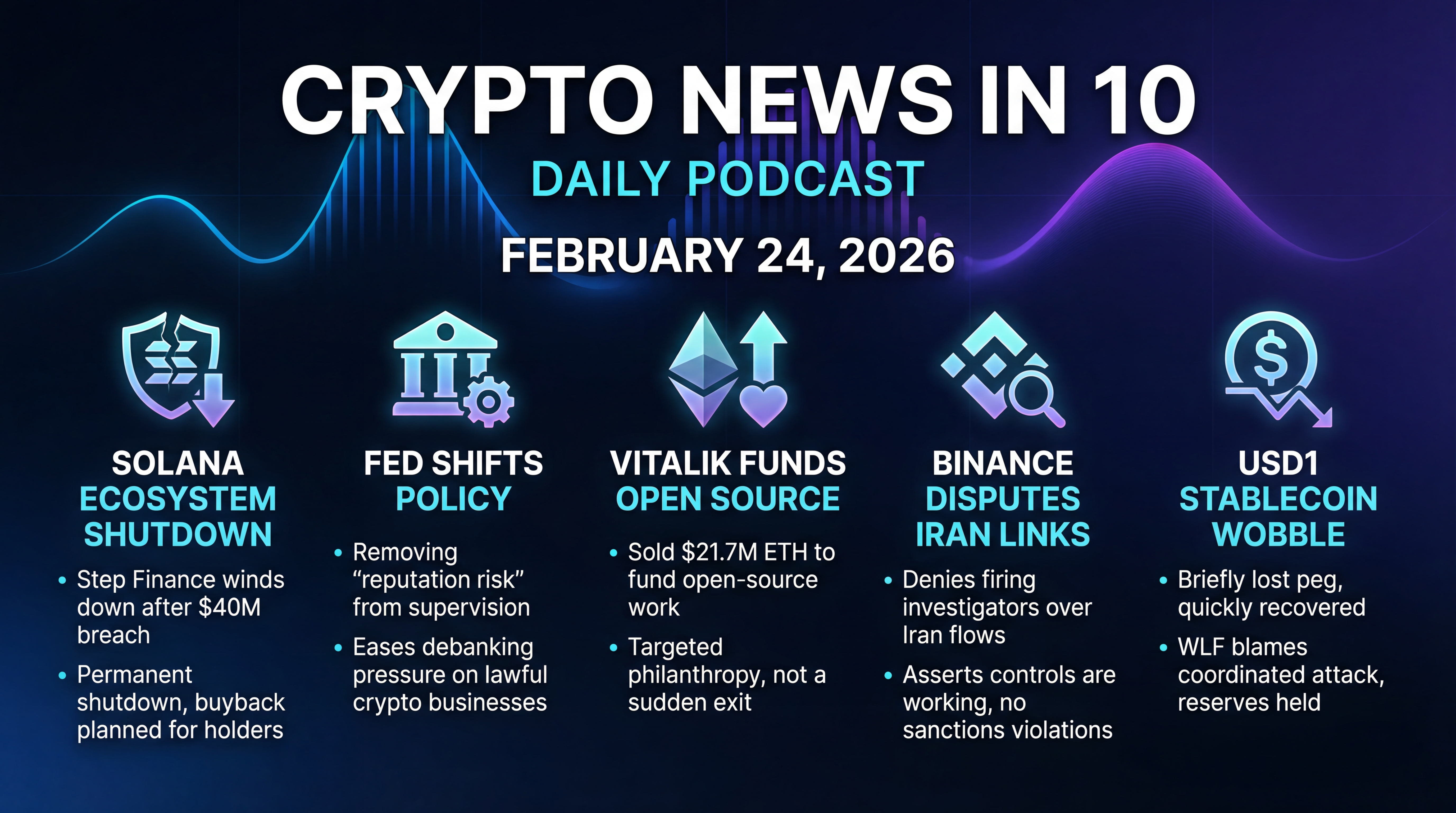
Episode Infographic
Show Notes
Welcome to our Crypto news in 10, a daily podcast bringing you the latest news about crypto in under 10 minutes.
It’s Tuesday, February 24, 2026, and here’s what matters in crypto today.
We’ve got a major Solana ecosystem shutdown after a forty million dollar breach... a meaningful policy move from the Federal Reserve that could ease debanking pressure on lawful crypto businesses... fresh on-chain data showing Vitalik Buterin sold more than ten thousand ETH this month to fund open-source work... Binance pushing back on media reports about Iran-linked flows and investigator firings... and a brief wobble in the Trump-affiliated USD1 stablecoin that quickly re-pegged.
Let’s get into it...
[BEGINNING_SPONSORS]
First up, Step Finance is shutting down — permanently.
The Solana portfolio and analytics platform says it’s winding down operations after a late-January security incident drained roughly forty million dollars from its treasury and fee wallets.
The team spent the last few weeks trying — and failing — to secure financing or an acquisition, and now it’s closing Step Finance along with related businesses, including SolanaFloor and Remora Markets.
The project says it’s preparing a buyback for STEP token holders based on a pre-hack snapshot, while Remora will move ahead with a one-to-one redemption process for rToken holders in USDC. According to market data, STEP fell almost forty percent on the news.
Reports today add some technical context around the January thirty-first breach — executives’ devices were reportedly compromised, not core smart contracts.
Zooming out to policy — the Federal Reserve just took a step the crypto industry has been asking for since the Operation Chokepoint-style banking frictions: codifying the removal of so-called reputation risk from bank supervision.
In a press release dated Monday, February twenty-third, the Fed asked for public comment on a proposal that would make permanent its earlier move to stop using reputation risk as a basis for supervisory actions — underscoring that banks shouldn’t be pressured to refuse services to customers engaged in lawful activity.
Vice Chair for Supervision Michelle Bowman framed it as preventing politicized or unlawful discrimination, with a sixty-day comment window ahead. The OCC and FDIC had already moved in this direction in 2025. For crypto, the signal is clear — if you’re compliant and lawful, your bank shouldn’t be nudged away from you because of headlines.
Story three — Vitalik Buterin has been moving ETH, methodically, and for a reason he flagged in advance.
On-chain data compiled by analytics watchers shows he has swapped a cumulative ten thousand seven hundred twenty-three ETH for stablecoins since February second — about twenty-one point seven million dollars, at an average around two thousand twenty-seven dollars per ETH.
The transactions accelerated over the past few days, with roughly three thousand seven hundred sixty-five ETH sold in the last two and a half days alone. This lines up with his January thirtieth pledge to personally fund an open-source, secure, and verifiable full stack across software, hardware, and even biotech.
Coverage today emphasizes the sales are consistent with that plan. Separate reporting notes his known wallets still hold well over two hundred thousand ETH — so the market context matters — but the narrative here is targeted philanthropy and ecosystem investment, rather than a sudden exit.
[MIDPOINT_SPONSORS]
Fourth — Binance is denying reports it fired internal investigators after they flagged Iran-linked crypto flows.
Multiple outlets this month — most recently the Wall Street Journal and the New York Times — reported that internal probes identified roughly one point seven billion dollars moving to entities tied to Iran in 2024 and 2025, and that several investigators were later suspended or dismissed.
Binance says no one was fired for raising compliance concerns, that its internal review found no sanctions violations tied to the activity described, and that suspicious flows were detected and reported — evidence, it says, that its controls are working. The broader backdrop here is Binance’s 2023 U.S. settlement and ongoing monitorship — scrutiny remains intense — but the company’s line is unequivocal: it disputes both the alleged violations and the motive for any personnel decisions.
And fifth — a brief scare for USD1, the dollar-pegged stablecoin associated with World Liberty Financial, backed by members of the Trump family.
The token slipped fractionally below its peg — reports range from about ninety-nine point four cents on some trackers to roughly ninety-eight cents on certain venues — before recovering within an hour.
WLF blamed what it called a coordinated attack: hacked co-founder social accounts, paid FUD campaigns, and heavy short positioning designed to spark panic. The firm said reserves and redemption mechanisms held, and that core wallets and infrastructure were unaffected.
Coverage today pegs USD1’s market value around four point eight to five billion dollars — significant scale for a newer stablecoin — which is why even a small wobble attracts attention. The big takeaway: minor, short-lived depegs can happen in stress, but the speed of re-pegging — and the transparency of reserves — remain the market’s litmus tests.
Quick recap...
Step Finance’s shutdown is a gut check for operational security across DeFi. The Fed’s move to codify the end of reputation risk could smooth access to banking for compliant crypto firms. Vitalik’s roughly twenty-two million dollars in ETH sales look aligned with his public commitment to fund open-source work. Binance pushed back on explosive media reports, asserting its controls are functioning. And USD1’s brief slip — then quick recovery — underscored how fast stablecoin confidence can be tested... and restored.
See you tomorrow — more in ten.
Thanks for listening and see you tommorow!
