
Kiosk Bans, ZKsync Sunset, Yen Stablecoin, Private BTC
Minnesota moves to ban crypto ATMs, ZKsync retires Lite, Figure posts strong Q4 with a 200 million dollar buyback, Japan readies a trust-bank yen stablecoin, and Starknet unveils private, composable strkBTC. A fast, clear roundup to start your crypto day.
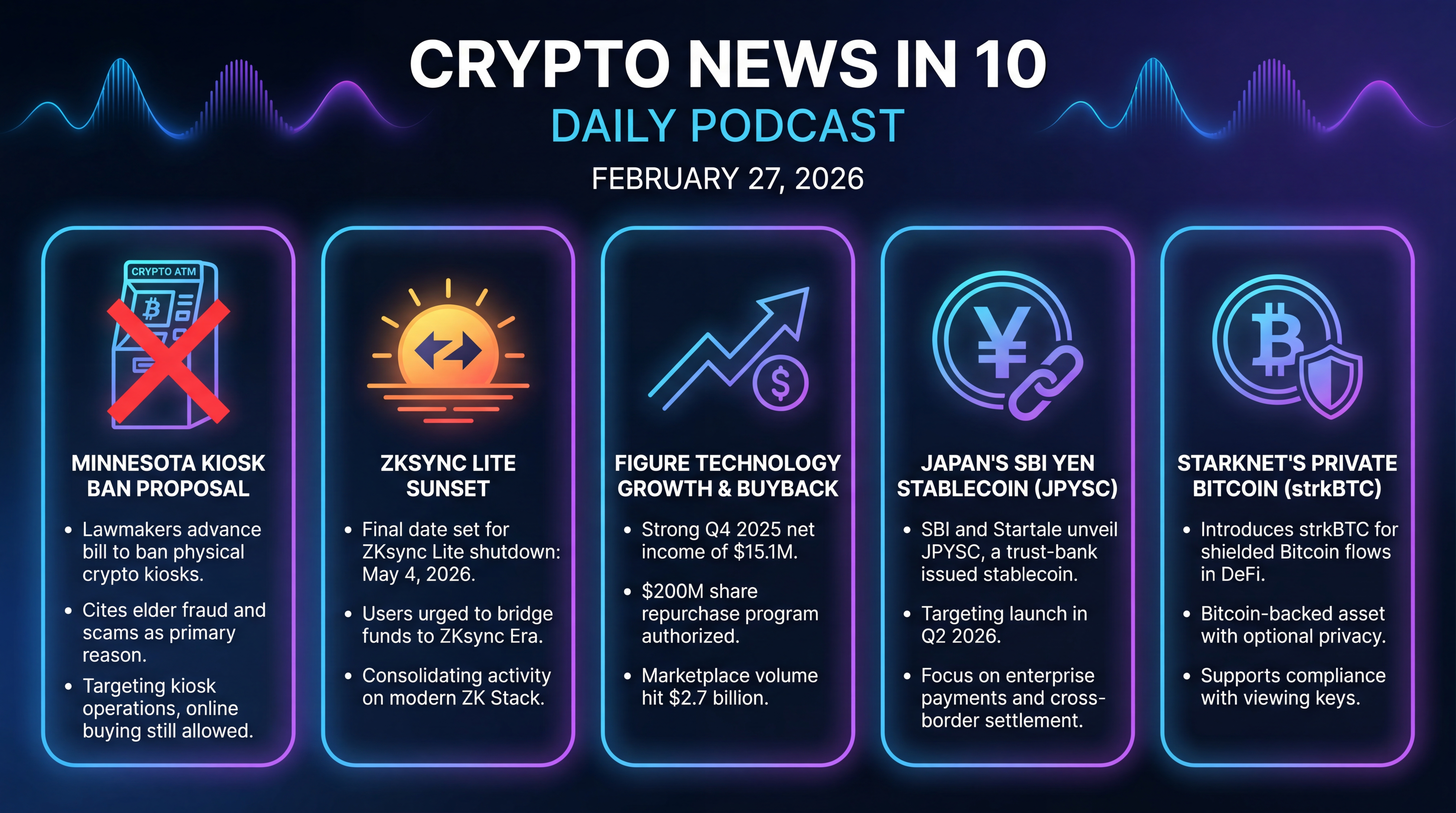
Episode Infographic
Show Notes
Welcome to our Crypto news in 10, a daily podcast bringing you the latest news about crypto in under 10 minutes.
Here’s what’s new in crypto for Friday, February 27th.
We’re starting in the U.S., where Minnesota lawmakers just advanced a proposal to ban physical crypto kiosks after a wave of elder fraud.
Then — Ethereum scaling. ZKsync has set a hard date to switch off its first-generation network and fold activity into Era.
On the market-structure side, Figure Technology posted a strong fourth quarter and authorized a 200 million dollar buyback.
In Asia, Japan’s SBI and Startale unveiled JPYSC — a yen stablecoin issued by a trust bank — with a target launch in the second quarter.
And we’ll wrap with Starknet’s new strkBTC, designed to bring shielded, private Bitcoin flows into DeFi.
[BEGINNING_SPONSORS]
Story one — Minnesota’s push to ban crypto kiosks.
A bill from Representative Erin Koegel would prohibit operating virtual currency kiosks anywhere in the state. Why now... Law enforcement told lawmakers the machines are being used in romance and tech-support scams that drain seniors’ savings. One victim reportedly sent roughly half of her monthly income over several months and needed help from adult-protection services.
The state commerce department says it strongly supports the ban, citing about 70 kiosk-related complaints in 2025 and roughly 540 thousand dollars in reported losses. Minnesota currently has about 350 licensed machines run by eight to ten operators.
The measure would roll back a 2024 law that tried to curb abuse with disclosures, a two thousand dollar daily cap for new customers, and fast-track refunds for fraud — regulators say those steps haven’t been enough. If passed, the ban targets the machines only; residents could still buy or sell crypto online.
It fits a broader pattern. Illinois last year adopted the Digital Asset Kiosk Act... New Zealand announced a nationwide ATM ban for 2025... and Australia floated limits for high-risk products like crypto kiosks. Sources: The Block’s policy desk and Minnesota House Session Daily.
Story two — ZKsync is sunsetting its original chain.
Matter Labs says it will fully deprecate ZKsync Lite — launched in 2020 as version 1.0 — on Sunday, May 4th. Block production stops that day and the final state is frozen; a read-only API will remain available for at least a year. Assets aren’t lost, but users are urged to bridge funds early for a smoother exit.
Why pull the plug... Lite focused on basic transfers and NFT minting, while the ecosystem has since moved to ZKsync Era and the ZK Stack — including so-called prividiums for privacy-preserving rollups. The message is clear: consolidate developer activity and liquidity in one modern stack. Source: The Block.
Story three — Figure Technology’s numbers, and a buyback.
The blockchain-native capital markets firm reported fourth-quarter 2025 net revenue of about 160 million dollars and net income of 15.1 million — up 156 percent year over year. Marketplace volume hit 2.7 billion dollars for the quarter, with Figure Connect growing to more than half of that flow. Adjusted EBITDA came in around 81 million dollars at a 52 percent margin.
Alongside earnings, the board authorized a 200 million dollar share repurchase program. Management highlighted expansion of its OPEN on-chain public equity network, a YLDS token balance near 464 million dollars across use cases, 307 active partners, and growth into new loan categories — including crypto-backed lending and SMB credit. Bernstein kept an outperform rating and a 72 dollar target, saying they like it more after the print. Sources: Figure’s earnings release and The Block’s markets coverage.
[MIDPOINT_SPONSORS]
Story four — Japan’s SBI and Startale unveil JPYSC, a trust-bank-issued yen stablecoin with a second-quarter launch target.
It’s structured under Japan’s revised Payment Services Act using a trust-bank model. SBI Shinsei Trust Bank will handle issuance and reserves, distribution will run through SBI VC Trade, and Startale will provide the blockchain rails.
The goal is a regulated, interoperable yen instrument that enterprises can actually use for payments, treasury, and cross-border settlement — not just trading. The partners say JPYSC will support interoperability across multiple chains and traditional rails, and they’re pitching a longer-term role in things like payments between AI agents and distributions for tokenized assets. It’s a notable step for yen adoption on-chain, following Japan’s broader work to formalize stablecoin reserves and intermediation rules. Sources: The Block, BanklessTimes, and other outlets.
Story five — Starknet’s strkBTC aims to bring private Bitcoin to DeFi.
Announced overnight, strkBTC is a Bitcoin-backed asset on Starknet that supports optional shielded balances and confidential transfers — while staying composable with DeFi. It’s minted deterministically against verifiable BTC deposits — with no discretionary issuer in the middle — and lets users toggle between public and shielded modes.
For compliance, viewing keys can provide lawful auditability without exposing everyone’s activity. The idea is to unlock Bitcoin’s role as productive collateral and trading capital... without broadcasting positions and counterparties on public ledgers. This builds on Starknet’s broader BTCFi push, including staking and incentives to attract Bitcoin liquidity. Sources: Starknet’s official blog and reporting from The Block.
Quick recap... Minnesota’s legislature is weighing a first-of-its-kind state ban on crypto ATMs. ZKsync will freeze Lite on May 4th and focus on Era. Figure posted strong marketplace growth and a fresh 200 million dollar buyback. Japan’s SBI and Startale rolled out a trust-bank model for a yen stablecoin set for the second quarter. And Starknet introduced strkBTC to marry Bitcoin liquidity with privacy in DeFi.
That’s your crypto news in 10 — see you tomorrow.
Thanks for listening and see you tommorow!
