
Europe’s Stablecoin Pivot, Solana’s Payments Push
Europe’s stablecoin rules hit a hard deadline as PSD2 and MiCA converge, while Solana debuts a payments hub and SoFi enables direct SOL deposits. Plus, exploit losses drop to a yearly low, miners pivot toward AI data centers, and Circle posts a standout quarter that spotlights stablecoins’ growing independence from crypto cycles.
Episode Infographic
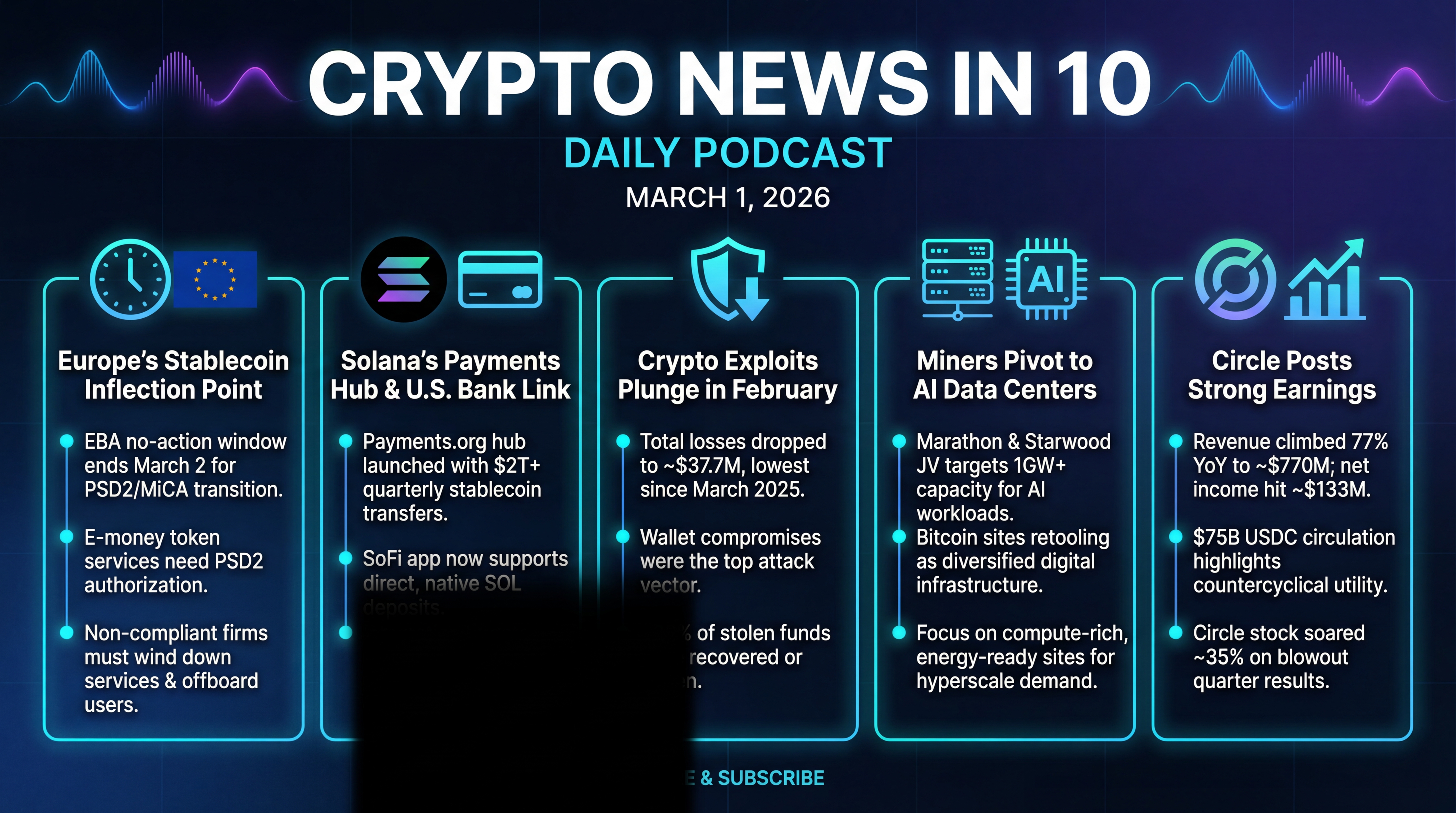
Show Notes
Welcome to our Crypto news in 10, a daily podcast bringing you the latest news about crypto in under 10 minutes.
It’s Sunday, March 1, 2026, and here’s what’s moving in crypto.
Europe hits a regulatory inflection point for stablecoin services tomorrow. Solana just planted a big flag in payments — and a U.S. bank made it easier to go straight from checking to SOL. We’ve also got data showing crypto exploits fell to a one-year low in February, miners retooling for the AI wave, and a major stablecoin issuer posting punchy earnings with a surging stock price. Let’s dive in...
[BEGINNING_SPONSORS]
First up: the European Banking Authority’s clock runs out tomorrow — Monday, March 2 — on the transition between PSD2 and MiCA for electronic money tokens.
The EBA’s February 12 opinion lays out what national regulators should do once the nine-month no-action window ends. In plain English: if you’re a crypto asset service provider that touches e-money tokens — think fiat-backed stablecoins — in ways that count as a payment service, you now need proper PSD2 authorization — or a qualified partner — beyond your MiCA license.
Regulators can let firms continue if they meet specific conditions. Those that don’t are supposed to wind down affected services and offboard customers. It’s a significant operational test — and a preview of how Europe will coordinate stablecoin oversight across securities, banking, and payments rules.
Remember, the EBA’s 2025 no-action letter set March 2, 2026, as the end date. Now it’s here. Expect announcements from EU-licensed platforms in the coming days as they clarify their status.
One more wrinkle... Industry voices warn about duplicative licensing if both MiCA and PSD2 apply to the exact same custody or transfer activity. Policy shops and companies are lobbying to streamline this so one law governs each activity. Whether national authorities flex that pragmatism this spring will be a key storyline for stablecoin growth in Europe.
Story two: Solana wants to own payments — and it just launched a public hub to prove it.
Payments dot org went live this week as a single entry point for builders and enterprises.
The site highlights some eye-popping figures — more than two trillion dollars in quarterly stablecoin transfers on Solana, and roughly three hundred million dollars in monthly payments volume — plus a live USDC payment simulator, integration docs, and case studies. The pitch is clear: a low-fee, sub-second finality network already used by big names in money movement.
Those numbers are project-reported, but the direction of travel is clear — remittances, payouts, and merchant settlement are leaving the lab and hitting production.
And in a notable U.S. banking tie-in, SoFi — yes, the nationally chartered bank — now supports direct Solana network deposits inside its app, giving 13.7 million customers a native on-chain rail without an exchange hop. It’s another step in SoFi’s return to crypto after it relaunched consumer trading in late 2025 as the first nationally chartered U.S. bank to do so. The bank piece matters — if regulated consumer banks can safely bridge on-chain rails, stablecoin-powered payments become far more mainstream.
Story three: security losses eased — sharply.
February 2026 saw about 37.7 million dollars in total losses from hacks and exploits, the lowest monthly figure since March 2025, based on CertiK tracked data. Wallet compromises led the loss categories, phishing followed, and roughly 30 percent of stolen funds were frozen or clawed back.
Notable incidents included YieldBlox at roughly 10.6 million dollars, IoTeX at about 8.9 million, and Foom at 2.3 million. One month doesn’t make a trend... but down and to the right is exactly what everyone wants — especially as more consumer-facing payment flows hit public chains.
[MIDPOINT_SPONSORS]
Story four: miners are morphing into data center landlords for the AI era.
Marathon Digital signed a joint venture with Starwood Digital Ventures — the data center arm of Starwood Capital — to convert and expand selected sites for enterprise, hyperscale, and AI workloads.
The partners say they can deliver about one gigawatt of near-term IT capacity, with a pathway to two and a half gigawatts. Starwood handles design, development, tenant sourcing, and operations — Marathon contributes energy-ready sites. It’s emblematic of a broader pivot we’ve been tracking: compute-rich Bitcoin campuses recast as revenue-diversified digital infrastructure. Shares in crypto-exposed names have been moving on these AI tie-ins, even when mining margins are under pressure.
Finally, a corporate scorecard with macro implications.
Circle’s stock ripped roughly 35 percent midweek after the company posted a strong fourth quarter. Revenue climbed to about 770 million dollars — up 77 percent year on year — with earnings per share of 43 cents versus 16 cents expected. Net income hit roughly 133 million dollars, up from about 3 million a year earlier.
Circle also flagged about 75 billion USDC in circulation, underscoring how fiat-backed stablecoins can be countercyclical to speculative crypto prices — especially when yields on reserves and real-world payments use pick up. For markets, it’s a reminder: stablecoin economics are increasingly their own story, not just a sidecar to Bitcoin’s chart.
Quick recap...
Europe’s PSD2 and MiCA transition period ends tomorrow, putting practical pressure on stablecoin service design across the EU. Solana is packaging its payments pitch — complete with big-league partners and builder tools — just as SoFi brings native SOL deposits to a U.S. bank app. Security losses cooled in February to the lowest monthly tally in nearly a year. Miners are refitting for AI demand, with Marathon and Starwood targeting gigawatts of capacity. And Circle’s blowout quarter shows how stablecoin issuers can thrive even in choppy crypto markets.
We’ll watch for EU licensing updates Monday, bank-to-chain integrations, and whether the security downtrend sticks as payment volume scales on-chain.
Thanks for listening and see you tommorow!
