
Banks, Brokers, and Bitcoin Converge This Week
MicroStrategy buys more Bitcoin as Coinbase rolls out commission-free stock trading, CME expands listed futures to cover most of crypto, and OCC trust charters advance for Crypto.com and Morgan Stanley. Here's how Wall Street rails are wiring into on-chain markets — and why access may drive the next wave of adoption.
Episode Infographic
Show Notes
Welcome to our Crypto news in 10, a daily podcast bringing you the latest news about crypto in under 10 minutes.
It's Tuesday, March 3rd, and here's what's moving in crypto today... A fresh nine-figure Bitcoin buy from the world's largest corporate holder... a big expansion from Coinbase that blurs the line between stocks and tokens... CME's derivatives footprint now spanning most of the crypto market... and two bank-charter moves that show how quickly digital assets are being pulled inside the U.S. banking perimeter.
Quick market note to set the stage: Bitcoin is hovering in the upper sixty-thousand-dollar range after a bounce — with roughly a billion dollars of recent inflows, and resilience despite macro jitters. That sets a constructive tone for the week.
[BEGINNING_SPONSORS]
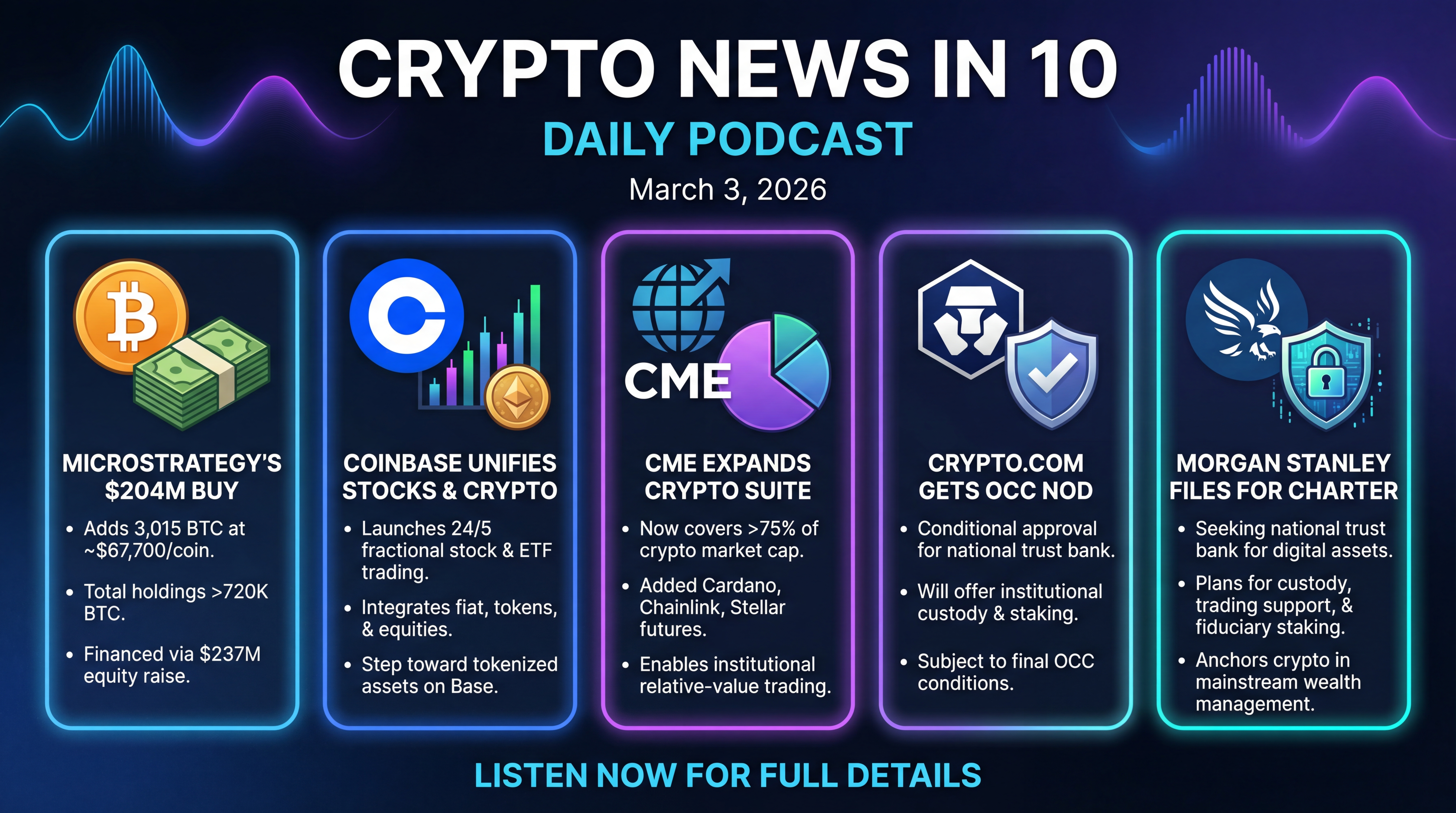
Story one: MicroStrategy — shown as 'Strategy' on some tickers — just doubled down again. Barron's reports the company bought another 3,015 Bitcoin for about 204 million dollars, at an average price near 67,700 per coin. That lifts its holdings to roughly 720,737 Bitcoin, acquired at an average cost of about 75,985 dollars per coin. The purchase was financed with proceeds from a 237 million dollar, at-the-market equity raise — continuing the playbook we've seen for years: sell stock, buy Bitcoin, repeat.
Chairman Michael Saylor is staying the course through volatility. Critics point to leverage and mark-to-market swings, but the company's message is clear: they view Bitcoin as a long-duration treasury asset, and they're buying on weakness. Shares have been choppy year to date... but the conviction hasn't budged.
Why it matters: in an environment where ETF flows are stop-and-go, a corporate balance-sheet buyer stepping in with over 200 million dollars sends a signal about institutional risk appetite. It also keeps the corporate Bitcoin standard narrative alive — warts and all — heading into the spring.
Story two: Coinbase is leaning into an everything-exchange vision. Over the past week, Coinbase began rolling out commission-free stock and ETF trading for U.S. customers — fractional shares from a dollar, and trading available 24 hours a day, Monday through Friday. The company says this is a step toward tokenized equities down the road, but for now it's a traditional brokerage feature living alongside crypto. Reports note the move boosted the stock, highlighting investor interest in a broader revenue mix that's less tied to crypto trading cycles.
If you're a builder or trader, the strategic takeaway is bigger than equities access: Coinbase is stitching together a unified front end for assets — fiat, tokens, and now stocks — which is where the industry has long said we'd end up.
There are a couple of wrinkles to watch. First, how fast do users adopt weekday, around-the-clock equity trading inside a historically crypto-first app? Second, how quickly can Coinbase tie this experience to on-chain rails on Base — their Layer 2 network — for things like payouts, collateral, or tokenized wrappers, without tripping regulatory wires? The goal is clear... but the migration path matters.
Story three: CME's crypto complex now reaches more than three-quarters of the market's capitalization. After adding Cardano, Chainlink, and Stellar futures in February, CME says its suite gives institutions listed-market access to over 75 percent of crypto market cap. The firm also disclosed that average daily open interest across its crypto lineup was nearly 25 billion dollars in 2025.
Why this is a big deal: listed futures are the on-ramp for many risk desks, risk models, and compliance programs. Expanding beyond Bitcoin and Ether into large-cap alts lets banks and asset managers express relative-value views, hedge basis, and manage exposures with the same governance they use for commodities or foreign exchange. In short... the more of crypto that fits into the same boxes as oil, gold, and the euro, the easier it is for big money to participate.
[MIDPOINT_SPONSORS]
Story four: Crypto.com just notched an important U.S. regulatory milestone — conditional approval from the Office of the Comptroller of the Currency to form a national trust bank. In plain English, that's a step toward becoming a federally supervised qualified custodian that can offer institutional-grade custody, staking services, and trade settlement under OCC oversight. Crypto.com says the entity would operate as Crypto.com National Trust Bank, subject to final conditions before opening. Existing state-level operations continue while it works through the OCC's conditions.
One nuance to keep in mind: conditional means there's still a to-do list — capital, governance, and controls — before final approval. But it's a strong signal that the charter pathway for crypto custody banks remains open.
Story five: Morgan Stanley is moving, too. The firm filed for a national trust bank charter — Morgan Stanley Digital Trust, N.A. — with the OCC. The non-confidential parts of the plan describe custody for certain digital assets, support for client trading and transfers, and even fiduciary staking. If green-lit, this would anchor crypto services inside one of America's largest wealth platforms, making it much simpler for advisors and institutions to treat digital assets like any other bank-custodied exposure. It's also a competitive marker — if a marquee wirehouse is building its own stack, others won't want to be left behind.
Stepping back, today's thread is unmistakable: crypto is getting embedded where mainstream capital already lives — derivatives venues like CME, broker platforms like Coinbase, and bank-supervised trust entities from fintechs and Wall Street incumbents. That doesn't erase market risk... but it does lower operational and compliance friction — often the deciding factor for institutional adoption.
Quick recap: MicroStrategy added another 3,015 Bitcoin, pushing its stash north of 720,000 coins... Coinbase opened its doors to weekday, around-the-clock stock and ETF trading alongside crypto... CME says its futures lineup now spans roughly 75 percent of crypto market cap... Crypto.com secured conditional OCC approval to form a national trust bank... and Morgan Stanley filed for an OCC trust charter focused on digital assets. We'll keep watching how fast these banking and brokerage rails connect to on-chain markets — because when they do, the next wave of adoption won't just be about price... it'll be about access.
Thanks for listening and see you tommorow!
