
ETF Rebound, Prediction Markets, and Stablecoin Showdown
Bitcoin ETF inflows top $1.1B as institutional demand returns, while Senator Chris Murphy targets prediction markets tied to government actions. We break down the mEVUSD launch, a harrowing $24M attack on Sillytuna, and the escalating fight over stablecoin yields.
Episode Infographic
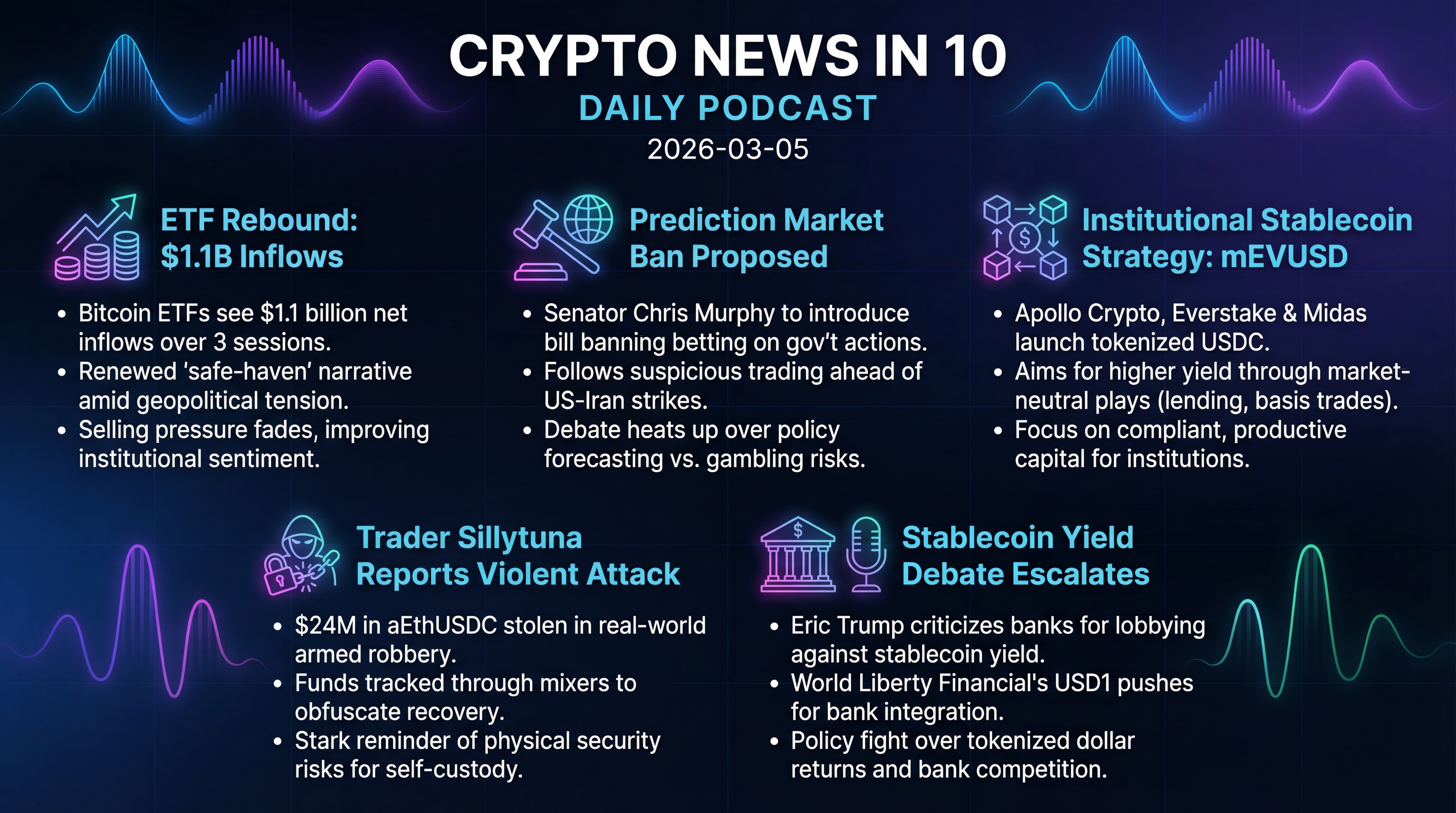
Show Notes
Welcome to our Crypto news in 10, a daily podcast bringing you the latest news about crypto in under 10 minutes.
It’s Thursday, March 5, 2026, and here’s what’s moving crypto today...
Spot Bitcoin ETFs are snapping back, with roughly $1.1 billion in net inflows over just three trading sessions as the safe-haven narrative makes a comeback.
In Washington, Senator Chris Murphy says he’ll introduce a bill to ban prediction markets on government actions after suspicious trading tied to the Iran strikes.
On the product front, Apollo Crypto has teamed up with Everstake and Midas on mEVUSD — an institutional, tokenized USDC strategy aiming to boost stablecoin returns with market-neutral plays.
Security is in focus after the trader known as Sillytuna reported a violent attack and a $24 million loss.
And the political rhetoric around stablecoins is heating up as Eric Trump slams banks for lobbying against yield on tokenized dollars.
Let’s dive in.
[BEGINNING_SPONSORS]
First up, flows...
Bitcoin ETFs just logged about $1.1 billion in net inflows over the past three sessions, helping push Bitcoin back into the low-to-mid seventy-thousand range. That reverses the late-February jitters and has some analysts dusting off the geopolitical-hedge framing as tensions with Iran ripple through traditional markets. BlackRock’s iShares fund and peers saw broad participation across the complex — and importantly, the fourteen-day trend has flipped positive, hinting that selling pressure may be fading.
Why does this matter? ETF demand is one of the cleanest signals of institutional appetite — pensions, registered investment advisors, and corporate treasurers. A three-day, billion-plus streak doesn’t guarantee new highs, but it does reset sentiment, tighten available supply, and often bleeds into alt liquidity as market makers re-risk. If you’re watching key levels, traders are eyeing sustained closes above seventy-three thousand — and whether flows follow through into next week’s macro data.
Now to D.C. and the battle over prediction markets.
Senator Chris Murphy says he will file legislation this month to ban markets that allow trading on government actions — think military strikes — following claims that well-timed bets profited ahead of a joint U.S. and Israel operation against Iran. Blockchain investigators previously flagged wallets that reportedly netted close to seven figures on contracts predicting the U.S. would strike Iran by February 28th, after buying hours before the news went public. It’s not the first time prediction markets have drawn scrutiny, but Murphy’s framing — insiders profiting off war — raises the political stakes.
Context helps here...
Kalshi and Polymarket have been growing fast, with February volume near 18.3 billion dollars by some dashboards. Supporters say these markets surface useful probabilistic signals. Critics worry about corruption risks and public perception when contracts touch national security. Expect a bruising debate over where to draw the line — policy forecasting versus gambling — especially as the C F T C continues to assert jurisdiction over event contracts.
On to new product plumbing.
Apollo Crypto, Everstake, and Midas introduced mEVUSD, a tokenized, USDC denominated strategy designed for institutions that want more than passive, money-market stablecoin yields. The aim is to earn returns from diversified, largely market-neutral plays — think lending via Aave, Morpho, and Pendle, plus basis trades — rather than big directional bets on token prices. Apollo serves as risk manager, while Midas and Everstake bring the platform and infrastructure muscle. The pitch is simple: turn idle stablecoin balances into productive capital under a compliant wrapper.
A couple of angles to watch with mEVUSD...
First, transparency — institutions will want robust disclosures on strategy weights, venue risk, rehypothecation limits, and stress testing under liquidity shocks.
Second, redemption mechanics — tokenized funds live or die on crisp creation and withdrawal flows, especially in volatile weeks.
And third, regulatory clarity — products targeting the E U or U.S. capital markets need to navigate stablecoin, fund, and securities regimes with care. If it works, we could see a wave of cash-plus tokenized yields competing with on-chain T-bill wrappers.
[MIDPOINT_SPONSORS]
Security story next, and it’s a tough one.
The trader known online as Sillytuna says about twenty-four million dollars’ worth of aEthUSDC was stolen in a violent, real-world attack — reports mention weapons, kidnapping, and threats. On-chain investigators at Arkham tracked funds moving across multiple layer-two networks, then into Bitcoin and Monero — classic attempts to break traceability and frustrate recovery. For all the advances in self-custody, this is a stark reminder that seed phrases and multisig don’t defend against physical coercion.
Operational security takeaways...
If you manage meaningful balances, consider splitting custody — keep life funds behind time-locked multisig with geographically separated co-signers, store spendable amounts in hot wallets with strict daily limits, and avoid publicizing holdings or routines. For teams, executive protection protocols and travel op-sec matter — especially around conferences and known industry hubs. Finally, map out rapid-response playbooks: law-enforcement contacts, blockchain analytics vendors, and exchange freeze procedures — ideally rehearsed before you need them.
And rounding out the day, the policy rhetoric around stablecoins keeps heating up.
Eric Trump criticized major U.S. banks for lobbying against paying yield on stablecoin balances — calling it anti-consumer and anti-American. He’s not a disinterested observer; he co-founded World Liberty Financial, whose USD1 stablecoin has been pushing for on-shore bank integration. Still, the message taps into a live policy fight: whether tokenized dollars, when properly regulated, should be able to offer competitive yield that might siphon deposits from traditional banks.
Why you should care: where this lands affects everything from payroll rails to cross-border settlement and cash management for fintechs. If stablecoin accounts can pay yield at scale under bank-grade supervision, expect faster migration of working capital on-chain. If not, watch for more walled-garden models and synthetic workarounds. With Congress weighing broader market-structure tweaks and agencies jockeying for remit, today’s rhetoric is tomorrow’s rulebook.
Quick recap...
ETFs are back in the spotlight with a one point one billion dollar, three-day inflow streak — bullish for sentiment. In policy, Senator Murphy’s push to ban markets on government actions could redraw the lines for event trading. Institutions got a new cash-plus option with mEVUSD’s tokenized yield strategy. A sobering security story underscores physical-world risks. And the stablecoin-yield debate is getting political — fast. We’ll keep tracking how flows, products, and policy collide as the week unfolds.
Thanks for listening and see you tommorow!
