
Dubai Crackdown, Kazakhstan Bets, Vitalik’s Call
Dubai orders KuCoin to halt unlicensed activities as Kazakhstan earmarks 350 million dollars for crypto-linked investments. We unpack Russia’s bank-led exchange proposal, OKX’s new social trading layer, and Vitalik’s push for bold yet principled Ethereum apps.
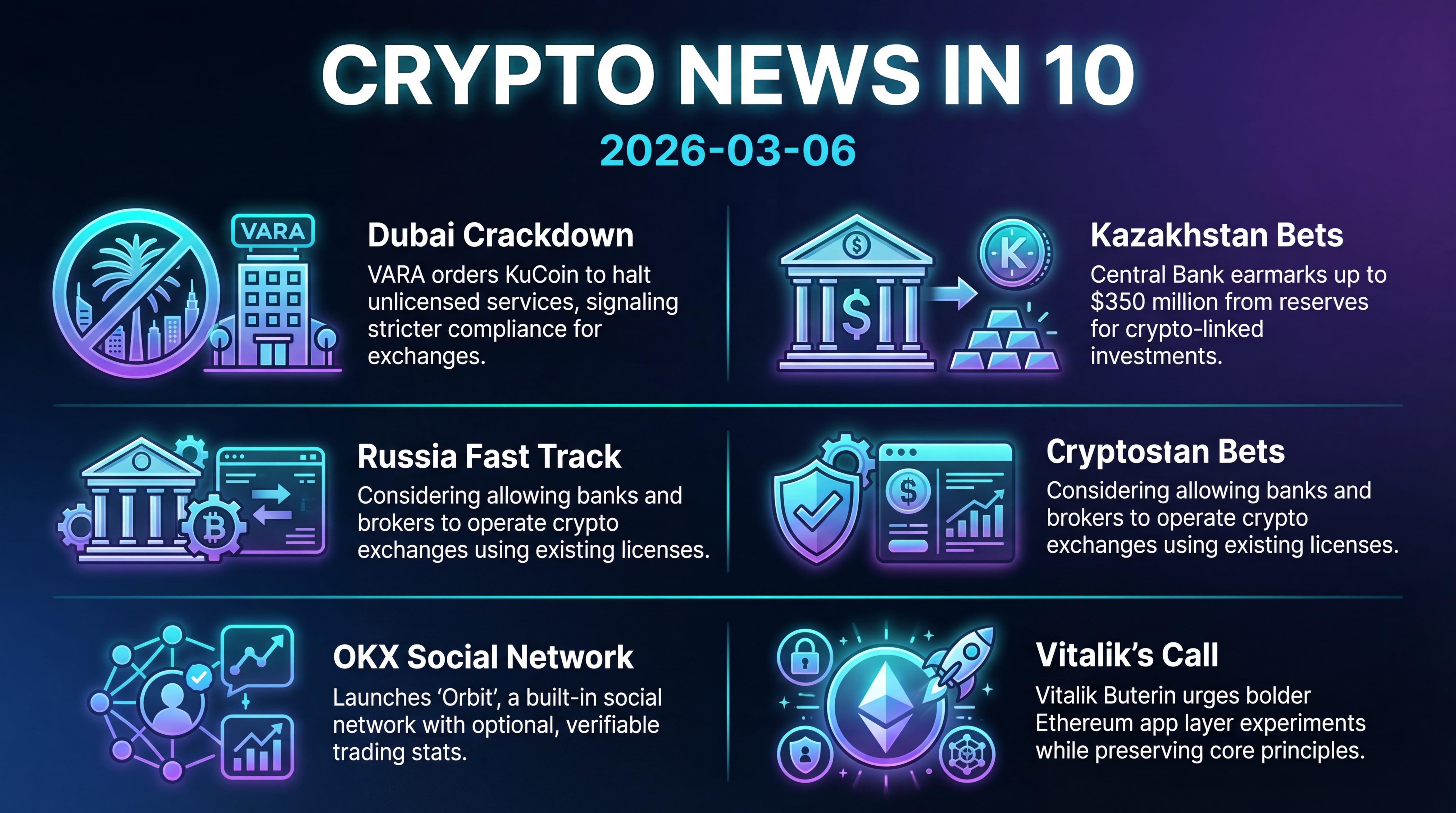
Episode Infographic
Show Notes
Welcome to our Crypto news in 10, a daily podcast bringing you the latest news about crypto in under 10 minutes.
Here’s your quick rundown for Friday, March 6, 2026.
Dubai’s crypto watchdog told KuCoin to stop offering unlicensed services in the emirate... Kazakhstan’s central bank set aside up to 350 million dollars for crypto linked investments... Russia is floating a fast track path for banks to run crypto exchanges... OKX rolled out a built in social network called Orbit, with optional, verifiable trading stats... and Vitalik Buterin is calling for bolder experiments on Ethereum’s app layer — without sacrificing core principles like censorship resistance and privacy.
Let’s dig in.
[BEGINNING_SPONSORS]
First up, Dubai versus KuCoin.
Dubai’s Virtual Assets Regulatory Authority — VARA — issued a market alert telling four entities operating as KuCoin to halt unlicensed virtual asset activities in or from the emirate. The regulator also warned that any promotions were not approved, and said KuCoin does not hold a VARA license under Dubai’s 2022 virtual asset law.
Why it matters — VARA has positioned Dubai as a rules first venue. Telling a top ten global exchange to stand down is a clear signal that marketing and onboarding without a local license will not fly. If you are in Dubai, VARA says to verify providers on its public register before you transact. Reported by The Block.
Next, a central bank making a measured crypto bet.
Kazakhstan’s National Bank says it has set aside up to 350 million dollars — drawn from gold and foreign exchange reserves — to invest in crypto related assets. Governor Timur Suleimenov says deployment could begin as soon as April or May, and may focus on crypto linked companies and index funds rather than big, direct token buys.
Context — Kazakhstan has been a mining heavyweight since 2021 and has explored a broader state crypto reserve structure. This is one of the clearest signals yet from a monetary authority that crypto exposed instruments belong — carefully sized — inside a reserve portfolio. Reported by The Block.
Number three — Russia is considering a notification process that would let banks and brokers operate crypto exchanges by leveraging their existing licenses. Interfax reports the proposal coincides with a broader bill to recognize trading of crypto and stablecoins within existing financial infrastructure — while keeping the ban on using them for domestic payments.
If adopted, this could pull trading activity onto rails supervised by the central bank and securities regulators — think compliance first, retail payments later. Watch for a draft headed to the Duma, and for implementation details around custody, anti money laundering, and investor protections. Reported by The Block.
[MIDPOINT_SPONSORS]
Fourth — OKX just launched Orbit, a native social network inside its trading app. The pitch is simple — close the trust gap in social trading by letting users optionally share verified metrics like profit and loss, win rate, and portfolio performance, right in their profiles. Orbit also supports cashtags like $BTC or $ETH, lets creators host livestreams, spin up topic groups, and even route posts directly to trade tickets — all within the OKX app.
It’s rolling out in phases starting today to a subset of users. Why it matters — social chatter already moves crypto… baking verifiable performance data into the venue where trades actually happen could nudge behaviors toward transparency, and cut down on screenshot theater. Reported by The Block.
And rounding it out, Vitalik Buterin wants Ethereum builders to get bolder at the app layer — without drifting from first principles.
In new comments, he urges experimentation that preserves security, censorship resistance, and privacy, while reexamining the role of Layer 2s so they remain additive to Ethereum rather than parallel ecosystems.
He also flags ideas like encrypted mempools and a FOCIL approach to reduce centralization in block building. For developers, the takeaway is clear — push user experience and performance forward… account abstraction, better privacy, safer MEV design… but keep Ethereum’s cultural and technical guardrails intact. Reported by The Block.
Quick recap — Dubai told KuCoin to stand down without a license, signaling a stricter future for exchange compliance in the UAE. Kazakhstan earmarked up to 350 million dollars from reserves for crypto linked instruments — a notable central bank level endorsement. Russia is weighing a bank led, notification based path that could formalize crypto market structure — without enabling retail payments. OKX’s Orbit fuses social and trading, with optional, verifiable metrics. And Vitalik’s call is a reminder: innovate fast, but don’t compromise Ethereum’s core values. We’ll keep watching how these threads — policy clarity, institutional adoption, and better user experience — reshape crypto’s next chapter.
Thanks for listening and see you tommorow!
