Crackdowns, Scams, and Tokenized Stocks
India tightens crypto reporting, Chainalysis flags record illicit flows, ICE bets on tokenized equities with OKX, Marathon tweaks its HODL strategy, and Europe grants a stablecoin grace period. A fast, clear rundown with takeaways for builders, investors, and compliance teams.
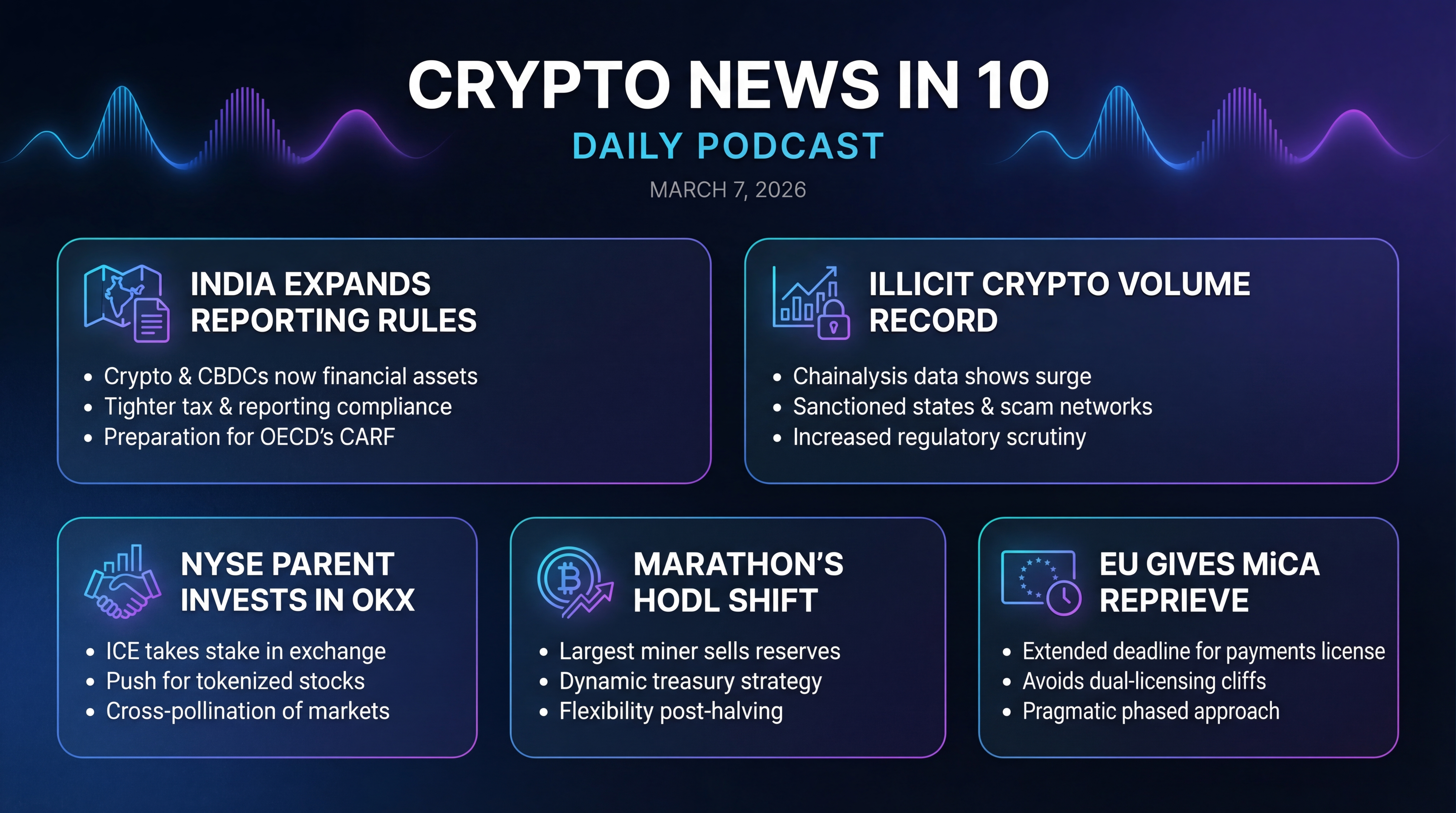
Episode Infographic
Show Notes
Welcome to our Crypto news in 10, a daily podcast bringing you the latest news about crypto in under 10 minutes.
It's Saturday, March 7, 2026... Today's crypto rundown spans policy, enforcement data, big-ticket deals, miner treasury moves, and a regulatory reprieve in Europe.
India just expanded its financial-asset reporting rules to explicitly include crypto and even central bank digital currencies. Chainalysis data shows illicit crypto activity from sanctioned states and scam networks hit a record last year. The New York Stock Exchange's parent company took a strategic stake in OKX to push tokenized equities. Marathon is shifting its long-standing HODL stance... and the European Banking Authority quietly gave stablecoin firms a few extra months to get their payments licenses in order. Let's jump in.
[BEGINNING_SPONSORS]
Story one: India turns the compliance screws.
Late Friday local time, India's Central Board of Direct Taxes broadened what counts as a “financial asset” for information reporting. It now explicitly includes crypto assets, “specified electronic currencies,” and central bank digital currencies — CBDCs — and it widens the idea of a “depository account” to cover accounts that hold those e-money products.
In practice, that means more institutions will have to identify, record, and report crypto and CBDC holdings and flows — tightening tax transparency and cross-border data sharing over time. Bloomberg Tax notes the move came via a March 5 notice and lands ahead of India's staged adoption of the OECD's Crypto-Asset Reporting Framework, or CARF. For exchanges and fintechs operating in India, the takeaway is simple: more reporting touchpoints, fewer gray zones... and higher penalties if you miss filings. Source: Bloomberg Tax — link in the show notes.
This shift also dovetails with India's stick-and-carrot approach: keep the 30 percent gains tax and the 1 percent TDS for now, but steadily migrate crypto into mainstream financial reporting. Firms should expect know-your-customer and anti-money-laundering — KYC and AML — data requests to expand, and wallet-level attestations to become routine as regulators knit crypto into existing frameworks. Source: Fortune India — link in the show notes.
Story two: illicit crypto volumes surged in 2025 — driven by sanctioned states and scam factories.
Chainalysis data, reported by DL News, pegs total illicit on-chain volume at roughly 154 billion dollars last year, up sharply year over year. Investigators point to Russia-linked flows, transactions tied to Iran's Islamic Revolutionary Guard Corps, and North Korea's banner year of exploits... plus sprawling Southeast Asian pig-butchering networks. One eyebrow-raising detail: a ruble-linked “A7A5” stablecoin reportedly used to skirt sanctions in cross-border trade.
The big picture — crypto's neutrality cuts both ways. As mainstream use grows, so does misuse... and the analytics arms race intensifies. Source: DL News, citing Chainalysis — link in the show notes.
For builders and compliance teams, expect more geofencing, more sanctions screening at the wallet and smart-contract level, and sharper definitions of what counts as “mixing” or “obfuscation.” The pressure will likely accelerate the rise of permissioned rails for institutional money alongside open networks.
Story three: a TradFi giant bets on a top exchange — and on tokenized stocks.
Intercontinental Exchange — the NYSE parent — has invested in OKX at a 25 billion dollar valuation. The partnership is notable on a few fronts: ICE gets a board seat; it will license OKX's spot price data to support new U.S.-regulated crypto futures; and the pair will explore listing tokenized NYSE equities and derivatives to OKX's 120 million-user base later this year.
It's a cross-pollination moment — market data and regulated futures from ICE, distribution and crypto liquidity from OKX. If executed carefully, tokenized equities could compress settlement cycles and enable fractional access for global users... without displacing primary markets. Source: The Block — link in the show notes.
One caveat — cross-border securities rules. Getting tokenized shares to trade to retail outside home jurisdictions will demand careful licensing, disclosures, and transfer-agent functionality. But the direction of travel is clear: traditional market operators are moving from observing tokenization to building with it.
[MIDPOINT_SPONSORS]
Story four: a mining bellwether loosens the HODL handbrake.
Marathon Digital — ticker M-A-R-A — the largest public bitcoin miner by on-balance-sheet holdings, updated its 2026 treasury policy to allow selling from its stockpiled reserves... not just newly mined coins. As of December 31, 2025, Marathon held about 53,822 bitcoin, with roughly 9,377 on loan and 5,938 pledged as collateral against credit facilities.
Management framed the change as flexibility — think capex, debt service, and opportunistic de-risking if volatility spikes. For miners broadly, this underscores a post-halving reality: treasury strategy is now an active lever, not a set-and-forget doctrine. Source: The Block, citing Marathon's 10-K — link in the show notes.
Expect investors to parse quarterly filings for realized sale timing, loan terms, and hedging — especially if fees soften or hashprice dips. A wave of “dynamic HODL” policies could dampen the extreme supply squeezes of prior cycles... but also blunt upside reflex rallies if multiple miners sell into strength.
Story five: a little breathing room for euro stablecoin operations.
With MiCA — the EU's Markets in Crypto-Assets regulation — overlapping with payments law, the European Banking Authority has extended the effective window for firms that submit a payment service provider application by March 2. Those firms can continue certain stablecoin services until July 1, 2026, subject to conditions. Spanish business daily Cinco Días reports the move aims to avoid cliff edges as hundreds of firms race to align MiCA authorization with payments licensing.
The industry has warned of dual-licensing friction — needing both a MiCA CASP license and a payments license for the same custody or transfer activity — something Circle and others flagged months ago. Sources: Cinco Días and Yahoo Finance — links in the show notes.
Zooming out... the EU is using phased, pragmatic guidance to keep services running while the rules harden — an approach that reduces consumer disruption but forces issuers and platforms to level up transparency, reserve management, and real-time disclosures. By late 2026, expect fewer, larger euro stablecoin programs with bank-grade attestation and 24/7 redemption.
Quick recap to wrap.
India folds crypto and CBDCs into mainstream financial-asset reporting — compliance teams, your to-do lists just got longer. Chainalysis data shows illicit crypto usage concentrated in sanctioned states and organized scams — policy and analytics will keep tightening. ICE's bet on OKX is a tokenization shot across the bow from Wall Street. Marathon's flexible treasury marks an era where miners actively manage reserves. And in Europe, the EBA's short extension buys time for a smoother MiCA-plus-payments landing by July 1, 2026.
That's your crypto brief for Saturday, March 7. See you tomorrow.
Thanks for listening and see you tommorow!
