
Nasdaq Eyes Tokenized Stocks, Bitcoin Hits 20M
Nasdaq unveils an issuer-led equity token framework with Kraken as Bitcoin crosses the 20 million milestone. Plus: Binance’s ETH pause for an upgrade, Bhutan’s 175 BTC transfer, and U.S. spot ETFs net $568M in fresh inflows.
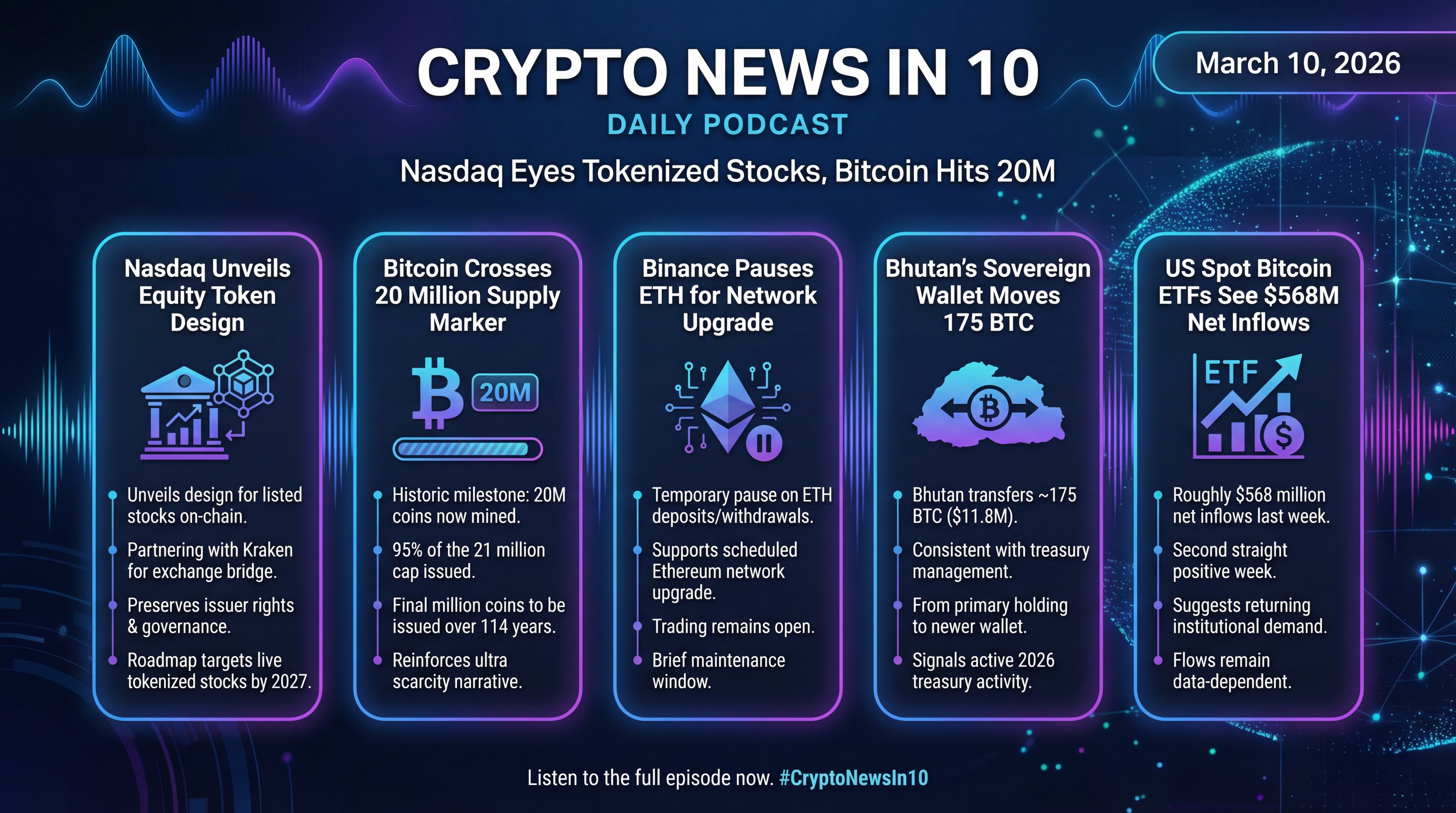
Episode Infographic
Show Notes
Welcome to our Crypto news in 10, a daily podcast bringing you the latest news about crypto in under 10 minutes.
It’s Tuesday, March 10, 2026. Here’s what’s moving in crypto today.
Big news on tokenization: Nasdaq has unveiled an equity token design—with Kraken in the mix—aimed at bringing listed stocks on-chain. Bitcoin just crossed a historic supply marker, with 20 million coins mined, and we’ll unpack what that really means. Binance is pausing ETH deposits and withdrawals today to support a scheduled Ethereum network upgrade. Bhutan’s sovereign wallet activity picked up again with a fresh transfer of 175 BTC. And U.S. spot Bitcoin ETFs logged roughly $568 million in net inflows over the week, hinting at returning demand even as macro jitters linger.
Let’s dive in.
[BEGINNING_SPONSORS]
First up: tokenization at the heart of traditional finance. Nasdaq announced an equity token design that would let public companies issue and control tokenized versions of their shares—keeping issuer rights, governance, and price integrity front and center.
The plan references prior SEC filings to enable trading and settlement of tokenized securities through established market plumbing like DTCC. And here’s the kicker—Kraken is named as a partner supporting the architecture, creating an exchange-native bridge between regulated markets and public blockchains.
Nasdaq frames tokenization as a way to make equities interoperable across regulated systems and open networks, while preserving issuer control. Industry chatter points to a roadmap targeting live tokenized stocks and ETPs by 2027... if approvals stay on track.
It’s notable because it’s issuer-led—not just a wrapper on top of existing shares. If the design ships, think programmable corporate actions, near-instant settlement windows, and composability with on-chain finance—without abandoning the protections of today’s market infrastructure.
Second, the milestone everyone’s been watching: the twenty-millionth bitcoin has been mined. With roughly 95% of the 21 million cap now issued, the remaining million coins will trickle out over more than a century, thanks to halving mechanics.
Several trackers flagged the milestone yesterday—March 9—with estimates converging around early to mid-March based on block height and issuance curves.
Context matters. While the first 20 million coins took about 17 years, the final million will take roughly 114 years—issuance is now ultra scarce, and over time the network will lean more on fees for security.
Scarcity narratives tend to resurface around these waypoints... but price doesn’t have to react instantly. In the short run, macro drivers and ETF flows still set the tone. For long-term allocators who prize predictable monetary policy, this is one to circle on the calendar.
Third, a heads-up if you’re moving ETH today. Binance is temporarily pausing Ethereum deposits and withdrawals to support a scheduled network upgrade.
The window was flagged in advance, with maintenance expected to last about an hour, and services resuming automatically once the upgrade completes. Trading stays open—this is strictly about wallet deposits and withdrawals during the window.
If you’ve got settlements or bridges hitting layer one today, build in a buffer. Most exchanges follow similar playbooks to protect clients during network changes.
[MIDPOINT_SPONSORS]
Fourth, sovereign flows. Bhutan moved 175 BTC—about $11.8 million—yesterday, pushing 2026 outflows from government-linked holdings toward the mid-forty-million range, according to on-chain analytics cited by multiple outlets.
The transfer went from a primary holding address to a newer wallet, consistent with prior patterns the kingdom has used before executing sales through institutional channels.
Bhutan has been an outlier among states—leaning on hydropower to mine and hold bitcoin—and its treasury activity is now being watched more closely as price volatility and funding conditions shift. One transfer doesn’t define policy... but continued moves suggest more active treasury management in 2026 than in prior years.
And fifth, flows before narratives. U.S. spot Bitcoin ETFs racked up roughly $568 million in net inflows over the latest week, led by the largest funds—even as late-week redemptions clipped totals.
By several trackers, that’s a second straight positive week after a rough patch—important because ETF flows have been a reliable barometer of institutional risk appetite this cycle. A steady bid from these products helps absorb miner issuance and market distribution, and it can tighten range-bound price action when macro is noisy.
Keep in mind, flows have been choppy day to day, and CPI lands mid-week—so allocators remain data-dependent. Still, the two-week streak is a constructive tell for near-term support.
Quick wrap-up. Nasdaq’s issuer-first tokenization blueprint—paired with Kraken’s crypto plumbing—signals that traditional equity markets are getting serious about on-chain rails. Bitcoin’s 20 million milestone quietly reinforces its fixed-supply design... while Binance’s brief ETH pause reminds us upgrades still require operational discipline. Sovereign wallets like Bhutan’s remain a wild card in supply dynamics. And ETF inflows near $568 million show institutions are tiptoeing back into BTC as they watch the macro tape.
That’s your crypto catch-up for Tuesday, March 10, 2026... see you tomorrow.
Thanks for listening and see you tommorow!
