
Ethereum’s Big Stake, Sei’s Leap, Quantum Reality Check
From Ethereum’s record staking deposits to Sei’s EVM migration and new U.S. guidance, we break down the moves shaping crypto right now. Plus, why Bitcoin ATMs are disappearing — and why quantum won’t crack mining anytime soon.
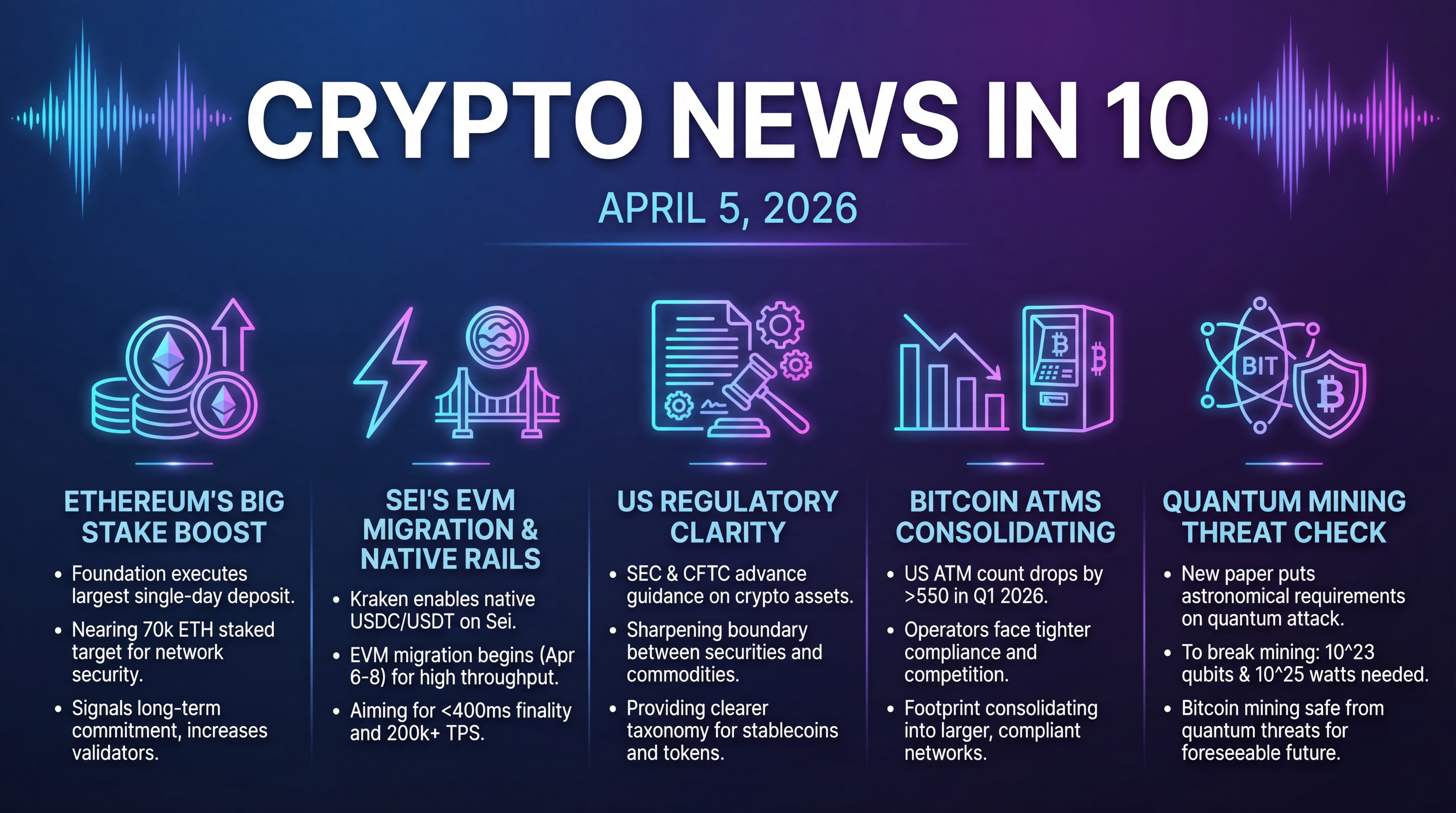
Episode Infographic
Show Notes
Welcome to our Crypto news in 10, a daily podcast bringing you the latest news about crypto in under 10 minutes.
It’s Sunday, April 5, 2026 — and we’ve got a tight lineup.
The Ethereum Foundation just ramped up staking with its biggest deposits yet. Sei’s EVM migration week kicks off, with Kraken wiring in native USDC and USDT. Washington’s rulemakers quietly advanced crypto guidance that’s being digested into the weekend. Bitcoin ATMs continue to disappear across the United States. And a new quantum computing paper puts eye-popping numbers on what it would take to break Bitcoin mining. Let’s get you caught up... in under ten minutes.
[BEGINNING_SPONSORS]
First, Ethereum’s treasury just leaned harder into staking.
Over the past week, the Ethereum Foundation executed its largest single-day deposit on record — 22,517 ether, roughly 46 million dollars at the time — sent via eleven transactions into the Beacon Deposit Contract, as tracked by Arkham. That push was followed on April 3 by another wave — around 45,000 ether — bringing the Foundation close to a stated goal near 70,000 ether staked, with rewards earmarked for grants, research, and securing the network.
Industry coverage this week highlighted the ramp and outlined the plan to reach that 70,000-ether mark across validators. If you’re wondering about market impact... the story here is less about short-term price and more about signaling — an anchor investor for Ethereum’s security budget committing to a steady, programmatic staking cadence. That can translate into rising validator counts and, over time, a modest tilt to ETH’s supply dynamics through rewards — even as broader macro drives price day to day.
Second, speed and convenience matter — and Sei is trying to remove friction right as it enters migration week.
Kraken has enabled direct USDC and USDT deposits and withdrawals to the Sei EVM, giving users a native, no-bridge stablecoin rail into the ecosystem. Sei’s weekly roundup highlighted the switch-on, and the timing lines up with the EVM-only migration set for April 6 through 8. The upgrade — nicknamed Giga — aims high, with public materials touting more than 200,000 transactions per second and finality under 400 milliseconds. Coinbase has also signaled operational support.
Why it matters: native stablecoin rails can turn a Layer 1 or EVM chain from a speculative venue into usable plumbing for apps, payments, and market making. If Sei’s migration lands clean — and those throughput targets hold under real load — users should see fewer hops and faster settlement... two levers that attract liquidity.
Third, the policy front.
In late March, U.S. market regulators made twin moves that the industry is still digesting this weekend. The SEC published an interpretive release on how federal securities laws apply to certain crypto assets and transactions — important for exchange listings, staking programs, and token distributions. In parallel, the CFTC issued final guidance on how non-security crypto assets fit under the Commodity Exchange Act — sharpening the boundary between securities and commodities treatment.
PwC’s March 27 brief captured the practical takeaway many compliance teams are acting on now: a clearer taxonomy, firmer inter-agency coordination, and early contours for how stablecoins and other token categories will be treated in supervision and reporting. Axios framed the posture as long expected — and friendlier than prior eras. It’s still not a finished legislative framework, but it’s a more predictable lane for product teams. For founders, that’s the difference between maybe later... and we can ship.
[MIDPOINT_SPONSORS]
Fourth, where are the Bitcoin ATMs going?
Quarter-to-date numbers show the United States lost more than 550 machines in Q1 — dropping from 30,788 on January 1 to 30,229 by April 1. That’s a 1.82 percent decline, averaging a net loss of a bit more than six machines per day. Data from Coin ATM Radar — compiled by Finbold — extend a trend we saw last year, as operators face tighter compliance costs, shrinking spreads, and competition from cheaper on-ramp options.
Bottom line: retail cash-to-crypto still has a place, but the footprint is consolidating into larger, better-capitalized networks with stricter KYC — and more users are simply opting for exchange apps or bank-linked stablecoin rails.
And fifth, that quantum threat headline you saw — let’s put numbers on it.
A new paper on arXiv estimates that mounting a direct quantum assault on Bitcoin’s proof of work, at January 2025 difficulty, would require on the order of ten to the twenty-third qubits and around ten to the twenty-fifth watts — numbers so extreme they flirt with a Kardashev Type Two energy scale. In other words... not happening with any remotely foreseeable hardware.
The practical takeaway: research into quantum-safe cryptography still matters — especially for signatures and long-term key storage — but the physics-level requirements to break mining itself are astronomically out of reach. Don’t ignore quantum, but don’t let it drive your 2026 portfolio either.
Quick recap before we go:
Ethereum’s foundation made its biggest single-day staking move and is closing in on a 70,000-ether target — a strong signal for network security.
Sei’s EVM migration kicks off this week with Kraken’s native USDC and USDT rails live, aiming at major performance gains.
U.S. regulators advanced guidance that sharpens the securities-versus-commodities line, giving builders clearer rules of the road.
America’s Bitcoin ATM count shrank again in Q1 as retail on-ramps consolidate.
And the latest quantum paper suggests Bitcoin mining is safe from sci-fi attacks for the foreseeable future.
That’s your crypto in ten — see you tomorrow.
Thanks for listening and see you tommorow!
