
Weekend Crypto Pulse: Policy Shifts, Futures Fade, Stablecoins Surge
From a new CFTC innovation task force to a cooler CPI backdrop, we break down what moved crypto into the weekend. Plus: the CME basis unwind, a giant corporate ETH disclosure, and a sweeping stablecoin forecast that could redefine payments.
Episode Infographic
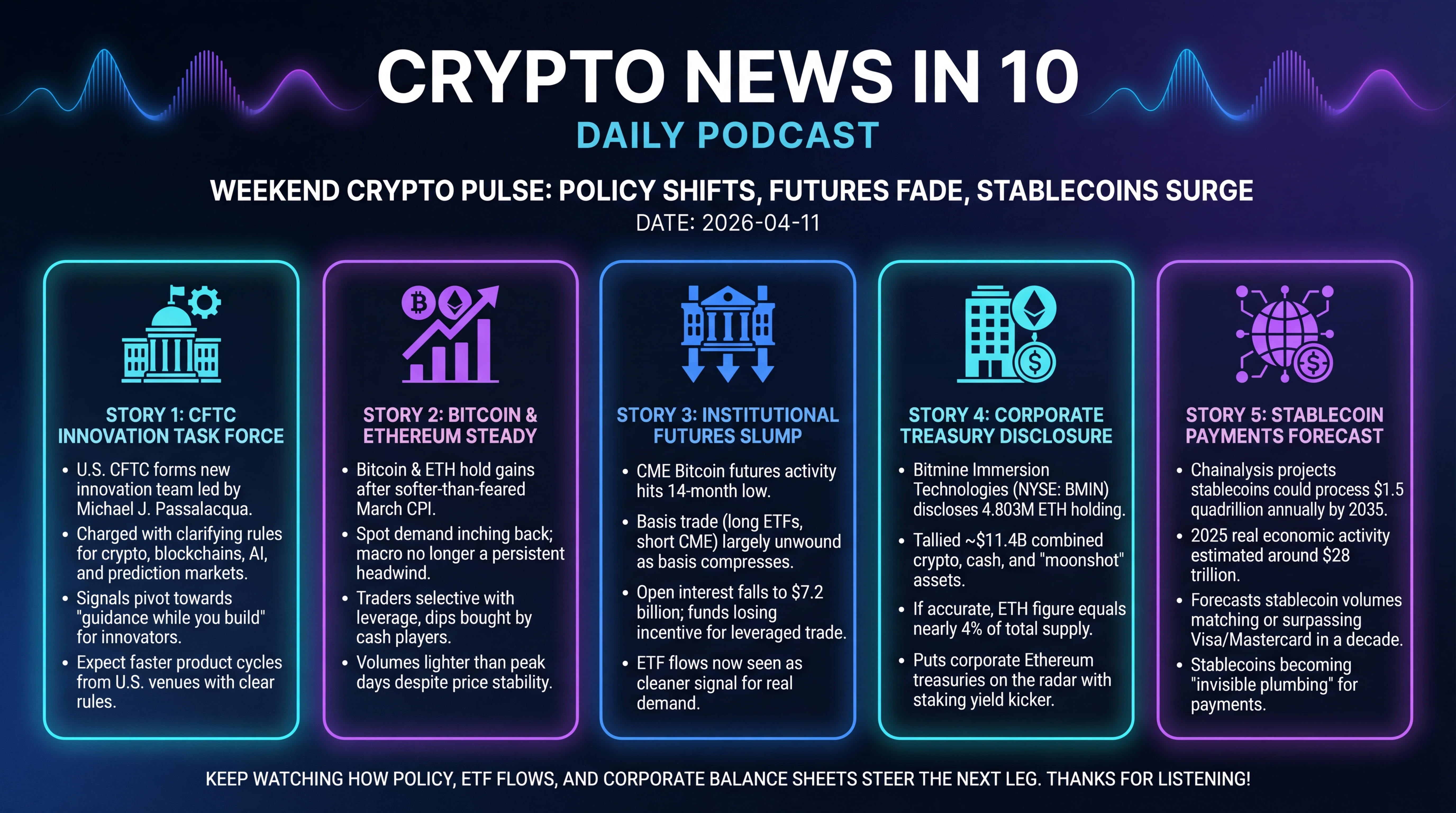
Show Notes
Welcome to our Crypto news in 10, a daily podcast bringing you the latest news about crypto in under 10 minutes.
It’s Saturday, April 11, 2026, and here’s what moved crypto as the week rolled into the weekend...
We’ve got U.S. regulators forming a new innovation team with crypto in scope, Bitcoin steadying after softer than feared inflation, a sharp pullback in CME Bitcoin futures that says a lot about institutions, a surprising corporate treasury disclosure tied to an NYSE uplisting, and a bold stablecoin forecast that—if it even comes halfway true—could reshape payments. Let’s get into it.
[BEGINNING_SPONSORS]
Story one—policy.
Late Friday, April 10, the Commodity Futures Trading Commission announced an Innovation Task Force, staffed across divisions and charged with clarifying rules for crypto assets, blockchains, AI systems, and even prediction markets. The group is led by Michael J. Passalacqua, with Chairman Michael S. Selig saying the goal is clear rules of the road for American innovators.
Why this matters: it signals a pivot toward guidance while you build—rather than after the fact enforcement. It also dovetails with the CFTC's recent digital asset taxonomy work and the no action relief steps we’ve seen this spring.
If this task force starts publishing advisory letters, sandbox parameters, or model risk controls for tokenized collateral, expect faster product cycles from U.S. venues that want to stay onshore. That’s the read through heading into late April.
Source: The CFTC's April 10 press release.
Story two—markets.
Bitcoin and Ethereum held their bid into the weekend as traders digested Friday's March CPI—it rose, but not as much as some feared—and a recent cooling in geopolitical risk. Bitcoin touched around seventy three thousand at one point this week, with Ethereum popping into the mid two thousands—around twenty two hundred—before easing.
The bigger context: after a bruising first quarter of outflows and headline shocks, spot demand is inching back, and a softer dollar helped risk appetite... but volumes remain lighter than peak days, and traders are still selective with leverage.
The takeaway for Saturday: macro is no longer a persistent headwind, but it’s not a green light either—position sizes are smaller, and dips are getting bought by cash players rather than perpetual traders.
Source: DL News market wrap from April 10, plus earlier week updates.
Story three—institutions.
CME Bitcoin futures activity has slumped to a fourteen month low as the once crowded basis trade—long the ETFs, short CME—has largely unwound. Average daily open interest fell to about 7.2 billion dollars in early April—levels not seen since February 2024—and March volume slid nearly fifty percent from its January 2025 peak.
When the annualized basis compresses to roughly the risk free rate, after fees and capital costs, leveraged funds lose the incentive to run that trade. Open interest bleeds out, and venues like Binance can retake share on sheer retail volume.
What to watch next week: does the basis meaningfully re widen versus Treasury yields? If not, hedge funds may stay on the sidelines, and ETF flows—rather than futures—will remain the cleaner signal for real demand.
Source: The Block analysis from April 9.
[MIDPOINT_SPONSORS]
Story four—corporate balance sheets.
A fresh filing tied to an NYSE uplisting disclosed that Bitmine Immersion Technologies now holds 4.803 million ETH, and tallied about 11.4 billion dollars in combined crypto, cash, and so called moonshot assets. The filing also notes the company's move from NYSE American to the NYSE, effective April 9.
If accurate, that Ether figure equates to nearly four percent of total supply, and would make Bitmine an Ethereum first analog to the well known corporate Bitcoin treasuries—except with a staking yield kicker that Bitcoin doesn’t provide.
Caveats: this is the company's own disclosure. Investors will be parsing footnotes, auditor sign offs, custody, and any lockups or debt used to acquire that stack. Still, the headline puts corporate Ether treasuries squarely on the 2026 radar.
Source: SEC EDGAR exhibit filed this week.
Story five—the payments future.
Chainalysis is out with a striking projection: by 2035, stablecoins could process on the order of 1.5 quadrillion dollars in annual transactions, if current adoption curves continue. The firm pegs 2025 stablecoin real economic activity around 28 trillion dollars—already rivaling some traditional rails—and argues that merchant acceptance and on chain settlement could push volumes to match, or even surpass, Visa and Mastercard within a decade.
Even if you haircut that forecast heavily, the directional point is powerful... stablecoins are becoming invisible plumbing. For builders, that means KYC compliant wallets, compliant on and off ramps, and chain agnostic acceptance layers. For investors, it means revenue shifting to issuers, treasurers, and wallet or checkout providers.
Source: DL News coverage of the Chainalysis forecast from April 8.
Quick recap...
The CFTC's new Innovation Task Force suggests more guidance while you build is coming. Bitcoin and Ethereum are holding post CPI gains, but with lighter volumes. CME's futures slump shows the basis trade's comedown and a reset in institutional positioning. Bitmine's NYSE uplisting and 4.803 million Ether disclosure, if validated, would be a landmark for corporate ETH treasuries. And a bold Chainalysis call says stablecoins could handle immense throughput by the mid 2030s.
We’ll keep watching how policy clarity, ETF flows, and corporate balance sheets steer the next leg. Enjoy the rest of your weekend.
Thanks for listening and see you tommorow!
