
Vietnam Greenlights Crypto, Jupiter Resets Airdrop
Vietnam moves ahead with a regulated crypto trading pilot as Jupiter slashes and reshapes its 2026 airdrop. We also break down Flare's FIP.16 tokenomics revamp, today's Aptos unlock, and Aave's newly raised deposit caps.
Episode Infographic
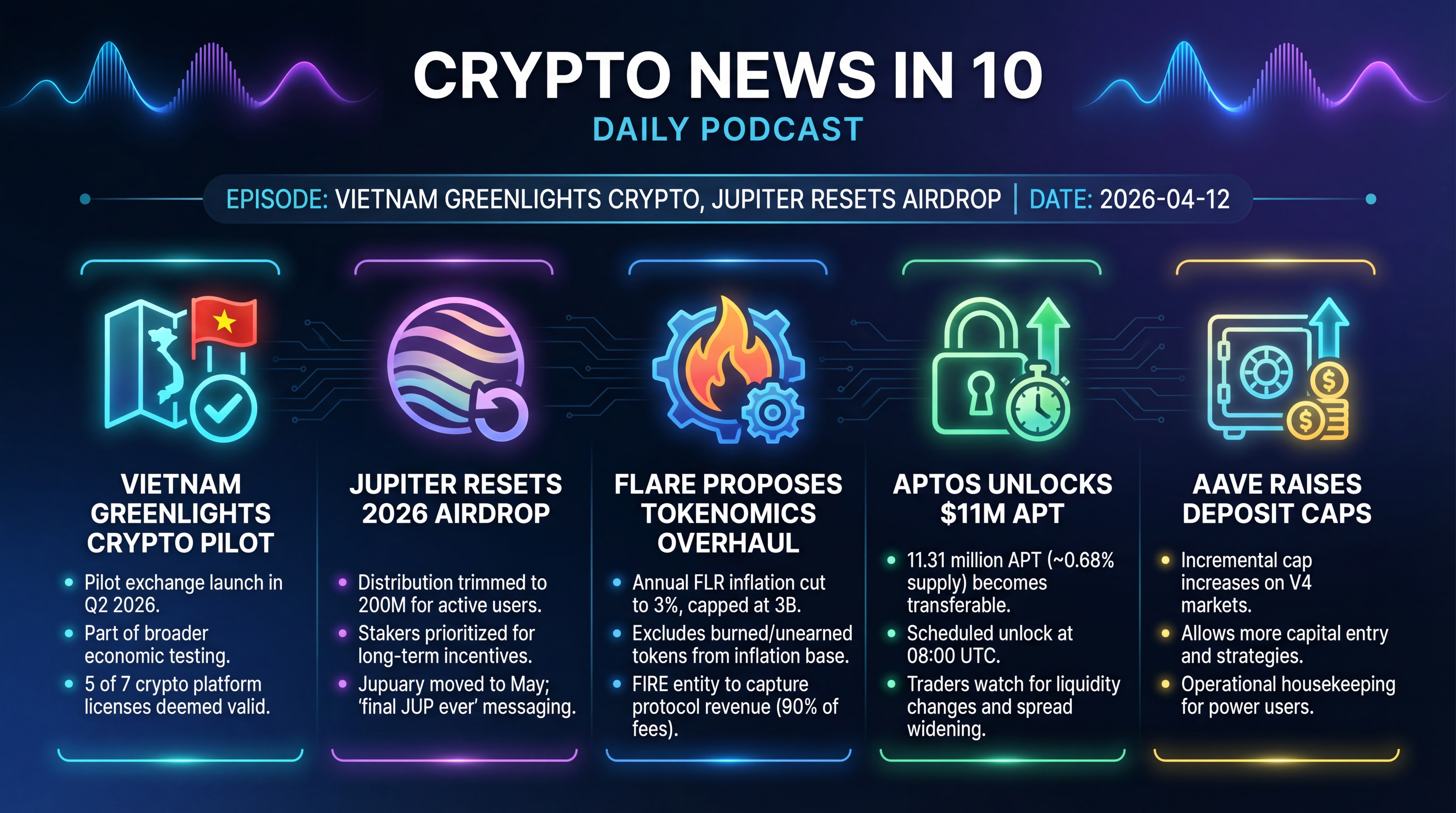
Show Notes
Welcome to our Crypto news in 10, a daily podcast bringing you the latest news about crypto in under 10 minutes.
It's Sunday, April 12, 2026. Here's your six-minute sprint through crypto's most interesting moves... A Southeast Asian government greenlights a pilot exchange, Jupiter retools its 2026 airdrop on Solana, Flare proposes a tokenomics overhaul, Aptos runs a sizable unlock this morning, and Aave quietly raises deposit caps. Let's get into it.
[BEGINNING_SPONSORS]
Story one — Vietnam just took a concrete step toward regulated trading of digital assets.
Prime Minister Le Minh Hung has directed the pilot launch of a trading platform for crypto and other digital assets starting in the second quarter of 2026 — part of a broader push to test new economic models.
The government's report, delivered on April 9 at the first session of the 16th National Assembly, pairs the exchange pilot with plans for a carbon credit market and data-trading platforms.
Notably, the Finance Ministry says it reviewed seven license applications for crypto platforms, with five deemed valid under current rules. That's meaningful — the pipeline is already forming before the pilot even turns on.
If the sandbox runs smoothly, expect a clearer path for licensing and bank connectivity in Vietnam's domestic market. Source: VnEconomy.
Story two — on Solana, Jupiter's community approved a proposal that reshapes its 2026 "Jupuary" airdrop.
The plan trims the widely discussed 700 million JUP distribution down to 200 million for active users, allocates another 200 million to stakers, and locks 300 million for longer-term incentives — a seventy-one percent cut to what some farmers expected near term.
Community messaging frames this as the "final JUP ever"... with staking-weighted rewards meant to favor committed holders over pure airdrop hunters.
Price action was modest — just a few percentage points — but the supply path and timing have changed. Fewer tokens will hit the market immediately, snapshots are done, and Jupuary slides to May. For Solana DeFi, it's another example of communities trading headline splash for longer-run alignment. Source: CoinMarketCap.
Story three — Flare governance is weighing a tokenomics overhaul via proposal FIP.16.
Headline move: cut annual FLR inflation from 5 percent to 3 percent, and cap yearly issuance at 3 billion tokens.
Under the hood, the plan would exclude burned tokens, unearned rewards in penalty pools, and treasury-held FLR from the inflation base — so effective sell pressure drops more than the raw percentage suggests.
It would also create FIRE — the Flare Income Reinvestment Entity — to capture protocol revenue. Ninety percent of Flare Data Connector fees would flow into that treasury for redistribution or burns.
It's a classic value-capture design: tie network usage to tokenholder benefit, and slow reflexive emissions. Markets noticed — the token ticked higher into the news — but the bigger question is whether other layer-one networks follow with similar supply discipline in 2026. Source: CoinMarketCap.
[MIDPOINT_SPONSORS]
Story four — Aptos executes a scheduled unlock today that traders have been eyeing all week.
At roughly 08:00 UTC, about 11.31 million APT — roughly 0.68 percent of released supply — become transferable. Unlocks don't guarantee volatility, but they do change microstructure: market makers often widen spreads around the event... funding rates can wobble as hedges come on or off... and spot desks watch whether newly unlocked allocations hit exchanges or stay sidelined.
If you track APT liquidity, watch depth on the majors and any basis widening between perpetual futures and spot as the window approaches. Source: Tokenomics.
Story five — in lending markets, Aave's latest governance updates raised deposit caps on V4 markets — incremental, but impactful if you live in the trenches of yield and borrowing costs.
Higher caps let more capital enter, which can compress deposit APYs at the margin while giving sophisticated borrowers more headroom for strategies that were bumping into ceilings.
The tweak landed alongside relatively quiet weekend price action — call it operational housekeeping that matters for power users. If you've been capped out on deposits, check the dashboards today to see what reopened. Source: CoinMarketCap.
Quick wrap-up: Vietnam's pilot exchange decision is a real policy step — licenses, a sandbox, and a timeline — while on-chain governance dominated the rest.
Jupiter cut near-term emissions and tilted rewards to stakers... Flare's FIP.16 aims to hard-wire value capture and slow dilution... Aptos's unlock is the day's key supply event... and Aave nudged deposit ceilings higher for capital that was waiting at the door.
We'll keep tracking what actually ships next — especially whether Vietnam's pilot lists its first pairs in Q2, and how today's governance moves translate into flows this week. Source: VnEconomy.
Thanks for listening and see you tommorow!
