
Korea’s Circuit Breakers, DOT Exploit, Options Uncapped
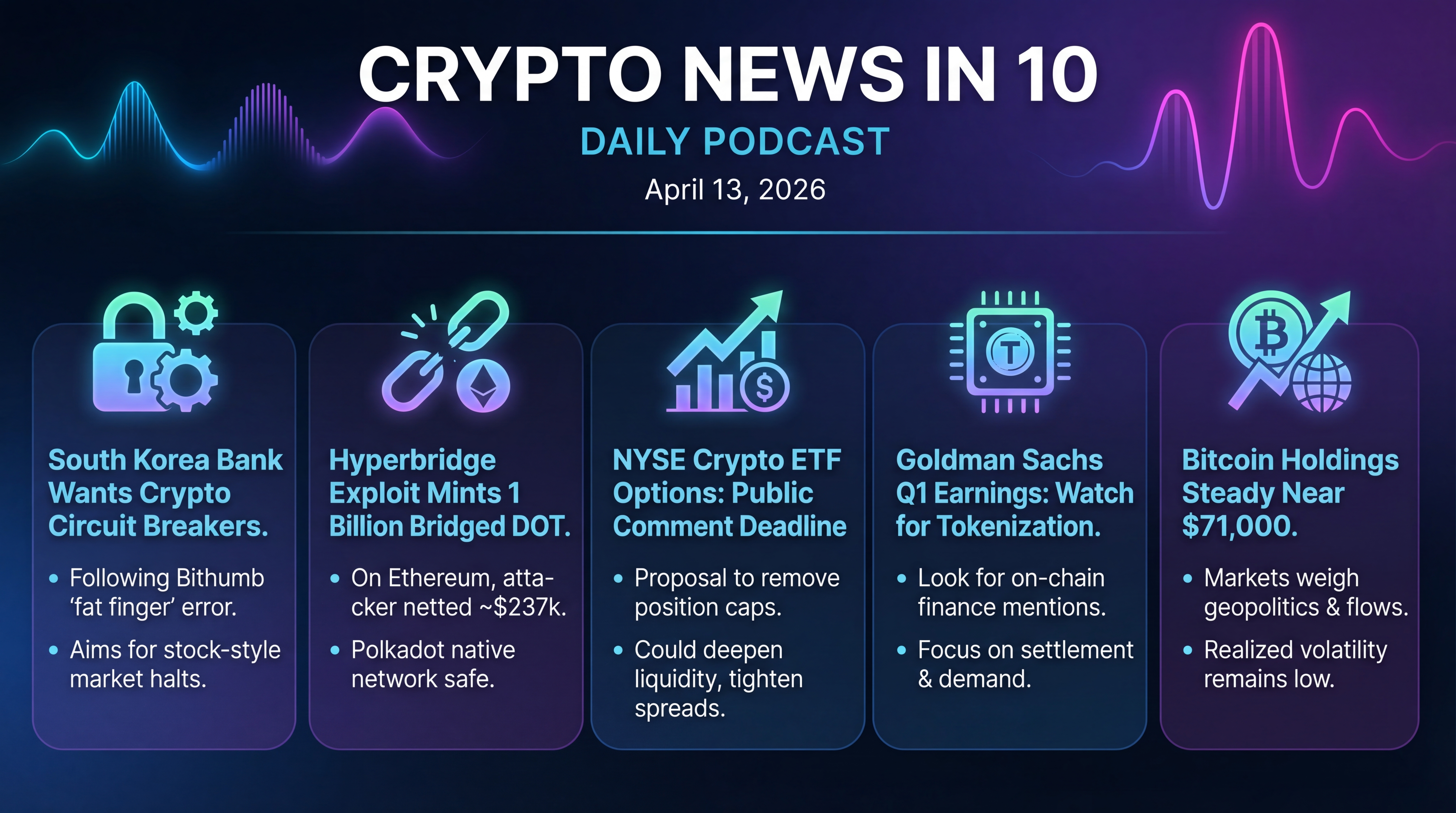
South Korea pushes stock style circuit breakers for crypto as Hyperbridge’s exploit mints a billion bridged DOT on Ethereum, while NYSE options caps hit a key comment deadline. Plus, what to watch in Goldman’s earnings and where Bitcoin stands to start the week.
Episode Infographic
Show Notes
Welcome to our Crypto news in 10, a daily podcast bringing you the latest news about crypto in under 10 minutes.
Here’s what’s moving crypto this Monday, April thirteenth, twenty twenty six.
We’ve got a big policy signal out of South Korea — the central bank wants stock style circuit breakers for digital assets after February’s Bithumb mishap.
There’s also fresh security news: an exploit on Hyperbridge let an attacker mint one billion bridged DOT on Ethereum... and Korean exchanges briefly paused Polkadot deposits and withdrawals.
In the U.S., today is the public comment deadline on a New York Stock Exchange proposal to remove position caps on options tied to crypto ETFs — a small change on paper, potentially big for liquidity.
We’ll set expectations for Goldman Sachs’ first quarter earnings — especially anything on tokenization.
And we’ll close with a market check: Bitcoin is holding around seventy one thousand dollars as traders weigh geopolitics and flows.
[BEGINNING_SPONSORS]
Story one — Korea’s central bank wants a crypto circuit breaker.
In a new report, the Bank of Korea is calling for tighter internal controls at exchanges. It also wants a market wide circuit breaker — similar to equities — to trigger temporary trading halts during abnormal price moves.
The push follows Bithumb’s February fat finger. A staffer keyed BTC instead of KRW on a giveaway, mistakenly transferring what amounted to about six hundred twenty thousand bitcoin equivalents across hundreds of wallets. The Bitcoin to Korean won pair dropped roughly fifteen percent before the platform reacted.
The BOK says the episode shows how quickly venues can cascade without hard stops. It wants lawmakers to bake safeguards into the forthcoming Digital Asset Basic Act. It’s a notable shift — after years focused on AML and licensing, Korea’s macro prudential guardrails may soon look more like public markets’ plumbing. According to The Block, Bithumb took about twenty minutes to detect the error — time a circuit breaker would try to buy back.
Story two — a bridge exploit hits DOT on Ethereum.
Early today, on chain sleuths and security firm CertiK flagged an attack on Hyperbridge’s gateway contract. The attacker seized admin control and minted one billion bridged DOT on Ethereum.
The haul? Only about one hundred eight ETH — roughly two hundred thirty seven thousand dollars — because the bridged asset had thin liquidity and collapsed to near zero as the mint was dumped.
Polkadot’s teams stressed the issue was isolated — it did not touch the Polkadot network or other bridges. Even so, native DOT slipped about four percent intraday as headlines hit. The Block reports that South Korea’s Upbit and Bithumb temporarily suspended DOT deposits and withdrawals as a containment step, and local notices pointed users to an investigation in progress. The takeaway: cross chain message verification remains a prime attack surface... token supply illusions can appear off chain even when layer ones are fine.
Story three — options plumbing for crypto ETFs, and today’s the line in the sand.
NYSE exchanges have moved to remove certain caps on options tied to crypto exchange traded funds — covering products like BlackRock’s IBIT and Fidelity’s FBTC. Why it matters: lifting position limits lets market makers warehouse more risk, which can tighten spreads and deepen liquidity for hedgers around these ETF underlyings.
The public comment window on the NYSE filings closes today, April thirteenth, so we should see the next round of SEC staff feedback and, soon after, final approvals. If you trade volatility across spot ETFs and CME futures, this change could affect how quickly options markets absorb large directional flow.
[MIDPOINT_SPONSORS]
Story four — Goldman Sachs prints before the bell. Listen for tokenization.
DL News has the first quarter report on the macro calendar and flags tokenization as a theme to watch. Goldman has already piloted tokenized assets and digital market infrastructure with clients. On recent calls, bulge bracket desks have framed on chain finance as an operations and distribution story — not a pure crypto beta bet.
Here’s what we’re tracking on the call: mentions of private market tokenization, settlement pilots with custodians, and client demand for spot crypto ETF workflows routed through prime brokerage channels. If management leans into the idea that financial market plumbing goes on chain, watch for revenue lines beyond trading — think issuance, servicing, and data.
Story five — markets. Bitcoin steadies near seventy one thousand dollars.
Price action this morning is calm after a headline heavy week that saw crypto shrug off parts of the macro tape. Local roundups put BTC around the seventy one thousand mark and ETH in the high three thousands as of early U.S. hours.
Bigger picture: ETF flows have flipped between days of net outflows and strong inflows, funding markets remain orderly, and realized vol sits below the spikes we saw in March — leaving room for positional resets into late April catalysts. Keep an eye on whether today’s options housekeeping, and this week’s U.S. bank earnings, nudge hedging flows around the seventy two to seventy five thousand strikes.
Quick wrap up: Korea’s central bank wants circuit breakers in crypto... a Hyperbridge exploit minted a billion bridged DOT on Ethereum and briefly hit sentiment... the NYSE’s crypto ETF options cap changes hit a key comment deadline today... Wall Street is watching Goldman for tokenization color... and Bitcoin is holding around the seventy one thousand dollar handle as we start the week.
We’ll be back tomorrow with the next wave of product launches, policy moves, and anything else the crypto tape throws our way.
Thanks for listening and see you tommorow!
