
On-Chain Stocks, Tokenized Bonds, and THYP
Europe’s SIX Group brings equities data on-chain, Ripple and Kyobo Life pilot tokenized Korean bond settlement, 21Shares reveals THYP for its Hyperliquid ETF, Virginia sets in-kind rules for unclaimed crypto, and TeraWulf raises big for AI data centers. A fast, clear rundown of the day’s biggest crypto moves.
Episode Infographic
Show Notes
Welcome to our Crypto news in 10, a daily podcast bringing you the latest news about crypto in under 10 minutes.
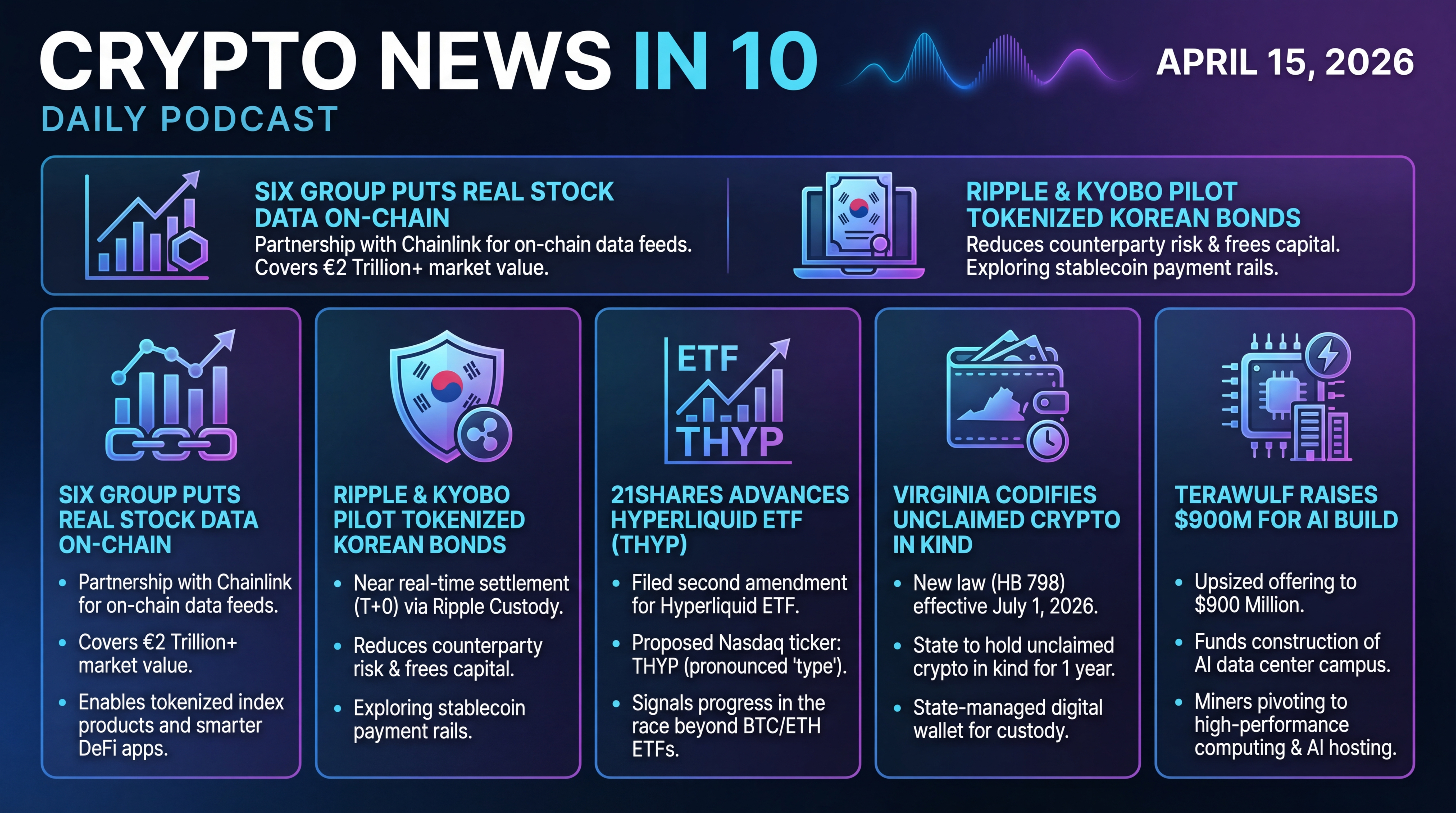
It’s Wednesday, April 15, and here’s what’s moving in crypto today... Europe’s SIX Group is putting real stock market data on-chain through Chainlink, Ripple and Kyobo Life are piloting tokenized settlement for South Korean government bonds, 21Shares hits an ETF milestone with an S-1 update and a proposed Nasdaq ticker, Virginia just clarified what happens to unclaimed crypto — with an in-kind twist — and bitcoin miner TeraWulf raised big to fund an AI data center buildout. Let’s get into it.
[BEGINNING_SPONSORS]
First up, a major bridge between TradFi and DeFi.
Switzerland’s SIX Swiss Exchange and Spain’s BME — both part of SIX Group — are now publishing equities market data directly on-chain using Chainlink. SIX says these feeds will be available to more than 2,600 applications across over 75 public and private blockchains, covering companies that together represent more than two trillion euros in market value.
That opens the door to tokenized index products, structured notes, and smarter DeFi apps that rely on high-quality, permissioned reference data. It’s another proof point that tokenization isn’t just pilots anymore — it’s production data landing on-chain.
SIX flagged April 15 as the go-live date and framed the move as extending its market-data footprint onto blockchain rails. We’ve seen similar on-chain data hookups from Deutsche Börse, FTSE Russell, and S&P Global... and now SIX adds two major European venues to that list.
Now to Asia, where tokenized fixed income just took a leap.
Ripple announced a partnership with Seoul-based Kyobo Life Insurance to enable tokenized South Korean government bond transactions using Ripple Custody. Moving settlement from T plus two into near real time could cut counterparty risk and free up capital — think faster settlement cycles and automated post-trade.
They also plan to explore stablecoin-based payment rails alongside custody. It’s Ripple’s first collaboration with a major Korean insurer, and local business media report both sides reviewed a live test environment as part of the pilot. For institutions wondering when tokenized bonds become operational rather than experimental... Korea may be an early case study.
Next, the ETF pipeline widens beyond bitcoin and ether.
21Shares filed a second amendment to its S-1 for a U.S. Hyperliquid ETF and disclosed the proposed Nasdaq ticker: THYP — pronounced “type.” The filing progress signals ongoing dialogue with the SEC, with reporting noting initial seeding mechanics and the planned listing venue.
The Hyperliquid race is heating up. Bitwise recently updated its own filing to include the ticker BHYP and a 0.67 percent fee, while Grayscale filed for GHYP in late March. So 21Shares planting a flag for THYP matters for product positioning and ticker mindshare. Today’s move doesn’t mean an approval is imminent — but it does mark forward motion in the first wave of spot ETFs tied to a non-BTC, non-ETH asset in the U.S.
[MIDPOINT_SPONSORS]
Stateside policy development... Virginia just codified what happens to crypto that sits dormant.
With the governor’s approval on April 13, HB 798 is now law, effective July 1, 2026. It creates a statutory framework for digital assets under the state’s Disposition of Unclaimed Property Act and, notably, instructs the state to hold unclaimed crypto in kind — that is, as the original coin — rather than converting to cash right away, for at least one year.
The fiscal impact memo even calls for a state-managed digital wallet to custody assets, with an estimated 120,000 dollars in ongoing annual costs starting in fiscal year 2028 to operate the capability. For users, the idea is simple: if you reclaim funds, you can receive what you had — crypto — rather than the fiat proceeds of a quick liquidation. For other states, Virginia just published a model.
And we’ll close with a sizeable raise that shows how miners are evolving.
TeraWulf priced 47.4 million shares at 19 dollars, upsizing its offering to roughly 900 million dollars. Proceeds are earmarked to fund construction of a new data center campus in Hawesville, Kentucky, repay a bridge facility, and support additional site acquisitions.
The company has been pivoting beyond pure bitcoin mining into high-performance computing and AI hosting — and market reports noted the stock traded lower in pre-market after the deal priced. The offering is slated to close as soon as April 16, subject to customary conditions. Whether you’re bullish or cautious on miners, the signal is unmistakable: cheap power plus capital markets access is turning some bitcoin miners into AI infrastructure landlords.
Quick recap...
SIX Group put Swiss and Spanish equities data on-chain via Chainlink — moving tokenization from talk to tooling. Ripple and Kyobo Life kicked off a tokenized Korean government bond pilot with custody and near-real-time settlement in scope. 21Shares advanced its Hyperliquid ETF plan with a proposed Nasdaq ticker — THYP. Virginia’s new law sets an in-kind standard for unclaimed crypto. And TeraWulf’s 900 million dollar raise underscored how mining meets AI infrastructure. That’s your crypto news in ten.
Thanks for listening and see you tommorow!
