
Arbitrum Freeze, On-Chain Bonds, and Benchmark Shifts
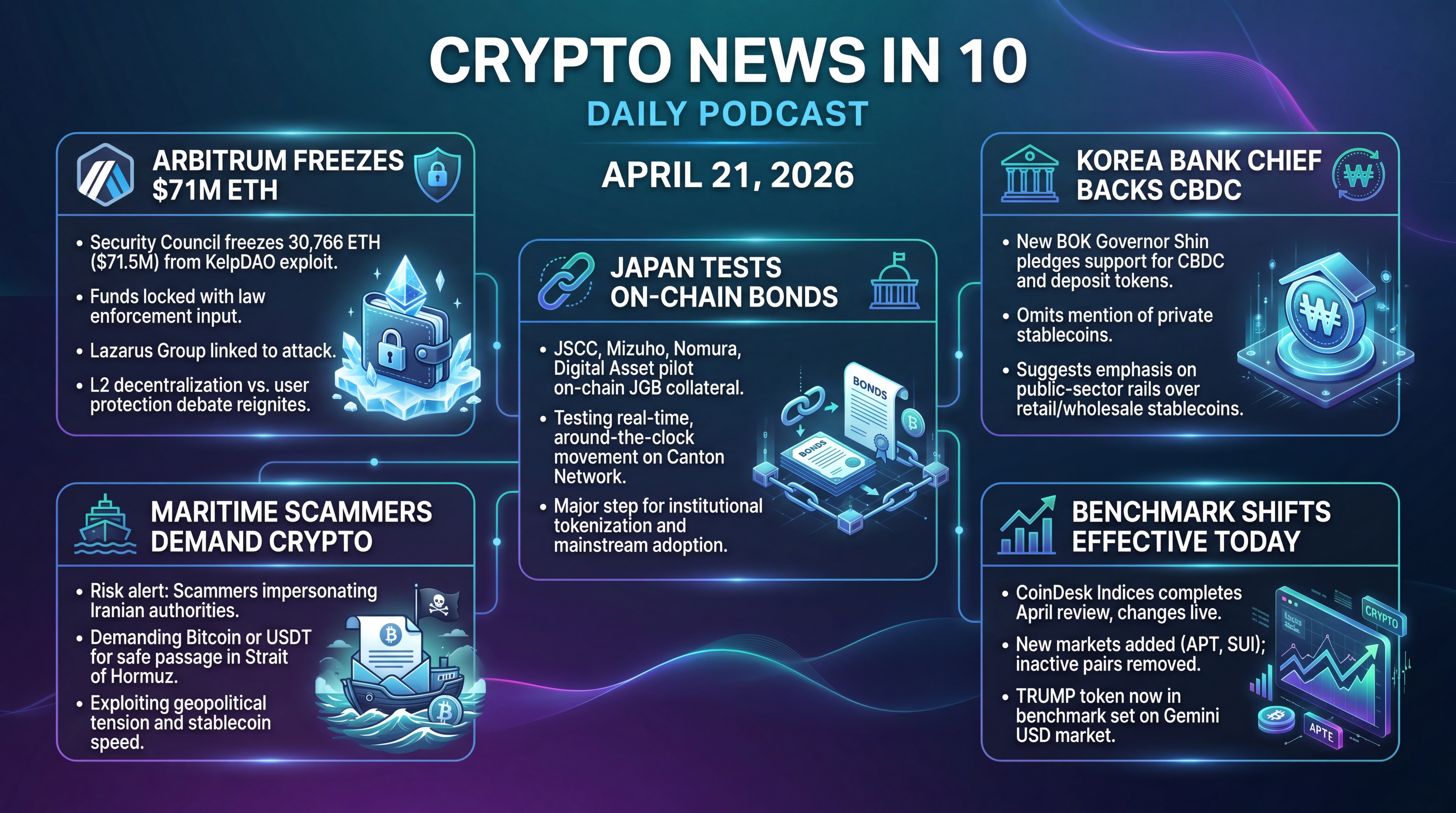
Arbitrum’s security council freezes $71M in ETH after the KelpDAO exploit, Japan pilots on-chain JGB collateral, and Korea’s new central bank chief favors CBDC and deposit tokens. Plus, a Hormuz crisis-phishing scam demands crypto and CoinDesk Indices’ reconstitution nudges market benchmarks.
Episode Infographic
Show Notes
Welcome to our Crypto news in 10, a daily podcast bringing you the latest news about crypto in under 10 minutes.
Here’s what’s moving crypto this Tuesday, April 21, 2026.
A major governance moment on Ethereum’s scaling stack — Arbitrum’s Security Council has frozen roughly 71 million dollars in ETH tied to the weekend’s KelpDAO exploit.
In Japan, the securities clearinghouse JSCC is teaming with Mizuho, Nomura, and Digital Asset to test Japanese government bonds as on-chain collateral.
In Korea, the new central bank governor opened his term by backing a CBDC and deposit tokens — while notably skipping stablecoins.
At sea, a maritime security firm warns that scammers are demanding Bitcoin or USDT for supposed safe passage through the tense Strait of Hormuz.
And finally, index changes that traders actually feel — CoinDesk Indices flips the switch on today’s benchmark reconstitution, including some attention-grabbing constituents.
[BEGINNING_SPONSORS]
Let’s start with Arbitrum.
Overnight, the Arbitrum Security Council took emergency action — freezing 30,766 ETH, about 71.5 million dollars, at an address linked to the KelpDAO restaking-bridge exploit.
Those funds were moved to an intermediary frozen wallet, and can only be touched again with further Arbitrum governance approval.
According to the council, input from law enforcement factored into the decision.
Early attribution points to North Korea’s Lazarus Group as the likely source of the broader exploit.
The move has reignited the decentralization-versus-user-protection debate for L2s — should a security council have the power to halt stolen assets... and if so, under what guardrails and transparency?
Reporters at The Block and Decrypt confirm the figures and the mechanics of the freeze.
Big step in institutional tokenization.
Japan’s JSCC, part of Japan Exchange Group, announced a proof of concept with Mizuho, Nomura, and Digital Asset to test using Japanese government bonds as digital collateral across institutions on the Canton Network.
The trial aims for real-time, around-the-clock collateral movement, while staying compliant with financial instruments and exchange laws.
Why it matters... Japanese government bonds are among the world’s most systemically important assets — if their settlement and collateral mobility move on-chain, that’s a powerful signal for mainstream market plumbing.
The joint statement landed yesterday in Tokyo, with coverage hitting U.S. hours today.
Shifting to policy — South Korea’s central bank just changed tone at the top.
In his inauguration speech today, new Bank of Korea Governor Shin Hyun-song pledged to push a central bank digital currency and bank-issued deposit tokens, positioning the BOK to advance pilots like Project Hangang and international tokenization work — while not mentioning won-pegged stablecoins.
That omission is striking, given Seoul’s parallel legislative efforts on a domestic stablecoin market.
For market structure, this suggests Korea may emphasize public-sector rails and bank-money tokens over private stablecoins in both retail and wholesale use cases.
[MIDPOINT_SPONSORS]
On the geopolitical front, a maritime risk alert with a crypto twist.
Greek security firm MARISKS warned that unknown actors have been messaging shipowners west of the Strait of Hormuz, impersonating Iranian authorities and demanding payment in Bitcoin or Tether for clearance and safe passage.
The messages request documents and say the fee will be determined after an assessment by Iranian security services.
The warning comes as hundreds of ships — and roughly 20,000 seafarers — remain stuck amid sporadic reopenings and reports of gunfire last week.
It’s a classic crisis-phishing playbook... timed to chaos, leaning on stablecoins’ speed and perceived deniability.
And for traders who benchmark — today brings quiet but material plumbing changes.
CoinDesk Indices has completed its April review of the benchmark reference rates, and the changes take effect today, April 21.
New, liquid, top-tier markets were added across assets such as APT and SUI, while a few inactive pairs were removed for zero volume.
One eyebrow-raising inclusion: the USD market on Gemini for the TRUMP token now meets the provider’s liquidity and quality thresholds, and thus enters the benchmark set used by funds, pricing engines, and risk models.
If your desk pipes CDI rates into valuation or compliance, expect small but real shifts in index weightings — and in eligible venues — starting with today’s session.
Quick recap...
Arbitrum’s emergency freeze shows how L2 governance can intervene — controversially — in live thefts.
Japan’s clearinghouse is piloting on-chain JGB collateral with Mizuho and Nomura, a signal moment for tokenized finance.
Korea’s new central bank chief is pointing at CBDC and deposit tokens, not stablecoins.
Maritime scammers are exploiting Hormuz tensions to demand crypto clearance fees.
And index plumbing matters — today’s CoinDesk Indices reconstitution quietly nudges how markets price and track crypto.
That’s your six-minute download for Tuesday, April 21, 2026.
Stay safe out there... and keep an eye on both the headlines and the plumbing — they’re converging fast.
Thanks for listening and see you tommorow!
