AI Judges Markets, Base Azul, Sun vs WLFI
Gensyn’s Delphi puts AI in the referee’s chair for prediction markets as Base readies its Azul upgrade and Russia advances a cross-border crypto bill. Plus, UK IFISAs open to crypto ETNs and Justin Sun sues WLFI in a test of token governance.
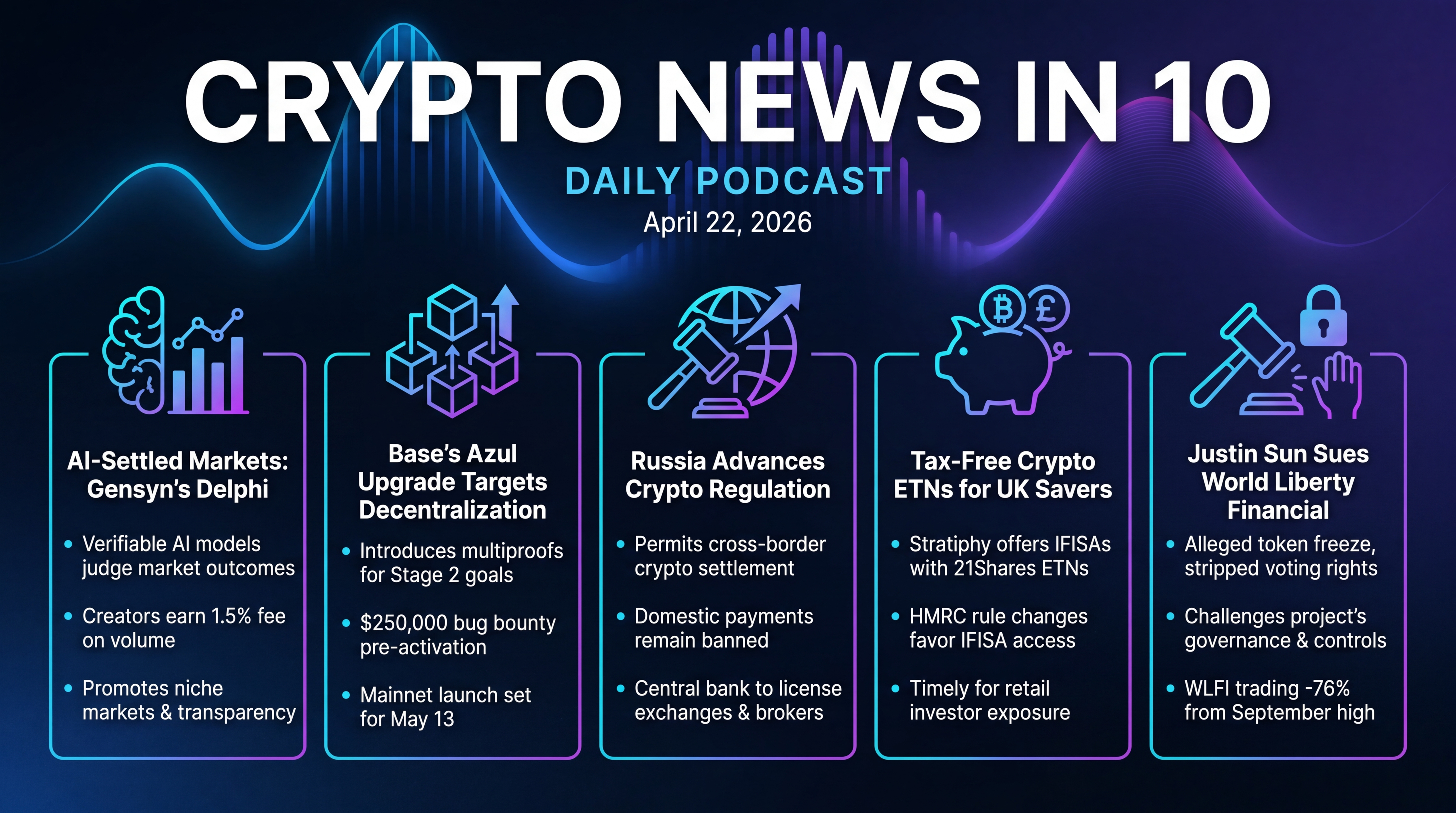
Episode Infographic
Show Notes
Welcome to our Crypto news in 10, a daily podcast bringing you the latest news about crypto in under 10 minutes.
It’s Wednesday, April 22, 2026, and today’s crypto rundown spans AI-built prediction markets, an important decentralization step on Base, a significant policy marker out of Moscow, a new route for UK savers to hold crypto ETNs tax-free, and a heavyweight lawsuit pitting Justin Sun against World Liberty Financial... let’s get into it.
We’ll start with Gensyn’s big launch, then move to Base’s Azul upgrade, Russia’s first-reading crypto bill, the UK’s Innovative Finance ISA opening for crypto ETNs, and we’ll close on the WLFI lawsuit fireworks.
[BEGINNING_SPONSORS]
Story one: Gensyn—an a16z crypto-backed decentralized AI network—just rolled out Delphi, a platform for information markets where anyone can spin up a market, traders price outcomes, and, crucially, settlement is performed by verifiable AI models rather than human moderators. Creators earn 1.5% of all trading volume in any market they launch, paid out once the market resolves—a fee designed to reward niche expertise and curation.
Beyond the mechanics, Delphi positions itself as a way to monetize and test AI models in the open, with on-chain transparency around how outcomes are scored. It’s a fresh twist on prediction markets: build the market, bring liquidity, and let AI adjudicate.
Why this matters: if AI becomes the referee for market resolution, you remove some—but not all—human bias and moderation bottlenecks. It also opens a long tail of creator-owned micro-markets that bigger platforms wouldn’t list, potentially reshaping how signal gets priced around everything from model benchmarks to app launch timelines. Watch the fee design and model audits... if creators actually earn meaningful income and resolution quality holds up under stress, Delphi could become a template others copy.
Story two: Base just pushed its first standalone network upgrade—called Azul—onto testnet, aiming for a May 13 mainnet activation. The headline feature is multiproofs, a new proof design Base says moves it closer to Ethereum’s Stage 2 decentralization targets. There’s also a new client stack, plus an Immunefi audit competition running April 21 through May 4 with up to $250,000 in bounties to flush out critical bugs ahead of activation. The framing here is deliberate: independent upgrades and broader fault-proof participation are part of Base’s bid to reduce centralized operators and improve liveness and security.
Zooming out, multiproofs and the push toward Stage 2 decentralization arrive as rollups face pressure to harden their fault-proof systems and remove trusted training wheels. Azul is a visible checkpoint—if the audits land clean and the May 13 cutover holds, expect other layer twos to showcase their own proof-hardening timelines through the summer.
Story three: Russia’s State Duma passed a crypto bill in its first reading that sketches a regulated market with the central bank licensing exchanges and brokers—allowing crypto use in foreign economic activities while continuing to prohibit domestic payments. The split approach—no crypto at the cash register at home, but a green light for cross-border settlement—tracks with Russia’s multi-year pivot to use digital assets around sanctions-constrained trade flows. It’s still early... first reading means amendments and further votes can change details, but the vector is clear: heavier licensing at home, and explicit permission for international settlement.
For markets, keep an eye on how qualified participants and custody are defined in the next drafts—and whether stablecoin issuers or miners get bespoke treatment. Also watch the Bank of Russia’s role; earlier remarks from officials teed up spring-session movement, and now we’re seeing the legislative gears engage.
[MIDPOINT_SPONSORS]
Story four: UK savers just got a cleaner path to hold crypto ETNs inside a tax-advantaged wrapper. Start-up Stratiphy secured authorization as an Innovative Finance ISA—an IFISA—manager and will offer 21Shares’ exchange-traded notes, including Bitcoin, Ether, and a Bitcoin-gold blend, within that tax-free account. 21Shares says its ETNs command over 40% market share on the London Stock Exchange’s crypto segment, where average daily volumes have hovered near six million pounds since October. Context matters here: HMRC’s rule changes reclassify crypto ETNs from April 6, 2026, so new purchases belong in IFISAs—not traditional Stocks and Shares ISAs—making Stratiphy’s approval timely for retail investors who want exposure without losing the ISA benefits.
Two angles to watch: first, platform coverage—whether bigger retail brokers and robo-advisers also roll out IFISA support for crypto ETNs; second, product breadth—whether the market sticks to large-cap trackers or expands to baskets and covered-call variants. Either way, tax-aware access tends to broaden participation, especially for long-term, dollar-cost-averaging strategies.
Story five: Justin Sun has sued World Liberty Financial—the Trump-linked crypto project—alleging his WLFI tokens were frozen, his voting rights stripped, and even threatened with token burns. Sun says he’s the single largest WLFI holder after a reported $75 million purchase, and that a September freeze blacklisted his wallet. He filed in U.S. federal court in California and argues he’s being treated differently than other early investors. Legal experts say the case could hinge on whether WLFI’s smart contracts embed admin powers that weren’t clearly disclosed relative to how the token was marketed—that recurring tension between decentralized branding and centralized controls. As of publication, WLFI was trading around eight cents, about 76% off its September high.
Why it matters: beyond the politics, this case is a live test of governance promises. If a court scrutinizes backdoor admin functions or selective freezes, the ripple effects could touch many projects that rely on upgradable contracts and blacklist features for compliance. Expect sharp discovery fights over what was disclosed to investors, what’s in the bytecode, and who holds the keys.
Quick recap: Gensyn’s Delphi is pushing AI-settled markets into the mainstream of crypto, Base’s Azul upgrade advances multiproofs on a May 13 timeline, Russia’s first-reading bill carves out foreign-trade permissions while keeping the domestic ban, UK savers regain a tax-sheltered path to crypto ETNs via IFISAs, and Justin Sun’s lawsuit against WLFI sets up a consequential standoff over token governance. We’ll keep tracking launch metrics, audit results, committee amendments, ISA platform coverage, and any court filings that land next.
Thanks for listening and see you tommorow!
