
Optimism Bugs, Aave Rescue, and the MEGA Clock
Security findings shake Optimism’s testnet as Aave weighs a 25,000 ETH rescue, the Ethereum Foundation reallocates 10,000 ETH, and MegaETH triggers a seven-day token countdown. Plus, DeepSeek’s chip pivot hints at new crosswinds for crypto compute.
Episode Infographic
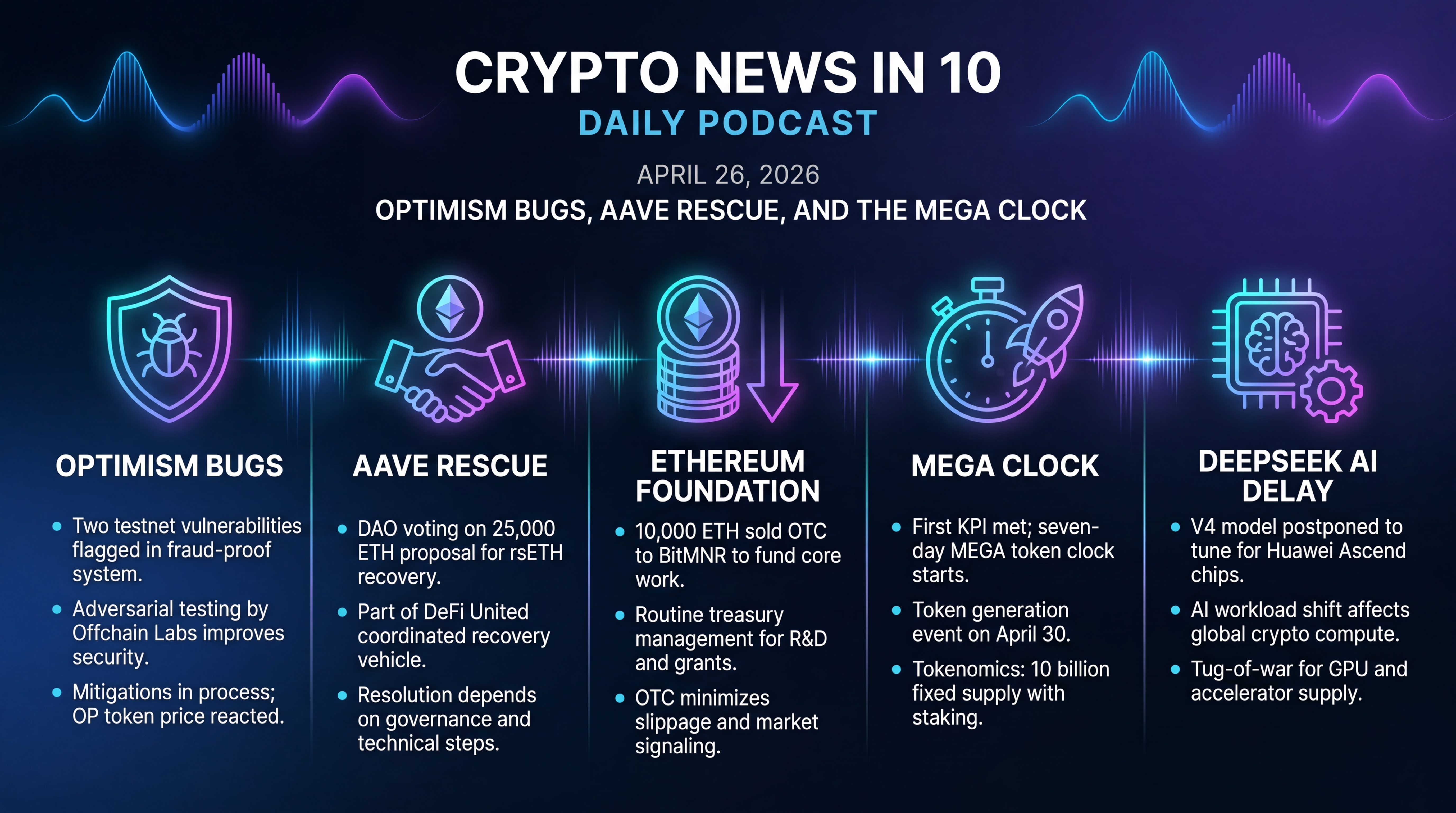
Show Notes
Welcome to our Crypto news in 10, a daily podcast bringing you the latest news about crypto in under 10 minutes.
It’s Sunday, April 26, 2026 — and here’s what matters in crypto today.
Fresh security findings on Optimism’s testnet — and what they mean for Layer 2 safety... Aave rallying DeFi around a 25,000 ETH proposal to shore up rsETH after the April exploit... the Ethereum Foundation quietly moving 10,000 ETH in an OTC deal to fund core work... MegaETH flipping the switch on a seven-day token countdown... and an AI curveball — DeepSeek delaying its next model to tune for Chinese chips, and why that could ripple into crypto compute and mining.
[BEGINNING_SPONSORS]
Let’s start with security, because that’s where trust begins in crypto.
Offchain Labs — the team behind Arbitrum — says it found two serious vulnerabilities in Optimism’s proposed fraud-proof system during a testnet run. In plain English, a bad actor might have been able to push a fraudulent claim through... or stall an honest claim at the dispute stage — threatening both safety and liveness.
Optimism responded that a concurrent Sherlock audit didn’t find a bypass of safety mechanisms, and they publicly thanked Offchain Labs for the early disclosure. It’s a good reminder that adversarial testing between rivals can still make the whole ecosystem safer.
Traders took notice — the OP token slipped about five percent intraday as the headlines landed. Source — The Defiant.
Next up, a tangible industry response to April’s restaking shock.
Aave service providers have proposed sending 25,000 ETH — nearly 58 million dollars — from the DAO treasury to DeFi United, a coordinated recovery vehicle aimed at fully restoring rsETH’s backing after the KelpDAO exploit earlier this month.
Total commitments across contributors are approaching 70,000 ETH. But DeFi United says resolution still depends on a few third-party steps — like KelpDAO reopening withdrawals and the Arbitrum Security Council releasing frozen ETH — so both governance and technical sequencing matter.
Whichever way Aave’s vote lands, it’s a bellwether for how DeFi socializes, prioritizes, and funds crisis cleanup in 2026. Source — The Block.
Staying with big balance-sheet moves...
The Ethereum Foundation confirmed it sold 10,000 ETH via an over-the-counter trade to BitMNR at about 2,387 dollars per coin. Why go OTC? To route a large order off public books — minimizing slippage and market signaling.
The Foundation framed it as routine treasury management to fund protocol R&D, ecosystem development, and grants — similar to a 5,000 ETH OTC sale in March. Reactions were split: some worry about sell pressure, others prefer transparent, scheduled funding. The through-line is predictability... public goods need recurring budgets. Sources — The Defiant and KuCoin News.
[MIDPOINT_SPONSORS]
Now, a product milestone with a timer attached.
MegaETH says it just cleared the first of its self-imposed launch KPIs — deploying ten Mega Mafia apps on mainnet — and that starts the seven-day countdown to the MEGA token generation event on April 30.
According to its public dashboard, the other two KPIs — a 500 million dollar USDM circulation threshold and a fees-based activity target — aren’t hit yet. But the rules only require one KPI to trigger the clock.
Tokenomics call-outs: a 10 billion fixed supply, with roughly 53 percent slated for staking rewards tied to performance goals, plus a vesting mix for investors, the team, and the community. If you’re watching secondary markets, pre-market perps are pricing MEGA well below last fall’s peak — so mind the gap between narrative and order books. Source — The Defiant.
And finally... an AI headline with crypto implications.
Bloomberg reports that DeepSeek postponed the release of its V4 model to re-engineer the stack around Huawei’s Ascend chips — a deeper pivot to China’s domestic silicon amid tighter access to foreign hardware.
That’s squarely an AI story — but it matters for crypto because GPU and accelerator supply is already a tug-of-war between AI inference, training, and high-performance computing, including decentralized GPU networks and miners exploring AI workloads.
If Chinese AI workloads migrate further to homegrown accelerators, global demand could reshuffle again — affecting costs and availability for tokenized compute projects, proof-of-useful-work experiments, and even miners’ side hustles. Keep an eye on where the racks go... capital follows. Source — Bloomberg.
Quick recap before we wrap.
Two testnet bugs in Optimism’s fraud-proof design were flagged — with mitigations in process — thanks to Offchain Labs’ disclosure... Aave’s DAO is weighing a 25,000 ETH contribution to a cross-protocol rescue fund for rsETH... the Ethereum Foundation funded the roadmap with a 10,000 ETH OTC sale to BitMNR... MegaETH cleared its first KPI and started the seven-day MEGA token clock... and DeepSeek’s V4 delay to tune for Huawei chips is a fresh reminder that AI and crypto now share the same supply chains — silicon and power.
That’s your Sunday slate. See you tomorrow.
Thanks for listening and see you tommorow!
