Tether’s Merger Gambit and Korea’s Stablecoin Pilot
Tether pushes a bold three-way merger, Shinhan Card teams with Solana on stablecoin payments, and a multi-chain exploit hits Wasabi Protocol. Plus, Ark reshuffles crypto exposure and Korean prosecutors seek 20 years for Delio’s CEO.
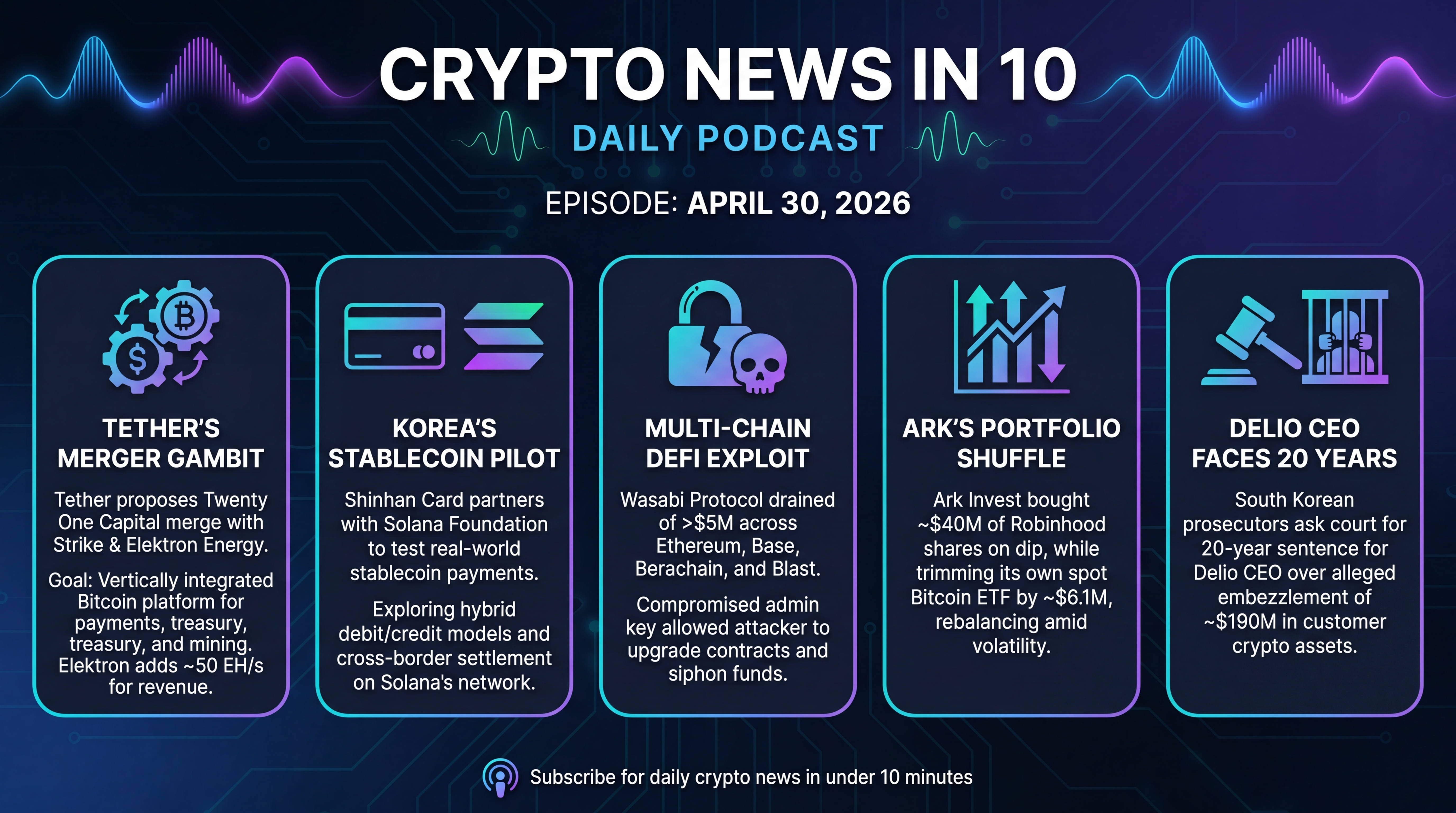
Episode Infographic
Show Notes
Welcome to our Crypto news in 10, a daily podcast bringing you the latest news about crypto in under 10 minutes.
It’s Thursday, April 30, 2026, and here’s your crypto rundown in about six minutes. We’re starting with a bold consolidation play from Tether that could reshape a public Bitcoin company. Then to South Korea, where Shinhan Card is teaming up with the Solana Foundation to test real-world stablecoin payments. We’ll also break down a fresh DeFi exploit that hit Wasabi Protocol across several chains. On the markets side, Ark Invest scooped up nearly forty million dollars of Robinhood shares while trimming its own spot Bitcoin ETF. And we’ll close with a major legal development in Seoul, where prosecutors just asked a court to give the CEO of Delio two decades behind bars in a high-profile crypto case. Let’s get into it.
[BEGINNING_SPONSORS]
Story one: Tether’s three-way chess move.
Overnight, Tether said it wants Twenty One Capital — the New York Stock Exchange–listed Bitcoin treasury and services company — to merge first with Strike — Jack Mallers’ Bitcoin payments firm — and then with Elektron Energy, a large-scale Bitcoin miner. The goal: transform Twenty One from a treasury vehicle into a vertically integrated, revenue-generating Bitcoin platform that spans payments and mining. Tether, as the majority shareholder, says it intends to vote its shares in favor. Twenty One’s stock jumped in after-hours trading on the news.
Reporters note that Elektron claims roughly 50 exahash per second — about 5 percent of Bitcoin’s current network hashrate — which could make mining a core earnings driver for the combined entity. Tether framed the proposal as a pivot toward operating businesses with recurring revenue and long-term BTC accumulation. Outlets including Bloomberg and The Block reported the plan, and Tether posted a detailed release.
What’s the strategic read? If it closes, you’d have a public company that can process Bitcoin payments, hold BTC on its balance sheet, and mine it — reducing reliance on a single Bitcoin-price beta. It’s also a signal that stablecoin cash-flow engines are increasingly funding broader crypto infrastructure.
Story two: a Korean payments giant goes on-chain.
Shinhan Card — one of South Korea’s largest credit card issuers — signed an MOU with the Solana Foundation to run an advanced proof of concept this year for stablecoin payments between customers and merchants. The pilot will run on Solana’s testnet and explore real-world checkout flows, hybrid debit–credit models for spending stablecoins, and cross-border settlement mechanics. Executives say they’re exploring next-generation financial models and non-custodial wallets, building on a six-project pilot they completed earlier this month. Local media and crypto outlets say the work formalizes a partnership aimed at commercializing Web3 payments infrastructure.
Why this matters: Korea’s legislature is drafting a comprehensive Digital Asset Basic Act, and banks and card networks there tend to move in packs once a path is proven. A live retail stablecoin stack — even starting as a testnet pilot — puts pressure on incumbents and competitors to follow... and it’s another real-economy use case where Solana’s throughput and low fees can shine.
Story three: a multi-chain exploit hits Wasabi Protocol.
Security firms flagged that Wasabi — a DeFi derivatives venue focused on memecoins and NFTs — was drained for more than $5 million across Ethereum, Base, Berachain, and Blast. Analyses from Blockaid, CertiK, and others point to a compromised admin key on the deployer wallet that let the attacker upgrade contracts, seize privileges, and siphon funds across chains within minutes. Investigators urged users to treat LP-share tokens as compromised and to revoke approvals. Separate tallies suggest April has been one of the heaviest months for crypto exploits in over a year — driven by multi-stage attacks and weak key management more than classic contract bugs.
Two quick lessons here: protocols must harden off-chain key custody just as much as on-chain code, and multi-chain deployments multiply the blast radius when admin credentials are abused. If you touched Wasabi pools recently, consider revoking allowances and monitoring project channels for recovery steps.
[MIDPOINT_SPONSORS]
Story four: Ark’s portfolio shuffle.
Cathie Wood’s Ark Invest bought about 554,000 shares of Robinhood — roughly $39 to $45 million depending on the valuation you cite — after HOOD fell 13 percent post-earnings. At the same time, Ark trimmed around $6.1 million of its own spot Bitcoin ETF holdings. The firm disclosed the moves in its daily trading report, and outlets like The Block and Investing.com highlighted the contrast: buy the broker on weakness, while locking in some gains — or rebalancing — on Bitcoin ETF exposure. It also fits Ark’s pattern this year of leaning into crypto-adjacent equities during volatility.
Why do we care? Robinhood remains a retail on-ramp for crypto, prediction markets, and equities — all converging products in 2026 — so Ark’s conviction buy is a read on consumer-facing crypto rails. The ETF trim, meanwhile, could be simple risk management or housekeeping as flows and weightings change.
Story five: prosecutors seek 20 years for Delio’s CEO.
In Seoul, prosecutors asked a court to sentence Delio chief Jeong Sang-ho to 20 years over alleged embezzlement tied to about 250 billion won — roughly $170 to $190 million — in customer crypto assets. Delio, a prominent local crypto lender, halted withdrawals back in June 2023. The case became a touchstone in South Korea’s debate over custody, disclosures, and investor protection ahead of broader digital asset legislation. Today’s sentencing request — reported via Yonhap and echoed by crypto outlets — signals a tougher stance on mismanaged customer funds. A verdict is pending.
Stepping back, the through-line today is integration and accountability. Tether’s plan would fuse treasury, payments, and mining under one public roof. Korea’s biggest card issuer is pressure-testing stablecoin rails with Solana. DeFi’s attack surface keeps expanding across chains — a reminder that governance keys can be a single point of catastrophic failure. And traditional market players — from Ark to Korean prosecutors — are actively shaping the crypto perimeter: capital allocation on one side, consumer protection on the other.
That’s your slate for Thursday, April 30, 2026: Tether’s merger gambit, Shinhan and Solana’s stablecoin tests, Wasabi’s exploit, Ark’s buy-and-trim, and a 20-year sentencing ask in Korea. We’ll keep watching for official responses and deal timelines... and we’ll be back tomorrow with the next wave of crypto in ten.
Thanks for listening and see you tommorow!
