
USDC's Asia Push, Record Hacks, MegaETH
Circle spotlights Hong Kong as a leading USDC corridor, April sets a record for exploits, and U.S. Bitcoin ETFs notch their best month of 2026. Plus, TON ships consumer-scale tools and MegaETH lands on major exchanges—here's what to watch.
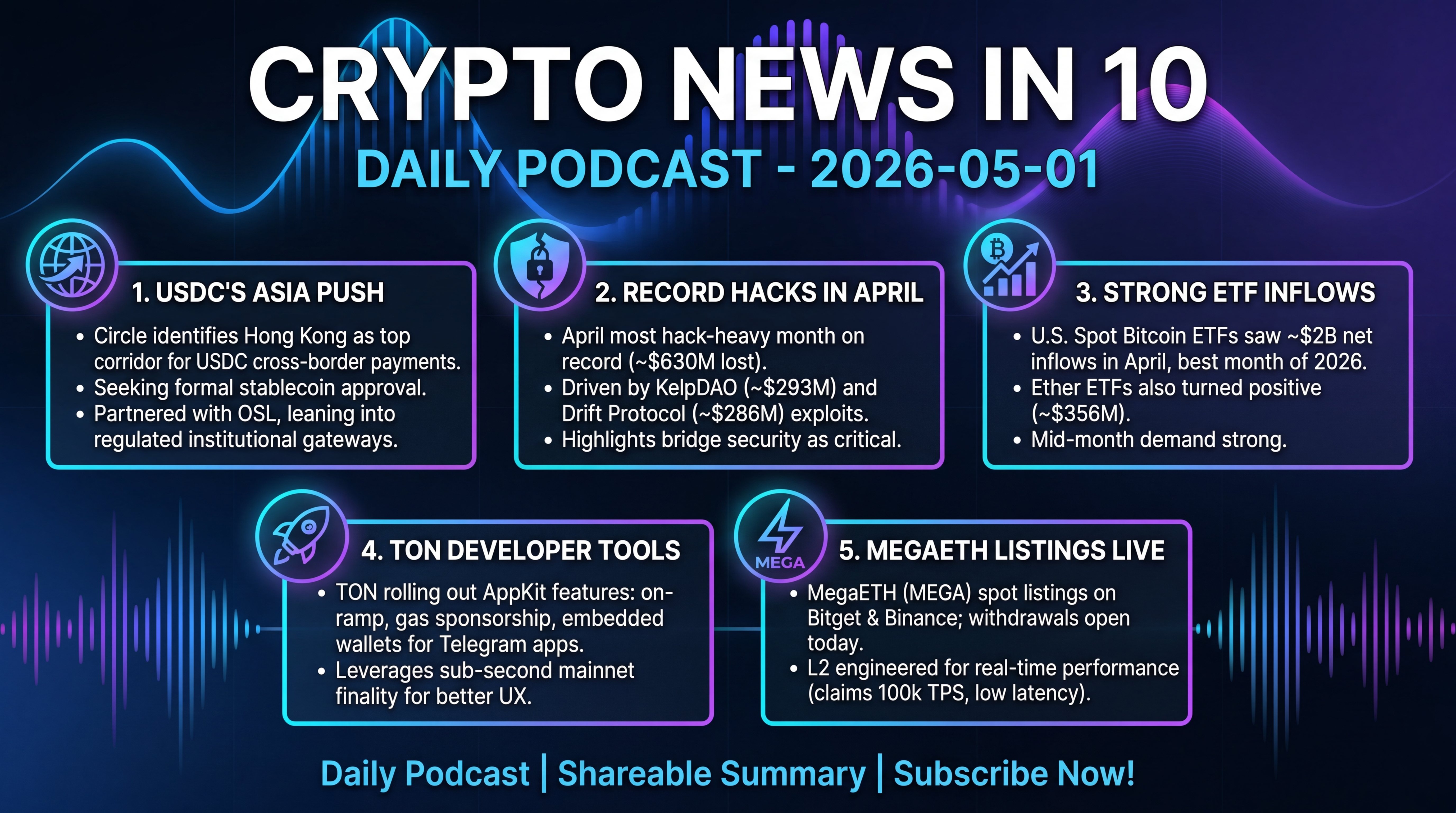
Episode Infographic
Show Notes
Welcome to our Crypto news in 10, a daily podcast bringing you the latest news about crypto in under 10 minutes.
It's Friday, May 1st, and we've got a punchy lineup. Circle says Hong Kong is becoming one of the busiest corridors for USDC cross-border payments... April just ended as crypto's most hack-filled month on record... U.S. spot Bitcoin ETFs closed April with their best inflows of 2026... TON is pushing new developer tools live that make Telegram-scale apps far easier... and a buzzy new L2, MegaETH, just hit big exchanges with withdrawals opening today. Let's get into it.
[BEGINNING_SPONSORS]
First up, Circle's CEO Jeremy Allaire is out with a notable data point and a clear strategy signal. In an interview published this morning, he called Hong Kong a central trade hub and said payments into the city are among the most popular routes for cross-border settlements on Circle's network. Circle hopes to see USDC formally approved as a foreign stablecoin under Hong Kong's regime. The company recently partnered with Hong Kong-listed OSL to expand USDC support, but Allaire also stressed they don't plan to issue a Hong Kong dollar stablecoin. The takeaway... USDC's Asia strategy is leaning into regulated gateways—where institutional settlement is already happening at scale. Reported by the South China Morning Post.
Second—security. April just closed as the most hack-heavy month in crypto history by incident count. Data from DeFiLlama shows roughly 30 exploits in April, totaling around 630 million dollars in losses—driven largely by two outsized events: the KelpDAO bridge exploit, near 293 million, and the Drift Protocol attack on Solana, near 286 million. The Kelp incident, linked by multiple analyses to a North Korea-associated group, wasn't a smart-contract bug so much as an off-chain verification failure in a single-verifier, cross-chain setup. Downstream, Aave's core markets briefly hit 100% utilization, and the Arbitrum Security Council froze about 30,766 ETH as part of the incident response—illustrating how a bridge failure can ripple into lending and liquidity. The bigger lesson for builders and treasurers today: multi-verifier designs and live invariants across bridges aren't nice-to-haves anymore... they're table stakes. Coverage via CryptoNews Australia.
Third—markets... and a constructive signal from ETFs. U.S. spot Bitcoin ETFs drew roughly 2 billion dollars of net inflows in April—their best month of 2026—flipping year-to-date flows positive again. BlackRock's IBIT led with about 2 billion for the month, even after late-April redemptions, while Morgan Stanley's new MSBT logged about 194 million without a single outflow day. Notably, ether ETFs posted their first monthly net inflow since October 2025—about 356 million—suggesting the bid isn't just BTC-only. Cointelegraph attributes the figures to SoSoValue and Farside. The nuance is that late-month outflows didn't erase the earlier, steadier demand. For investors, that dynamic—soft spots at month-end, strength mid-month—matters for timing and for reading how dips are being bought.
[MIDPOINT_SPONSORS]
Fourth, The Open Network—TON—is quietly shipping a toolkit that could matter to any team building consumer-scale apps, especially inside Telegram. Around May 1st and 2nd, the project is rolling out new AppKit features: an integrated card on-ramp, cross-chain deposits, gas sponsorship so developers can cover users' fees, and embedded wallets that abstract away most of the crypto friction. This lands on top of TON's April upgrade that brought sub-second finality to mainnet—designed for exactly the kind of high-throughput mini apps we're seeing explode in Telegram's ecosystem. The net effect... it should get cheaper and simpler to build dapps with a sane UX while still consuming TON for gas under the hood. If you're shipping product, watch gas-sponsored flows and on-ramp conversion over the next few weeks—that's where we'll see whether the tooling moves the needle.
Fifth, listings with a performance pitch—MegaETH. Bitget listed MEGA for spot yesterday and says withdrawals open today at 12:00 UTC. Binance also flagged listing and withdrawals today. MegaETH markets itself as an EVM-compatible layer 2 engineered for real-time performance via node specialization—with claims of up to 100,000 transactions per second and millisecond-level response times—dividing the network into speed-first executors and separate verifiers. If that architecture holds up outside the lab, it's another entrant in the low-latency L2 race, and today's exchange support puts tokens—and soon, withdrawals—into user hands. Two things to watch: whether fees stay low under load, and whether builders show up to deploy apps that actually require this profile.
Quick recap... Circle says Hong Kong is already one of the busiest USDC settlement routes and wants formal approval there... security dominated April with a record number of exploits, mostly concentrated in two mega hacks... U.S. spot Bitcoin ETFs just booked their strongest month of 2026, with ether ETFs finally turning positive... TON's AppKit features are rolling out now with on-ramps, embedded wallets, and gas sponsorship riding on sub-second finality... and MegaETH's token is now trading broadly with withdrawals opening today as it touts real-time L2 performance. More tomorrow—stay safe out there, and keep your keys and your ops tight.
Thanks for listening and see you tommorow!
